8 Fascinating Historical Facts About the Album Amicorum
Published on August 21, 2026 · Updated on August 22, 2026
Category: Friend Books & Friendship Keepsakes · Tags: album amicorum history, friendship book tradition, Friend Books & Friendship Keepsakes, album amicorum, childhood keepsakes
A Tradition Half a Millennium in the Making
Most things that survive five hundred years do so because they were powerful — ideas carved in stone, institutions backed by armies, texts reproduced by printing presses. The album amicorum survived because of something quieter and more stubborn: the human need to be remembered by the people who matter most. What began as a modest custom among students in Reformation Germany became one of history’s most enduring forms of social expression, moving from professors’ margins to royal courts, from bourgeois parlors to children’s bedrooms, and finally into the illustrated Friend Books children carry to school today. Here are eight facts about that tradition that might surprise you.
Fact 1: It Was Born Out of a Celebrity Autograph Craze
The keeping of an album amicorum was a practice that in all likelihood started in the 1540s. But calling it a “friendship book” slightly undersells the social electricity behind its origins. Although it had its precursors in medieval noble armorials, the album amicorum first found a large audience outside the family sphere in the environment of the Protestant University of Wittenberg, where famous Reformers such as Martin Luther and Philip Melanchthon were often accosted by students who requested an autograph as a keepsake.
These weren’t just admired professors — they were the intellectual celebrities of their day, whose words were shaping the course of European history. These figures would write their entries in the margins of a book the student already owned, for instance a Bible or an important scholarly text, and quickly the practice of asking people for an inscription extended to other academic lecturers, as well as fellow students. In other words, the album amicorum began as something very close to what we would now call a signed copy — except the signing was meant to travel, grow, and accumulate meaning over a lifetime. The oldest known example to date, by Claude de Senarclens, one of Calvin’s associates, began in 1545 and comes from Wittenberg.
Fact 2: The Earliest Entries Were Surprisingly Brief — Then Things Got Elaborate
It’s tempting to imagine the early albums as richly illustrated volumes from the start, but the tradition began modestly. In the first instances of this behaviour, inscriptions tended towards brevity, including little more than a name, a date, and perhaps a classical or biblical maxim in Latin or Greek.
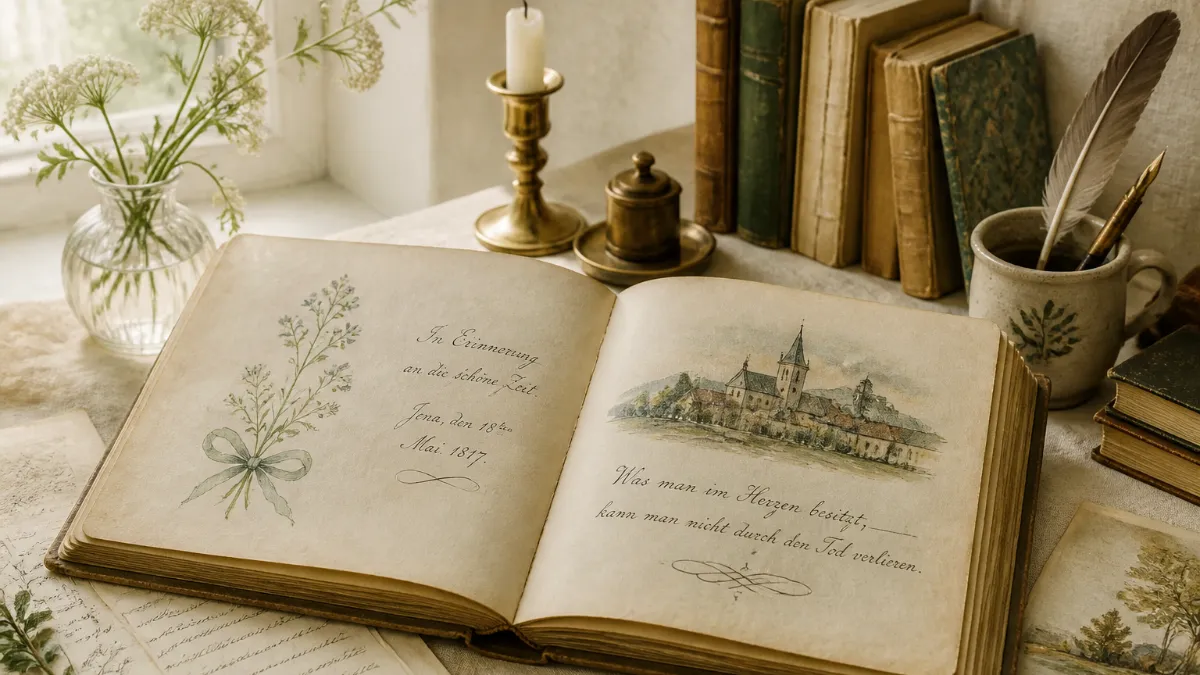
That restraint didn’t last long. As the albums spread and their owners began treating them as permanent keepsakes rather than working documents, contributors rose to the occasion. Such contributions came to include biblical, classical and literary quotations, proverbs and personal tokens of affection, and could be embellished with coats of arms, emblematic or allegorical representations, and scenes from daily life. By the seventeenth century, entries might consist in drawings, engravings, embroidery, paper silhouettes, locks of hair, pressed flowers, or the like. What strikes a modern reader about this range is how tactile and effortful it was — every entry required the contributor to sit down, think, and make something by hand. There was no quick tap of a “like” button. Each page was a small declaration of care.
Fact 3: It Spread Across Protestant Europe Remarkably Fast
The speed with which the album amicorum moved from a single university to an entire continent is one of the more remarkable cultural transmission stories of the early modern period. Friendship albums originated in the sixteenth century in the academic community of Wittenberg around 1545 and spread quite rapidly in German states. Towards the end of the century, these albums also began to appear in England and the Netherlands.
The mechanism of that spread was the students themselves. Owners of albums amicorum actively solicited contributions by carrying their blank or partially filled volumes during travels, academic peregrinations, or social visits, presenting empty pages to acquaintances with polite requests for inscriptions, signatures, or illustrations. This practice allowed collectors — often students, merchants, or diplomats — to gather entries from notable figures encountered in universities, courts, or distant cities, transforming the album into a portable record of social networks. By the 1550s and early 1560s, the custom of keeping an album amicorum had spread throughout most of the Holy Roman Empire. The album, in this sense, was the early modern equivalent of a network — a physical record of who you knew and who knew you back.
Fact 4: The Most Famous Album Took 50 Years to Fill
If the humble student album was one end of the spectrum, the Große Stammbuch of Augsburg art dealer and diplomat Philipp Hainhofer was the other. Between 1596 and 1647, Hainhofer traveled around Europe amassing an incredibly rich collection of signatures. His register is replete with the marks of Cosimo II de’ Medici, Holy Roman Emperor Rudolf II, and Christian IV of Denmark and Norway, to name a few.
Hainhofer compiled the signatures during the course of 50 years, beginning when he was a college student. As he gained religious figures and royalty as clients, he would ask them to sign his book and commissioned about 100 detailed illustrations to sit alongside. The elaborateness of the illustrations directly corresponds to the signatory’s status and rank in society. The book was, in every sense, a performance of social capital — the number and rank of the socially and politically influential ‘friends’ who immortalised themselves within its pages helped grant Hainhofer access to wider social circles that would have otherwise remained closed to him.
A richly illustrated album amicorum — a kind of friendship book for preserving the autographs of acquaintances — the Große Stammbuch was renowned in Hainhofer’s lifetime, becoming one of Augsburg’s must-see artworks. What began as a student’s keepsake had become, in Hainhofer’s hands, something closer to a diplomatic instrument.
Fact 5: It Functioned as an Early Modern Social Network
There is a temptation to romanticize the album amicorum purely as a private, sentimental object. But for its original owners, it also carried real social and professional stakes. Moving outside of the sphere of universities in the early modern period, the album amicorum served a purpose that was not unlike our modern social media as a means of recording, and in a sense — a way of maintaining a recorded social network across Europe to gain favor and display social capital.
The books often served as letters of recommendation for students switching universities, and through asking a person of a higher rank to sign one’s friendship book, the opportunity to reel in potential patrons and protectors for the holder also opened up. Philip Melanchthon — one of the Reformation’s most influential thinkers and one of the earliest names to appear in these albums — understood this dimension clearly. In his treatise on alba amicorum, Melanchthon describes the friendship album as a memory-aid, designed to “remind the owners of people.” The book was simultaneously a private treasury of relationships and a public-facing credential — proof that you had been in the rooms where things happened, and that the people in those rooms remembered you.
Fact 6: What They Contained Was Astonishing in Its Variety
To read a well-preserved album amicorum from the sixteenth or seventeenth century is to encounter an entire paper world. The illustrated album amicorum is a singular visual example of early modern travelers’ fascination with swiftly changing fashions, regional customs, family lineage, and manuscript decoration. A predecessor of the sixteenth-century printed costume book, the illustrated album preserves in its pages colored depictions of dress, local scenes of work and entertainment, modes of transportation, regional festivals, games, and civic rituals such as weddings, funerals, and state and religious ceremonies.
The album immortalized the owner’s friends, acquaintances, relatives, professors and teachers, and other figures of authority with epigrams, mottos, or adages of friendship, wishes, dedications, coats of arms, drawings, silhouettes, embroideries, locks of hair, pressed flowers, or the like. No two albums were identical. Images could be drawn by the person writing the inscription, painted by a local artist, or taken from a printed book or single leaf, meaning that each album was as unique as its owner. That unrepeatable quality — each entry made by a specific hand, for a specific person, at a specific moment in time — is one of the deepest truths the tradition carries forward. It is why no scan, no screenshot, and no digital archive can fully replace it.
Fact 7: The Tradition Moved from Universities to Children’s Bedrooms
For its first century, the album amicorum was largely an academic and aristocratic phenomenon. That began to change around the eighteenth century, when the tradition experienced what researchers describe as a resurgence and broadening. Although the alba amicorum became less popular for a while, there was a resurgence in their use from the mid-18th century, and the general public started using the friendship albums from the 19th century onwards.
In the alba amicorum, in addition to scholarly quotes, you find poems in modern languages and drawings, embroidery, and paper pricking and cutting work. It increasingly became a pastime for girls.
By the end of the 19th century, the “Poetry Album” (Poesiealbum) also emerged, filled in by family and friends and decorated with gummed stickers. By the 1880s, illustrated friendship books designed specifically for children were circulating widely, including editions featuring the beloved artwork of Victorian illustrator Kate Greenaway — a Victorian children’s book illustrator and writer whose work influenced the children’s style of the day and whose whimsical portrayals of childhood gave the friendship book a distinctly tender, child-centered quality. The album had completed a generational journey: from the hands of Europe’s scholarly elite to the desks of ordinary children collecting messages from their classmates and neighbors.
Fact 8: The Tradition Never Died — It Just Changed Its Name
Perhaps the most remarkable fact about the album amicorum is not how old it is, but how persistent. The album amicorum was an early form of the poetry book, the autograph book, and the modern friendship book. Each of those descendants carries a trace of the original impulse. The modern yearbook tradition in primary school education in the United States traces its origins to the album amicorum, as German immigrants imported this custom in the 18th century.
Universities have continued to revive the tradition in new forms. For centuries, academics carried an album amicorum with them — otherwise known as a friendship book — in which memories of dear ones and special moments were collected. They took it with them on their travels to different European universities. In 2009, one university breathed new life into this old tradition, and since then, master and PhD students receive a special gift at their award ceremony: their own Album Amicorum. Meanwhile, by the 19th century, autograph books had spread widely in Europe and North America, becoming common among schoolchildren, graduates, and social circles as sentimental keepsakes exchanged at milestones like commencements or departures. The form has always followed human need. Where there are meaningful relationships and a desire to hold them against the passage of time, something resembling an album amicorum tends to appear.
The Living Tradition
Five hundred years is a long time for any idea to survive, and the album amicorum has survived because it answers something genuinely, stubbornly human. The urge to ask people we love to leave a mark — a drawing, a message, a favorite color, a small confession of what they value and who they are — is not a trend. It is a form of witness. It says: you were here, and I wanted to remember exactly what that was like.
That is precisely the impulse behind the Album Amicorum Friend Book. Not a novelty or a moment’s whim, but the direct continuation of something half a millennium old. When a child passes their Friend Book around a birthday table or a classroom and collects the handwriting of the people they love most, they are doing something that Reformation-era students did in Wittenberg, that Philipp Hainhofer carried through the courts of Europe, that Victorian girls pressed flowers between the pages of. Every entry is unrepeatable. Every page closes a little window on a moment that will not come again. And that is exactly what makes it worth keeping.
Where Things Stand
The album amicorum tradition itself has seen no dramatic recent developments in the past 45 days, remaining a stable subject of historical scholarship and cultural interest. What has shifted meaningfully around it, however, is the broader cultural moment into which it fits. Data from early 2026 shows a striking surge in parental interest in analog, screen-free childhood experiences: recent reporting indicates that searches for “screen-free activities” have risen 200% year over year on major platforms, alongside sharp increases in searches for “family traditions” and related terms, pointing to a strong cultural appetite for exactly the kind of slow, handwritten, handmade connection the album amicorum tradition has always embodied. Parenting commentators have identified “analog childhood” as one of the defining movements of 2026, with families actively trading overscheduled, screen-saturated routines for crafts, unstructured play, and tangible keepsakes. This is the cultural water in which the album amicorum tradition swims today — not as nostalgia for its own sake, but as a live answer to a question many parents are urgently asking: how do we help our children hold on to what matters?
See Related below for more on this topic.
For further reading, see the Sources listed below.
About the author

Dori Fussmann — VP Content
Dori Fussmann leads Album Amicorum, an independent studio behind an illustrated Friend Book that children fill in by hand — turning the notes, drawings, and small messages of childhood friendships into a keepsake worth keeping. His background is in building consumer brands, and he started writing here out of a conviction that the memories that matter most belong off-screen. These articles draw on child-development research and the work of experts such as Jonathan Haidt.
Related
Sources / Further reading
Frequently asked questions
Where did the album amicorum tradition begin?
The album amicorum tradition began in the 1540s at the Protestant University of Wittenberg in Germany. Students there began collecting autographs from famous Reformers like Martin Luther and Philip Melanchthon in the margins of books they already owned — the practice then spread across Protestant academic Europe within decades.
What did people actually put inside an album amicorum?
Entries went far beyond a simple signature. Contributors added poems in Latin or vernacular languages, personal mottos, biblical quotations, hand-drawn coats of arms, allegorical sketches, embroideries, paper silhouettes, pressed flowers, and even locks of hair. Each entry was a small act of craft and intimacy unique to the relationship between contributor and owner.
When did children start keeping friendship books?
By the 18th century, the tradition had already moved beyond university students into bourgeois and domestic circles, and it increasingly became a pastime for girls and young people. By the 1880s, illustrated album amicorum books designed specifically for children — including editions featuring Victorian illustrator Kate Greenaway's artwork — were in circulation, making the friend book a firmly child-centered tradition.
How is the album amicorum tradition connected to modern yearbooks?
Researchers have traced the modern school yearbook tradition in the United States directly back to the album amicorum, brought over by German immigrants in the 18th century. The impulse — collecting signatures, drawings, and messages from classmates and teachers at a meaningful moment in life — is the same one that produced the earliest Stammbücher at Wittenberg nearly 500 years ago.