12 Analog Friendship Activities That Make Real Keepsakes
Published on August 18, 2026 · Updated on August 22, 2026
Category: Children's Keepsakes & Memory · Tags: Children's Keepsakes & Memory, friendship activities for kids, analog activities, screen-free kids activities, keepsakes for kids
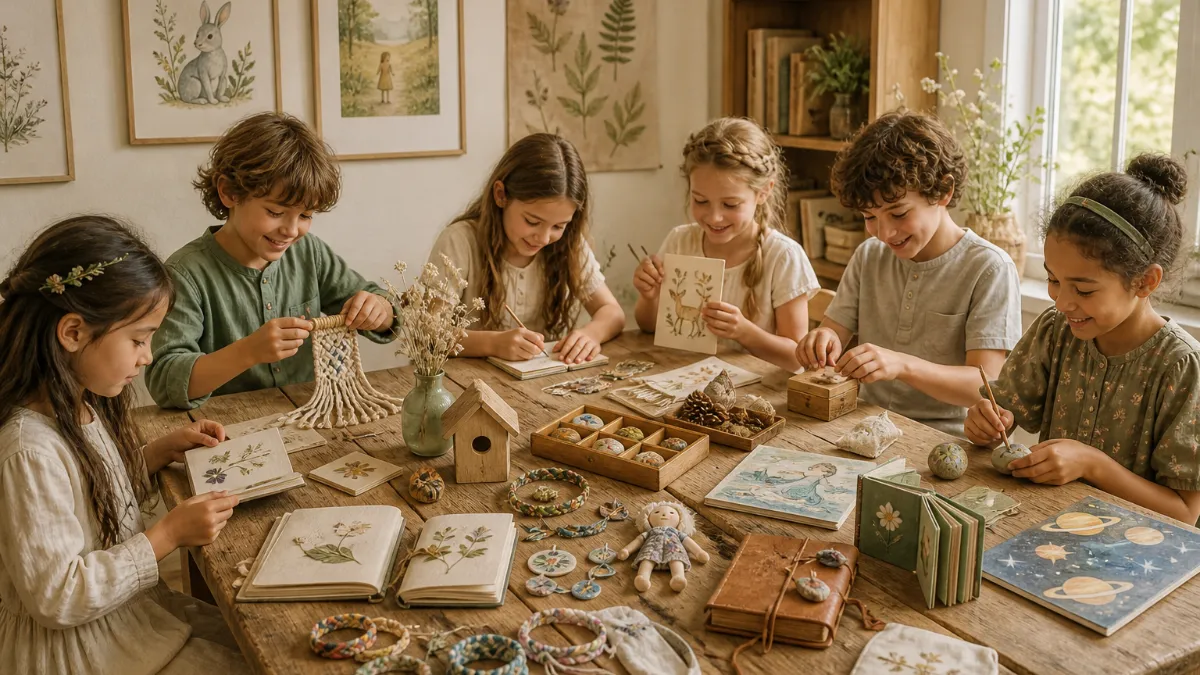
Not every afternoon of play becomes a memory. Most dissolve into the general warmth of childhood — felt but not held, real in the moment and blurry by Tuesday. What separates the afternoons children remember at thirty from the ones they forget by dinner is rarely the activity itself. It is whether something was made, and whether that something was kept. This list exists for parents who already understand that distinction and are looking for activities that honor it: twelve analog friendship activities for children ages 5–12, each evaluated against two criteria before earning its place here. Does it deepen connection between children in the moment? And does it leave a physical object behind that can be kept, revisited, and treasured? Activities that pass only one test were left off. Every activity on this list passes both.
No screens, no print-and-recycle worksheets, no digital outputs. Every item here uses materials that are tactile, durable, and chosen to last — quality paper, fine-liner pens, colored pencils, embroidery thread, fabric. The assumption is that the artifact matters as much as the experience, because for children, the artifact often becomes the memory.
The Two-Test Rule: Why Most “Friendship Crafts” Don’t Make the Cut
Browse any list of friendship activities for kids and you will find plenty of suggestions that check one box but not the other. A friendship bracelet made from cheap plastic beads deepens connection in the moment — children are close, laughing, helping each other tie knots — but the bracelet breaks by next week and ends up in a bin. A prompted worksheet about “my best friend” might produce something written, but if it is printed on flimsy paper and filled out in five minutes with no real investment, it rarely survives a backpack.
The activities on this list are different. Each one asks children to contribute something genuinely of themselves — their handwriting, their opinions, their imagination, their voice — and to do it in a medium that holds up. The distinction matters because a child who finds a friendship bracelet still on her wrist two years later, or pulls out a folded illustrated page from a box under her bed, does not just remember the craft. She remembers the afternoon, the friend, the particular way that day felt. The artifact carries the memory. That is the entire point.
Ages 5–7: Making Together, Keeping Together
At this age, children are learning that friendship is something you do — not just something you have. The best activities for this group are physical, side-by-side, and result in something wearable or illustrated that each child can take home and recognize as their own.
1. Friendship Bracelets with Handwritten Tags
Classic embroidery-thread friendship bracelets satisfy the wearable-keepsake test completely, but they become truly special when paired with a small handwritten gift tag. Each child writes (or dictates, for younger ones) a single sentence on a piece of card stock: This bracelet was made for [name] by [name] on [date]. The bracelet is worn; the tag goes in a memory box or is tucked into a book. Together, they form a two-part artifact — one for the body, one for the archive.
2. “My Favorite Things” Portrait Exchange
Each child receives a half-sheet of good-quality paper and draws a self-portrait in the center. Around it, they fill in their current favorite things: color, food, animal, book, dream. No prompts are pre-printed — the children write and draw freehand, which means every finished page looks different and distinctly like its maker. Children then exchange pages, so each child goes home with a portrait of their friend in their friend’s own hand. These pages, kept together over years, become a genuine visual record of who someone was at five, at seven, at ten.
3. Handprint Friendship Map
Lay out a large piece of sturdy paper — the bigger the better. Each child traces their handprint, writes their name inside it, and decorates it. Together, the children connect the hands with drawn lines and fill in the space between with illustrations of things they have done together or places they both love. The finished map is photographed and then cut apart so each child takes home their own hand surrounded by the illustrated world they built together. It is one artifact split into as many keepsakes as there are friends.
4. Illustrated “This Is Me” Accordion Book
Fold a long strip of card stock into an accordion and give one to each child. Each panel is a page: My name is, I am [age] years old, my favorite color is, my best memory this year is, I am good at. Children illustrate each panel with drawings. When they are finished, they share their books with each other before taking them home. At this age, these books are genuinely charming time capsules — the drawings are raw and vivid in the way only a six-year-old’s drawings can be, and they never look the same twice.
Ages 8–10: Depth, Detail, and the Beginning of the Archive
Children at this age have more dexterity, more self-awareness, and a growing understanding that friendship is something worth recording. They can handle more nuanced prompts, produce neater handwriting, and begin to appreciate the idea of keeping things for future reference. The best activities for this group produce something with real informational richness — something that will be interesting to read again at fourteen.
5. Friendship Interview Pages
This is one of the most powerful activities on the list, and one of the most underused. Each child receives an identical set of prompts: What do you want to be when you grow up? What is something most people don’t know about you? What is your favorite memory from this year? What do you think we’ll be doing in ten years? Every child fills in their own page in their own handwriting, with their own answers. The pages are exchanged so each child ends up with a completed interview page from each friend. Read together at eight; rediscovered at twenty-five. The contrast between what someone thought they would become and who they actually became is one of the most moving things a keepsake can hold.
6. Collaborative Illustrated Map of a Shared Imaginary World
Two or more children build an imaginary world together on a single large sheet of paper. They name it, draw its geography, populate it with places that matter to them — the Chocolate River, the Library of Every Book, the Cave Where Nobody Argues. Every place is labeled in the child who invented it. The map is signed by everyone involved and then carefully rolled, stored in a cardboard tube, and kept. Years later, it is genuinely fascinating: a record not just of imagination but of the specific things these specific children cared about at this age.
7. “What I Know About You” Letters
Each child writes a letter — not a card, a proper letter — to a friend, describing that friend as they see them. Not what I like about you (which tends toward compliments), but what I know about you (which produces genuine observation). The child might note that their friend always picks the blue crayon first, that they laugh before jokes are finished, that they know more about dinosaurs than anyone. Letters are sealed in envelopes, addressed by hand, and given. Some children choose to keep theirs; some open them immediately. Either way, the letter survives.
8. Pressed-Flower Friendship Cards
Collect flowers or leaves together on a walk — even dandelions and clover work beautifully — then press them between heavy books for a week. When the flowers are flat and dry, each child mounts them on card stock with a handwritten message. The result is a card that is also a botanical record of a specific afternoon in a specific place. These are among the most visually striking keepsakes children can make, and they require almost nothing beyond paper, flowers, and time.
Ages 10–12: The Intentional Keeper
By ten, many children have begun to develop a genuine sense of personal history. They understand that things were different before, and they are starting to suspect that things will be different again. Activities that tap into this awareness — that invite children to capture something on purpose, knowing it will change — produce some of the most meaningful keepsakes of childhood.
9. Friendship Time Capsule Letters
Each child writes a letter to their future self, or a letter to their friend’s future self, sealed inside an envelope and placed inside a shared box or tin. The box is sealed with tape, labeled with the opening date — one year, three years, five years from now — and given to a parent for safekeeping. The ritual of sealing and dating is part of the artifact. Children take the commitment seriously, and when the box eventually opens, the letters inside are read with the particular emotion that only time can produce.
10. “Year in Review” Illustrated Pages
At the end of a school year or before a summer apart, children create a single illustrated page that documents the year: three highlights, one low moment they got through, one thing they learned, one thing they are looking forward to. These pages are exchanged between friends. Kept together over multiple years, they become a layered record — a visual timeline of a friendship growing alongside the children inside it.
11. Handwritten “Things I Want to Remember” List
Sit together at the end of a significant day — a last day of school, a birthday, a final playdate before someone moves — and each child writes a list of specific things they want to remember about that day and about each other. Not general things (you are kind) but specific ones: the way you snorted when you laughed, the sandwich you made, what you said when the kite crashed. These lists are folded, named, and kept. They are the closest thing childhood has to a photograph taken with language.
12. Collaborative Friendship Zine
A zine is simply a small self-made booklet — fold three sheets of paper, staple the spine, and you have twelve pages to fill. Children divide the pages between them and each contributes their sections: an illustrated self-portrait, a list of current obsessions, a short piece of writing about a shared memory, a hand-drawn comic. The finished zine is duplicated (one copy per contributor, photocopied at a library or at home) so every child has a complete version. Of all the activities on this list, the zine most closely resembles a real publication — because it is one.
The Natural Next Step: One Place to Hold It All
There is a progression that tends to happen once children have a habit of making and keeping friendship artifacts. The bracelets pile up in a dish on the dresser. The illustrated pages accumulate in a folder. The letters and pressed-flower cards end up in a shoebox. At some point, a child — or a parent — starts to wish there were one beautiful, organized place where all of it could live.
That is exactly the impulse behind a dedicated friend book: not a project finished in one afternoon, but a book that grows alongside a child’s friendships, page by page, friend by friend. Each time a friend fills out a page — in their own handwriting, with their own drawings, capturing who they are right now — the book becomes more irreplaceable. Unlike any of the individual activities above, the friend book does not just hold one memory. It holds all of them, in one permanent, beautifully designed home.
Album Amicorum’s friend books are built for exactly this purpose. They carry the centuries-old album amicorum tradition — Latin for “book of friends,” originally passed between scholars and students in sixteenth-century Europe — into contemporary childhood, illustrated with care and designed to be filled slowly, over years, by the friends who matter most. If the twelve activities above give your child twelve reasons to treasure friendship, a friend book gives them somewhere to keep every single one.
Where Things Stand
The broader cultural moment in 2026 strongly favors the kind of analog, hands-on friendship making this list describes. Michaels declared 2026 “the Year of Creative Living in the analog era,” identifying a cultural shift in which consumers are using tactile, analog activities to reclaim their time and identity in an increasingly automated world. The data behind that declaration is substantial: searches for analog hobbies such as knitting, crocheting, embroidery, journaling, and painting have surged 136% over the past six months. Among the most telling signals is the rise of project-centered gathering: craft night searches are up 103% year-over-year, reflecting a broader appetite for shared making as a way to build real connection rather than passive scrolling. At the same time, Pinterest’s 2026 Parenting Trend Report found that searches are climbing for vintage toys, classic birthday parties, old-school sleepovers, and analog crafts — a signal that parents are actively seeking the tactile, social experiences of earlier childhood eras for their own children. Interest in analog activities has really taken off in the past few months, with activities that draw people away from screens and toward crafting, reading, and puzzle-solving increasing in popularity. For friendship keepsakes specifically, this convergence of analog revival and intentional parenting creates an unusually receptive moment: parents looking for meaningful, screen-free activities are finding that the supply of genuinely well-crafted options is finally catching up to the demand.
For further reading, see the Sources listed below.
About the author

Dori Fussmann — VP Content
Dori Fussmann leads Album Amicorum, an independent studio behind an illustrated Friend Book that children fill in by hand — turning the notes, drawings, and small messages of childhood friendships into a keepsake worth keeping. His background is in building consumer brands, and he started writing here out of a conviction that the memories that matter most belong off-screen. These articles draw on child-development research and the work of experts such as Jonathan Haidt.
Sources / Further reading
Frequently asked questions
How do I know if a friendship activity will actually produce something worth keeping?
Apply two tests before you commit: Does this activity require children to contribute something of themselves — their handwriting, their opinions, their imagination — rather than just follow steps? And will the finished object survive a drawer, a bookshelf, or a memory box? Activities that use quality paper, fabric, or durable materials and capture something personal to each child almost always pass both. Printable worksheets and digital outputs rarely do.
At what age do children start caring about keeping friendship mementos?
Most children develop a genuine attachment to physical mementos between ages 6 and 8, which is also when friendships begin to feel more deliberate and chosen. Younger children (ages 5–7) enjoy making things together and will treasure a wearable or illustrated page, but the meaning of 'this is from my friend' deepens noticeably as children approach ages 8–10. By 10–12, many children are highly motivated to collect and preserve records of their social world.
Do these activities work at birthday parties, or are they better for smaller gatherings?
Most of the activities on this list work beautifully in groups of two to four children — small enough that every child contributes something individual rather than disappearing into a crowd. A few, like a collaborative illustrated map or a friendship time capsule, scale well to a small party of six to eight. For larger gatherings, consider choosing one activity that produces individual artifacts (like a 'favorite things' exchange page) so every child leaves with something personal.
What supplies do I actually need to run most of these activities?
The core supply list is intentionally minimal: good-quality blank or lightly lined paper (heavier stock holds pen and colored pencil better), a set of fine-liner pens, colored pencils, and an eraser. A few activities call for embroidery thread (friendship bracelets), a box or tin (time capsules), or fabric markers (pillow or tote bag projects). The emphasis throughout is on tactile, durable materials — nothing that will fade, tear easily, or feel disposable.