Friendship Activities for Kids: Parent Questions Answered
Published on August 19, 2026 · Updated on August 25, 2026
Category: Childhood Friendship & Connection · Tags: friendship activities for kids, children's keepsakes, childhood memories, kids social skills, friend books for kids
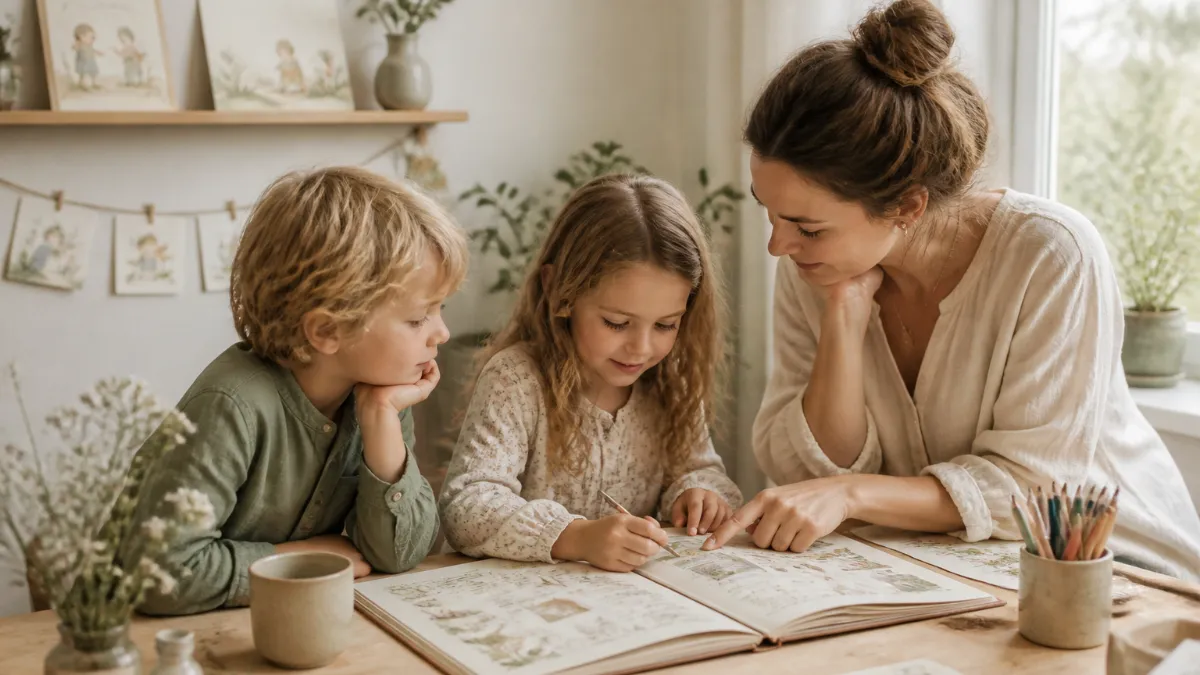
Friendship Activities for Kids: Parent Questions Answered
You planned the playdate. You set out the supplies. You had a rough idea of what you wanted to happen. And then reality arrived — one child took over, another went quiet, nobody could agree on what to make, and by the time it was over you had a stack of drawings that ended up on top of the microwave for a week before disappearing entirely.
Friendship activities for kids are genuinely valuable. Socializing through play and structured friendship activities helps children build socially and emotionally — as they explore these experiences, they learn to master the nuances of empathy, compromise, and conflict resolution. But the gap between knowing that and actually pulling off a successful afternoon is where most parents get stuck. Not on big philosophical questions — on the specific, practical ones. The “but what if my child is shy” questions. The “what do I do when one kid takes over” questions. The “we did all this — now what?” questions. This FAQ answers those.
“My Child Is Shy — Won’t Structured Activities Make It Worse?”
This is one of the most common concerns parents bring up, and the answer is usually the opposite of what they expect: for shy or anxious children, a structured activity often makes social time easier, not harder.
Think about what unstructured social time actually asks of a shy child. It requires them to generate conversation topics, initiate play, negotiate roles, and read social cues — all simultaneously, with no script. That is an enormous cognitive and emotional load. A structured activity removes most of it. There is already something to do, something to talk about, and a clear reason to be sitting near another person. The task carries the social weight that the child doesn’t yet know how to carry alone.
The crucial distinction is between low-stakes creative tasks and performance-based ones. Drawing side by side, writing answers to prompts, decorating a page together — these activities have no winners and no audience. A child cannot “fail” at filling in their favourite colour or drawing their dream pet. Games with scores, talent showcases, or activities with a “best” outcome are a different matter entirely: they introduce exactly the evaluative pressure that makes shy children shrink. Not every activity fits every child on every day — some kids thrive in group settings and hate role-play, while others will talk freely in a small group but freeze in a whole-class setting. Choosing creative, open-ended tasks over competitive ones is the single most reliable way to keep anxiety low and engagement high.
If your child is shy, structure is your ally. Just make sure the structure serves connection rather than performance.
“How Old Should My Child Be Before Friendship Activities Are Useful?”
The short answer: younger than you think, as long as you match the activity to the developmental stage. Ages 5–6 are not yet reliably collaborative in the way adults imagine collaboration to look. They are in what developmental researchers call parallel play territory — happiest doing something alongside a friend rather than with them in a tightly coordinated way. This is not a limitation; it is the ideal shape for this age. Two five-year-olds drawing their favourite animals side by side, occasionally peeking at each other’s pages and giggling, are doing exactly what their development calls for. The activity does not need to produce a unified outcome to be meaningful.
Ages 7–9 can handle genuinely collaborative tasks — ones where the output belongs to both of them, where they have to negotiate and make small decisions together. This is the age where a shared book, a joint drawing, or a back-and-forth letter exchange really begins to feel exciting rather than overwhelming. Friendships play a significant role in any child’s school life and development, and when children play and interact with their friends, they acquire essential life skills including problem-solving, expressing emotions, and empathizing with others. Activities that produce a shared artifact — something both children contributed to — are especially powerful here, because they give the friendship a tangible object to point to.
Ages 10–12 are a different proposition altogether. Children this age have a finely tuned radar for anything that feels babyish, and they will mentally opt out of an activity that strikes them as beneath them — even if their body stays in the room. The key is choosing activities that feel meaningful rather than cute. Writing a real letter. Creating a genuine record of the friendship. Making something that could actually matter in ten years. Research shows that prosocial behaviours like cooperation are strongly intuitive in early childhood, but by ages 9–10, reflective and deliberate prosocial decisions become just as natural — which means older children in this range respond especially well to activities that ask them to think intentionally about their friendships, not just feel them.
“What If One Child Dominates the Activity?”
It happens in almost every mixed-dynamic pairing: one child is more confident, more verbal, more opinionated — and the activity quietly becomes their project while the other child drifts to the edge. The good news is that this problem is almost entirely solved by the materials rather than by adult intervention. Named sections — a page with one child’s name at the top, a different page with the other child’s name — create physical territory that is genuinely theirs. It is much harder to dominate a page that clearly belongs to your friend. The same logic applies to alternating turns made concrete: “This is your question to answer, and that one is mine.” When the structure of the activity builds in reciprocity, you rarely need to enforce it verbally.
When you do need to step in, the lightest possible intervention is best. Simply pointing to the physical material — “whose page is this one?” — redirects attention without accusing anyone of bad behaviour. Playdates and activities won’t always go as planned, and being encouraging while suggesting different approaches to socialisation goes a long way. Dominance dynamics are often not about bossiness at all — they are about one child feeling more comfortable and another needing a little longer to warm up. Named spaces in a physical activity give the quieter child something to return to while they find their footing.
Introduce the “one page each” rule before you begin, not after a problem emerges. Prevention is far easier than correction.
“How Do I Keep the Energy Going After the Activity Ends?”
Most friendship activities end with a fizzle: the supplies get put away, everyone wanders off, and by dinner nobody could tell you what made the afternoon special. The fix is simple, and it takes about three minutes. Before you pack anything up, build in what you might call a handover moment — each child gives or reads what they made to the other. Not a performance, not a presentation: just the physical act of handing something across and saying “this is yours now.” That moment of transfer does something that the activity itself cannot do alone. It creates reciprocity — the feeling that something was exchanged, not just made — and it closes the afternoon with a small emotional beat that both children will remember.
Research has found that children with strong friendships have a higher sense of belonging and life satisfaction, and separate findings show that children with healthy friendships demonstrate better emotional intelligence and do better in school. The handover moment works because it makes the friendship feel real and mutual in a way that simply making something together doesn’t quite achieve. Each child leaves holding something that proves the other child was thinking about them. That is a remarkably powerful thing to carry home.
You can make this even more effective by being deliberate about what gets handed over. A page the friend filled out about themselves. A drawing made specifically for the other child. A written message addressed to them by name. The more personal the object, the more the handover lands.
“We Did a Friendship Activity — Now What? How Do We Not Lose It?”
This is the question most parents don’t think to ask until they’re looking for something in a drawer six months later and realising it is gone. The beautiful, irreplaceable artifacts of children’s friendships — the handwritten notes, the self-portraits, the lists of favourite things in a seven-year-old’s best attempt at joined-up writing — have a short life expectancy in most homes. They get shuffled under other papers, tucked into a folder that never gets opened, or quietly binned in a tidying session. The problem is not that parents don’t value them. It is that there is no designated home for them, so they drift.
The most reliable solution is also the most obvious one, once you see it: a dedicated physical book designed to hold exactly this kind of material. Not a general scrapbook that requires craft skills and assembly. Not a digital folder that removes the handwriting, the texture, and the slightly wobbly lines that make these things irreplaceable. A book with a place already made for each child’s contribution — structured enough that filling it in feels natural, open enough that the result is genuinely personal.
The best versions of these books are rooted in a tradition that is older than most people realise. The alba amicorum — the friend book — was a keepsake format used across Europe for centuries, in which scholars, students, and children collected the handwriting, drawings, and messages of the people they loved most. A beautifully illustrated modern friend book works on exactly the same principle: each child’s contribution gets its own named space, the handwritten memories and favourite things and small drawings are held together in one place, and the book becomes something a child can return to for years. The friendship activity doesn’t end when the afternoon does. It becomes something you can keep.
That is the real answer to “how do we not lose it?” — not a vague suggestion to make a memory box, but a book with a cover, a spine, and a shelf. A book that doesn’t get lost. A book that gets found.
Where Things Stand
The conversation around children’s friendships and social connection has sharpened considerably in recent weeks. A report published in late July 2026 concluded that friendship is effectively “in recession” among young people, with children spending less time with friends and losing access to the places where connection once happened naturally. This comes alongside research published in August 2026 that adds important nuance for parents: some elementary-age children who appear unsociable actually prefer solitary time, as long as they feel they belong to a broader social group — among a sample of fourth- and fifth-graders, children who preferred solitary play but valued social belonging still reported satisfactory peer relationships. Meanwhile, recent commentary has noted that summer can quietly become one of the loneliest times of year for children, precisely because the school year provides the structure — clear expectations, daily peer contact, sports and clubs — that organically sustains friendship. Taken together, these threads point in the same direction: children do not need more activities so much as they need more intentional, low-pressure opportunities to connect — and something tangible to show that the connection was real.
For further reading, see the Sources listed below.
About the author

Dori Fussmann — VP Content
Dori Fussmann leads Album Amicorum, an independent studio behind an illustrated Friend Book that children fill in by hand — turning the notes, drawings, and small messages of childhood friendships into a keepsake worth keeping. His background is in building consumer brands, and he started writing here out of a conviction that the memories that matter most belong off-screen. These articles draw on child-development research and the work of experts such as Jonathan Haidt.
Sources / Further reading
Frequently asked questions
At what age do children start to understand what a 'real' friendship means?
Most children begin forming genuine mutual friendships — ones based on shared interests and reciprocal care, not just proximity — between ages 6 and 8. Before that, friendships are more situational and activity-based, which is exactly why parallel creative activities (drawing together, making something side by side) are so effective for younger children: they build connection without requiring the emotional vocabulary that true friendship demands.
How long should a friendship activity session last for primary-school-aged children?
For ages 5–7, 20 to 30 minutes is typically the sweet spot — long enough to produce something tangible, short enough to end before energy flags. For ages 8–12, sessions of 40 to 60 minutes allow for more depth, especially if the activity has a creative output such as a drawing, a written page, or a shared book. The single most important thing is to end while enthusiasm is still high, so the memory attached to the activity stays positive.
What if my child and their friend disagree or fall out during the activity?
Minor friction during shared creative activities is normal and actually useful — it gives children low-stakes practice in negotiation and repair. The most helpful parent response is to briefly acknowledge the disagreement and redirect to the physical material. Named sections or clearly divided materials make redirecting much easier, because there is always an obvious 'yours' and 'theirs' to return to.
Can friendship activities work for children who are in different school years or age groups?
Yes, and mixed-age pairings can work especially well when the activity is creative rather than competitive. A slightly older child naturally takes a guiding role — explaining, demonstrating — which builds confidence on their side, while the younger child benefits from a more patient collaborator than a same-age peer might be. The key is choosing an open-ended task with no 'right' answer, so neither child feels judged by the other's output.