Host a Friendship Activity Afternoon Kids Will Treasure
Published on August 18, 2026 · Updated on August 22, 2026
Category: Childhood Friendship & Connection · Tags: friendship activities for kids, Children's Keepsakes & Memory, kids activities at home, slow childhood, children's friendship keepsakes
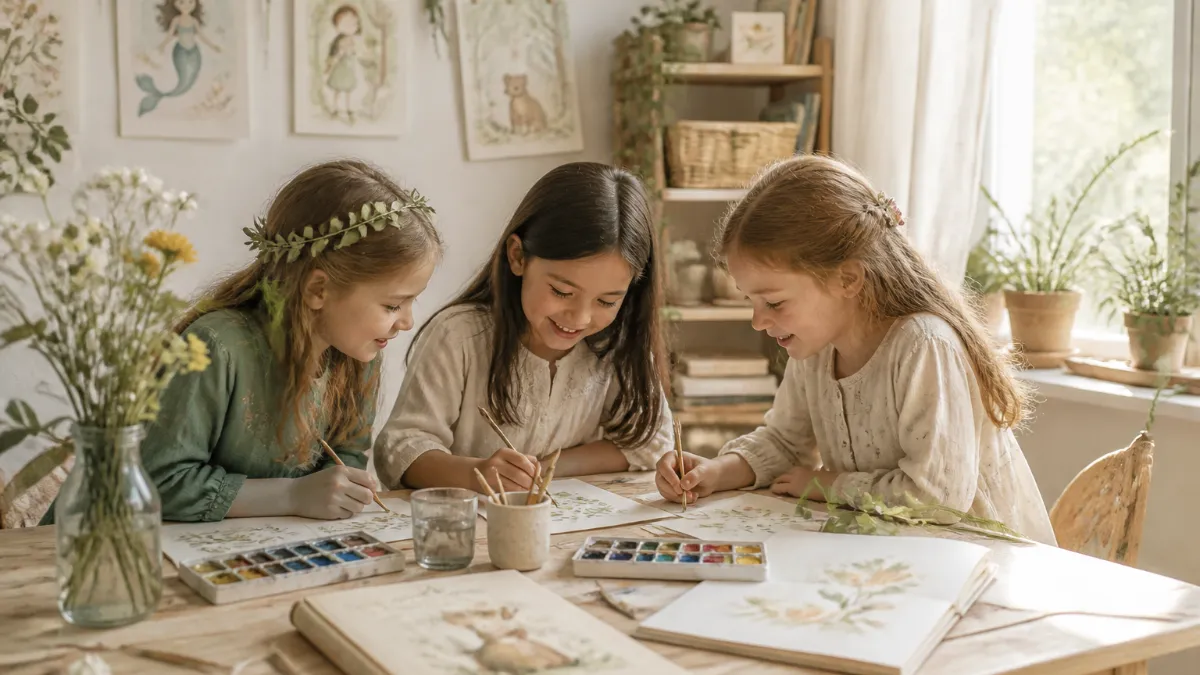
There is a moment near the end of a good afternoon that most parents rush past: the children are still buzzing, the table is littered with colored pencils and scraps of paper, and everyone is about to scatter to the kitchen or the backyard. That moment — messy, fleeting, warm — is exactly when something real could be saved. This guide is about how to design an afternoon so that it moves deliberately toward that moment, and how to make sure it doesn’t disappear.
Hosting a friendship activity afternoon at home is not a party and it is not a playdate in the usual sense. It is something more intentional: a curated experience structured around three distinct phases — warm-up, main activity, and capture — where each phase builds the conditions for the next. When all three work together, the afternoon produces not just a good time but a genuine record of a friendship at this exact point in childhood. That record is the part most people skip, which is why most afternoons leave no trace at all.
Phase One: The Warm-Up That Lowers the Walls
The warm-up phase has one job: to settle the children into an analog, creative register before anything else begins. It should take no longer than five minutes, require almost no materials, and carry zero stakes.
Why Screens Must Stay Out of This Phase
The temptation when children first arrive is to let them connect over something familiar — a show, a game, a shared playlist. Resist it. Screens resolve social awkwardness by absorbing attention rather than directing it toward each other. A child who has spent the first ten minutes of a visit watching a video has not warmed up socially; they have simply been distracted. The point of the warm-up is to get children looking at each other and listening, not staring at the same glowing rectangle.
Two Warm-Up Formats That Actually Work
The most reliable warm-up prompt is something open-ended and quick. Try one of these:
Draw your favorite thing right now. Give each child a piece of paper and a pencil and ask them to draw — in two minutes, not a masterpiece — whatever they like most at this exact moment in their life. It might be a pet, a food, a game, a season. When the two minutes are up, each child shows what they drew and says one sentence about it. This takes under five minutes and immediately gives the children something specific to talk about, because they are curious about each other’s answers.
Two truths and a wish. Each child shares two true things about themselves and one thing they wish were true. No voting, no competition — just listening and guessing which one is the wish. This format works particularly well with children who are less comfortable drawing, and it opens the door to genuine curiosity. A child who discovers that their friend wishes they had a dragon is going to be a lot more interested in that friend than they were sixty seconds ago.
The warm-up’s success is measured not by how polished it is but by whether the children are talking to each other by the end of it. That’s the only criterion.
Phase Two: The Main Activity That Makes Something Together
The main activity is where the afternoon lives. It should take between twenty and forty-five minutes, depending on the children’s ages and energy, and it works best when it produces something each child either takes home or contributes to a shared object. The making is not incidental — it is the mechanism through which the friendship gets expressed and remembered.
What Makes a Main Activity Work
Three design principles keep a main activity running smoothly without requiring constant parental intervention. It should have a clear starting prompt. Blank paper is paralyzing. “Draw whatever you want” produces frustration, not creativity. A structured prompt — “Draw a map of your perfect imaginary land” or “Make a list of your ten favorite things and illustrate three of them” — gives children a direction while leaving the expression completely open. The prompt is a container, not a constraint.
It should allow parallel and collaborative work simultaneously. Some children want to work side by side on separate pieces; others want to combine efforts on one shared page. The best main activities allow both at once. A collaborative illustrated map, for example, can have each child building their own section while working toward a shared whole. This mirrors the way real friendships function: close but individual.
It should produce something physical. Handwritten notes, decorated pages, drawn portraits of each other, lists of shared favorites, illustrated stories — any of these works. The physical artifact is not a craft project; it is evidence. It is the thing that will still exist in twenty years when everything else from this afternoon has faded.
Ideas for the Main Activity
- Illustrated favorite-things lists. Each child writes and draws their top ten favorite things right now — food, place, person, feeling, animal, season, game, smell, word, dream. Compare and find the overlaps.
- Portrait exchange. Each child draws the other’s portrait — not a realistic likeness but a creative interpretation. (“Draw what I feel like, not what I look like.”) These are exchanged at the end.
- Collaborative illustrated map. One large piece of paper becomes a shared imaginary world. Each child names and draws their territory; the middle ground is negotiated together.
- Handwritten notes to each other. Prompted by specific questions: What do I like about being your friend? What’s one thing I hope we do together someday? What’s the best thing that happened when we were together? These can be folded and tucked into envelopes to be read later.
The parent’s role during this phase is almost nothing. Set the materials out, give the prompt, and step back. Connection happens naturally when children have purposeful, creative structure and no screens competing for their attention. Hovering, hovering, and suggesting tends to break the spell rather than build it.
Phase Three: The Capture — the Most Skipped and Most Important Step
Here is the honest truth about most playdates and friendship afternoons: they end with a hurried goodbye and a vague sense that it was lovely. Three weeks later, nobody can remember the specific details — what made everyone laugh, what surprising thing one child said about the other, what they made together. The afternoon leaves no mark because nothing captured it.
The capture phase changes that. It is short — five to ten minutes — and it happens before anyone puts on their shoes to leave.
How to Run the Capture Phase
Bring the children back to the table. Give each child a fresh piece of paper, or a page in a shared book, and a single prompt: Write or draw one thing you want to remember about your friend today.
That’s it. The prompt is deliberately singular — one thing, not a list — because the constraint produces specificity. A child who must choose only one thing will choose something real: not “she is nice” but “she said she wished she could fly and she meant it.” That’s the raw material of a genuine friendship record.
For younger children, the capture can be purely visual: a small drawing of a moment from the afternoon, signed and dated. For older children, a sentence or two is enough — the handwriting itself becomes part of what is preserved.
If the afternoon has produced decorated pages, lists, or illustrated notes in the main activity phase, those can double as the captured artifact. The important thing is that before the afternoon ends, each child has created something that names the other and names the day.
Why This Phase Is Transformative
When children see themselves as participants in preserving something meaningful, it shifts the emotional weight of the afternoon. Unlike toys or digital experiences that are quickly outgrown, a handwritten record becomes a keepsake that transports a child back to this exact moment long after they are grown. The handwriting is the proof: this happened, we were here, this is what it felt like.
Parents often worry that children won’t engage with the capture phase, especially if it feels formal. The solution is to model it without making it a performance. A parent who quietly writes their own one-sentence observation — “Today I noticed how hard you both laughed about the map” — demonstrates that capturing is a natural act, not a homework assignment.
The Parent’s Real Role: Set the Conditions, Then Disappear
Across all three phases, the parent’s function is the same: build the container and then let the children fill it. That means having the materials ready before anyone arrives (paper, pencils, pens, perhaps watercolors or colored pencils — nothing elaborate), establishing the no-screens understanding before the afternoon begins, and introducing each phase with a single clear prompt rather than a set of instructions.
Friendship activities do more than keep children busy — they help children learn how to connect, communicate, and care for each other. That learning happens most naturally when children are given purposeful structure and then left to inhabit it on their own terms. An overorchestrated afternoon — where every minute is managed, every product is corrected, every interaction is narrated — produces polished artifacts and hollow connection. An underorchestrated one, where children are simply put in a room together with no focus, tends to drift toward screens or low-engagement parallel play. The three-phase structure threads the needle between those extremes.
What surprises most parents is how little the children need once the afternoon is underway. The warm-up breaks the ice. The main activity gives them something to do together. The capture gives the afternoon meaning it can carry forward. By the time they are pulling on their shoes to leave, they have already created something together — and one of them is taking it home.
Making This a Ritual, Not a One-Off
A single friendship afternoon is lovely. Done regularly — monthly, seasonally, whenever two particular children spend meaningful time together — it becomes something else entirely: an accumulating record of a friendship growing up. Each capture phase adds a page to that record. Each page carries a date, a drawing, a sentence in a child’s own handwriting. Taken together, they form something that no photograph can replicate: the texture of what these two people meant to each other at six, at eight, at ten.
This is the point at which the capture phase stops feeling like a project and starts feeling like a practice. And a practice, once established, is self-sustaining — children begin to anticipate it, to take it seriously, to want to do it well.
For parents who want a ready-made structure for that practice, Album Amicorum’s friend book is designed precisely for this moment. Rather than loose sheets that scatter or envelopes that get lost, it gives every capture phase a permanent, beautifully illustrated home: a book that each friend fills in by hand, building a page at a time across every afternoon spent together. The prompts are already there, the pages are designed to hold handwriting and drawings, and the book itself is made to last. If the three-phase afternoon is the ritual, the friend book is the vessel that makes every ritual permanent — a record of childhood friendship that neither child will want to throw away.
Where Things Stand
The conversation around children’s offline connection and analog creative activities has gained noticeable momentum through mid-2026, driven largely by a growing policy response to children’s screen use. Australia became the first country to ban social media for users under 16 in December 2025, and by mid-2026 more than 30 U.S. states had passed laws banning or restricting cellphones in K–12 classrooms — a legislative shift that is pushing parents and educators alike to think more deliberately about what structured, face-to-face time between children looks like. A systematic review tracking trends across pre- and post-pandemic periods found a dramatic rise in screen use among children and adolescents , reinforcing the urgency many parents already feel. Against that backdrop, interest in purposeful analog activities — including friendship-focused crafts, handwritten keepsakes, and memory-making rituals for children — remains steady and culturally resonant, with no signs of major disruption or shifting consensus in recent weeks. International Day of Friendship fell on July 30, 2026 , generating renewed seasonal interest in structured friendship activities for children, a pattern likely to continue into the back-to-school period through August and September.
For further reading, see the Sources listed below.
About the author

Dori Fussmann — VP Content
Dori Fussmann leads Album Amicorum, an independent studio behind an illustrated Friend Book that children fill in by hand — turning the notes, drawings, and small messages of childhood friendships into a keepsake worth keeping. His background is in building consumer brands, and he started writing here out of a conviction that the memories that matter most belong off-screen. These articles draw on child-development research and the work of experts such as Jonathan Haidt.
Sources / Further reading
Frequently asked questions
How many children do you need for a friendship activity afternoon to work well?
Two children is ideal, especially for the capture phase — it keeps the sharing intimate and the attention focused. Three works well too, as it naturally introduces turn-taking and collaboration. Beyond four, the energy can shift toward a party dynamic rather than a thoughtful friendship experience, so consider splitting into pairs for the main and capture activities if you have a larger group.
What age is this friendship afternoon format best suited for?
The three-phase format works well across ages 5–12, but the activities within each phase should flex to the children's ages. Younger children (5–7) do best with simple drawing prompts and very short capture moments — one drawn picture, one dictated sentence. Older children (9–12) can handle richer prompts, longer written answers, and more independent creative work during the main activity phase.
What if the children are shy or don't want to participate in the capture phase?
Don't force it — invite rather than require. Some children need to see a parent model it first ('I'm going to write one thing I noticed about you two today'). You can also make the capture phase physical rather than verbal: have each child draw a small picture of a moment from the afternoon and tuck it into an envelope with the date. The act of drawing is gentler than writing for children who feel self-conscious.
Can this work with children who aren't close friends yet — for example, after a first playdate?
Absolutely, and in some ways it works even better. The warm-up phase is specifically designed to lower inhibitions between children who don't know each other well. Low-stakes prompts like 'draw your favorite animal' or 'tell me one thing you like and one thing you wish for' give children something to talk about naturally. The capture phase then seals whatever connection did form that afternoon — even a new friendship deserves a record of its first page.