Friendship Activities vs. Free Play: What Actually Works?
Published on August 18, 2026 · Updated on August 22, 2026
Category: Childhood Friendship & Connection · Tags: friendship activities for kids, free play, children's development, slow childhood, childhood keepsakes
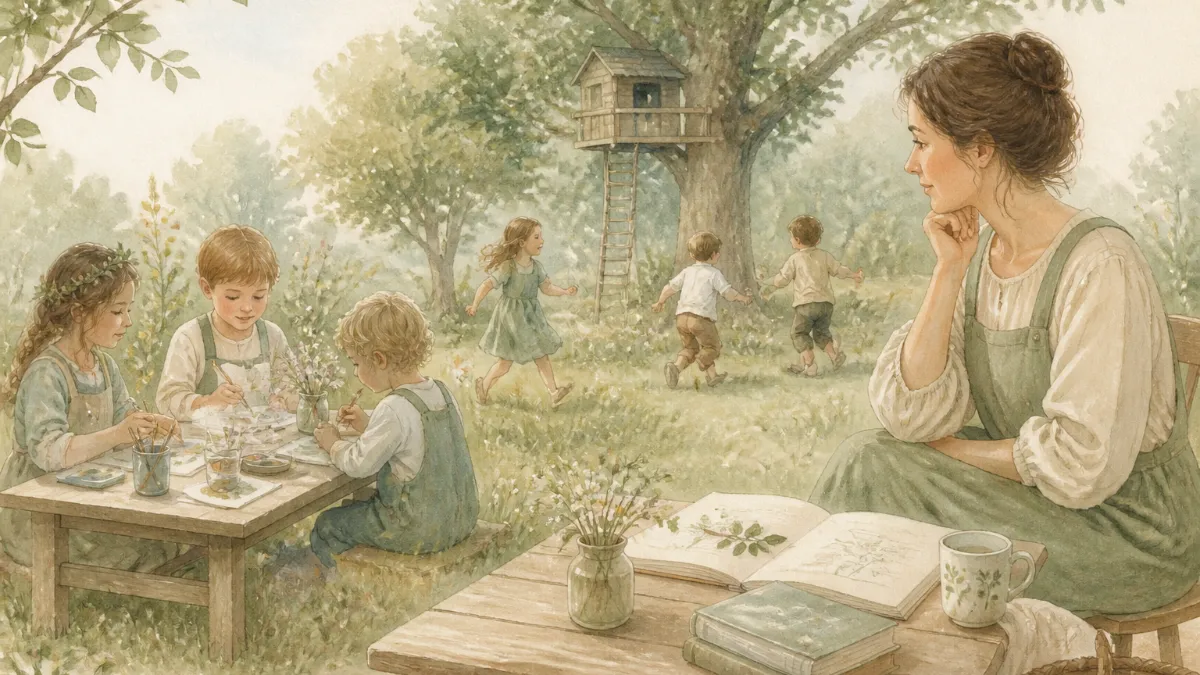
When a playdate is coming up, most parents face a quiet version of the same question: should I plan something, or should I just let them figure it out? It feels small, but it points to one of the more genuinely interesting debates in child development — whether structured friendship activities or open-ended free play does more to build the close, lasting friendships children need. The honest answer is that both camps are right, and for most families the real work is not choosing between them but understanding what each one actually does.
What Structured Friendship Activities Are Really Good At
Structured play often consists of organized games, crafts, songs, and activities during which children follow along together. That shared focus turns out to have a specific and valuable effect, especially when two children don’t know each other well. A 2026 study published in Infant and Child Development divided 148 children aged six to eight into pairs of friends and non-friends. Each pair completed two activities: an open-ended play session and a goal-directed drawing task in which they had to work together to create a picture. Researchers measured the children’s “connectedness” — how much they were talking about the same topic — to understand how far they cooperated, shared ideas, and communicated coherently.
On average, connectedness rates were higher during the drawing task than when the children were playing freely. A closer look revealed that the change occurred almost entirely among the non-friend pairs, whose connectedness during goal-directed play shot up by about 25%. Friend pairs showed almost no difference between conditions — because established friends already know how to find their rhythm. But for children who are still learning each other, a shared goal can transform two unfamiliar classmates into a more connected team, encouraging listening, responding, and working together.
This is the clearest case for structured friendship activities: they dramatically lower the social risk for children who don’t yet have a shared language. The blank-afternoon problem — two children staring at each other, neither sure how to begin — is not a sign of incompatibility. It is often simply a missing starting point, and a structured activity provides one. This is particularly true for shy or introverted children, for new friendships formed at the start of a school year, or after a family move, when the pressure of unstructured time can feel more like a test than a pleasure.
The Age Factor: Why Younger Children Need More Scaffolding
The question of structure is not the same across the whole childhood span. Children ages five to seven are still building the social skills that make unstructured interaction feel safe: how to enter play, how to negotiate roles, how to signal interest in another child’s idea. A light scaffolding — a craft, a game with simple rules, a prompt to fill in together — models these behaviors and gives children something to fall back on when the interaction feels uncertain. It lowers anxiety in the way that a menu lowers anxiety at a new restaurant: you still choose what you want, but you don’t have to invent the categories.
By contrast, children ages eight to twelve are increasingly capable of generating their own play worlds and sustaining them across hours. For this age group, too much adult-directed structure can actually work against friendship depth. At extracurricular activities like gymnastics or soccer, children are usually following instructions with very little or no time for socialization — they may even get redirected if they try to chat. That’s why kids usually need to meet outside of the organized activity to actually deepen their friendship. The activity created the introduction; free time has to do the rest.
What Free Play Builds That No Activity Can Replicate
Free play happens in unstructured time during which children can select their own activity — during recess, in an afterschool play center, or on the playground. When surrounded by same-age peers, children are better able to play in ways they most prefer. That self-direction is not a gap in learning; it is the learning.
When two children are left to create their own world — building an elaborate game, assigning roles in an imaginary scenario, arguing about the rules, making up, and starting again — they are practicing every skill that sustains a long-term relationship: negotiation, empathy, rupture and repair, the ability to hold another person’s perspective while still advocating for their own. None of these skills appear on a worksheet. They are developed in the slightly chaotic, spontaneous flow of children given time and trusted to use it.
Research consistently links rich free-play time to stronger, longer-lasting peer relationships precisely because these experiences are self-authored. A 2026 clinical report reaffirmed by the American Academy of Pediatrics emphasizes that play strengthens brain structure and function, particularly executive skills such as impulse control, emotional regulation, and goal-setting.
Children who have at least one hour of daily unstructured play show measurably stronger executive function scores by age seven compared to peers with heavily scheduled days. Executive function, it is worth noting, is the same cluster of capacities that allows a child to listen to a friend, take turns, and hold their temper when a game doesn’t go their way.
There is also the matter of preference. A Harris Poll of more than 500 children ages 8 to 12 across the United States found that 45% say they would rather play with friends in activities not organized by adults — and a growing number of American families are rethinking packed schedules in response. Children, in other words, are voting with their energy.
The Imaginative Core of Lasting Friendship
Free play is where children find out who their friends actually are — not as partners in a task, but as co-creators of a world. The games invented on a rainy afternoon, the rules agreed upon and immediately revised, the private jokes that emerge from shared pretending: these are the things children remember decades later, long after any organized activity has faded. Research from King’s College London and Cardiff University has uncovered how children’s play styles differ depending on whether they are playing alone or with someone else, and how these differences relate to their social skills and brain activity, suggesting that the social context of play — the fact of sharing it with a specific other person — is itself developmentally significant. Friendship is not just a backdrop to play. For children, it is largely built inside it.
The False Binary: Why ‘Both/And’ Is the Right Framework
It would be convenient if the research landed cleanly on one side of this debate. It doesn’t, and that is actually the most useful finding. Structured goal-directed tasks show clear advantages for non-friends or new acquaintances , while established friends reach their deepest connection through free, unstructured time. The implication is not that one is better than the other — it is that they serve different moments in the arc of a friendship.
The most friendship-deepening environments combine both: a light structure that initiates connection, followed by extended free-play time that deepens it organically. Think of a structured activity as the warm-up, not the main event. Fifteen minutes of making something together — a drawing, a game, a shared craft — can ease two children into the same emotional frequency. What follows, when the activity ends and the children are left to their own devices, is where the real friendship-building begins.
Guided play in early childhood education is defined as a playful learning approach in which children retain control over their activities, while adults intentionally scaffold the environment, pose open-ended questions, or subtly guide interactions toward specific learning goals. The practical version of this for parents is simpler than it sounds: set up a starting point, then leave the room.
The One Area Where Structure Has a Clear, Uncontested Edge
There is one dimension of friendship development where structured activities win decisively and without qualification: memory preservation. Free play is immediate and immersive and irreplaceable in the moment — and then it’s gone. There is no artifact. The elaborate fort, the invented game, the private language: they exist in memory and nowhere else.
A structured activity that produces something physical — a drawing made together, a page filled with each child’s favorite things, a written message from one friend to another — creates a tangible record that free play, by its nature, cannot. This matters more than it might first appear. Children grow up. Friends move away. The texture of a particular friendship at age seven, or nine, or eleven, becomes genuinely hard to recall. A physical object made during a shared afternoon carries that texture forward in a way that photographs alone cannot: it is in the handwriting, in the specific answer to a specific question, in the small drawing tucked into the margin.
This is where a friend book — a beautifully designed book that children fill in together, capturing favorite things, personal messages, and drawings — earns its place not as a structured activity in competition with free play, but as the natural complement to it. It doesn’t replace the wild afternoon; it takes fifteen minutes of that afternoon and makes it permanent. For families who have already found the rhythm of combining light structure with plenty of open-ended time, a friend book is simply the bridge that carries the memory forward. Album Amicorum’s friend book is designed for exactly this moment: not to turn a playdate into a lesson, but to give the playdate somewhere to live long after the children have gone home.
Where Things Stand
The structured-versus-free-play debate is seeing a meaningful surge in new research and public conversation as of mid-2026. A study published earlier this year in Infant and Child Development, conducted by researchers at the University of Cambridge, found that non-friend pairs of children ages six to eight showed a roughly 25% increase in cooperative, coordinated communication when given a shared goal rather than open-ended free play — while established friend pairs showed almost no difference between conditions, suggesting structure matters most at the beginning of a relationship. Simultaneously, a 2026 clinical report reaffirmed by the American Academy of Pediatrics emphasizes that play strengthens brain structure and function, particularly executive skills such as impulse control, emotional regulation, and goal-setting, reinforcing the case for protecting unstructured time. Recent expert commentary notes that children with four or more extracurricular activities may need more unstructured free playtime, and a Harris Poll found that 45% of children ages 8–12 say they would rather play with friends in activities not organized by adults. Taken together, the current evidence points strongly toward a both/and model: structure to initiate connection, free play to deepen it.
For further reading, see the Sources listed below.
About the author

Dori Fussmann — VP Content
Dori Fussmann leads Album Amicorum, an independent studio behind an illustrated Friend Book that children fill in by hand — turning the notes, drawings, and small messages of childhood friendships into a keepsake worth keeping. His background is in building consumer brands, and he started writing here out of a conviction that the memories that matter most belong off-screen. These articles draw on child-development research and the work of experts such as Jonathan Haidt.
Sources / Further reading
Frequently asked questions
At what age should I start doing structured friendship activities with my child?
Structured friendship activities can be introduced as early as age 4 or 5, when children are beginning parallel play and starting to engage with peers but may not yet know how to initiate or sustain interaction on their own. At this age, a simple shared task — building something together, completing a drawing, filling in a page about their favorite things — gives two children a common focus and reduces the social pressure of open-ended time. You don't need elaborate planning; even a five-minute shared activity before unstructured play begins is enough to lower social anxiety and get things started.
How much free play do children actually need each week for healthy friendship development?
Most child development guidance points to at least one hour of active, unstructured play daily — and importantly, not all of that time needs to include a peer for it to build friendship-related skills like imagination, negotiation, and self-regulation. When it comes specifically to peer friendships, even one or two extended free-play sessions per week with a consistent friend group can make a meaningful difference. The key word is 'extended': a 20-minute playdate rarely gives children enough time to move past the warm-up phase into the imaginative, self-directed play that deepens bonds.
Can structured activities actually hurt friendship development if overdone?
Yes — if every interaction between children is adult-directed and task-focused, kids miss out on the unstructured negotiation, conflict, and repair cycles that build genuine resilience in relationships. Highly scheduled children may find it harder to initiate their own play, manage boredom together, or navigate disagreements without an adult referee. The goal is balance: use structure to spark the connection, then step back and let free play take it deeper. Think of structured activities as the on-ramp, not the whole motorway.
What's the best way to preserve memories from both structured activities and free play?
Structured activities naturally lend themselves to preservation because they produce something tangible — a drawing, a written answer, a decorated page. Free play is harder to capture; photographs help, but they can't convey the texture of what was said or felt. A friend book that children fill in together — recording their favorite things, writing messages to each other, adding small drawings — works beautifully as a bridge: it takes only a few minutes of light structure but creates a lasting artifact of the friendship that neither child will find in a photo album.