Jonathan Haidt's Screen-Free Childhood Advice: Top FAQs
Published on August 11, 2026 · Updated on August 22, 2026
Category: Slow Childhood & Analog Play · Tags: screen free childhood, jonathan haidt screen free childhood advice, childhood friendship & connection, phone free parenting, anxious generation
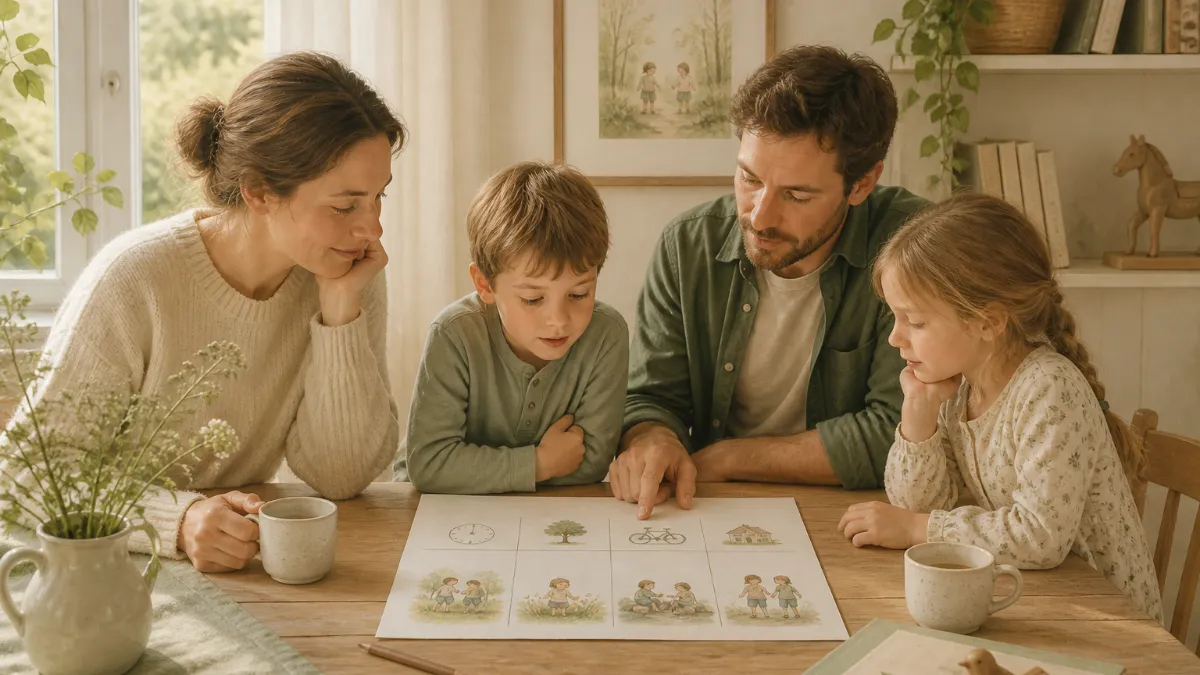
If you’ve picked up Jonathan Haidt’s The Anxious Generation — or heard his name in a school WhatsApp group, a podcast, or a worried conversation with another parent — you probably left with a feeling more than a plan. The alarm bells rang clearly. But the specific, practical answers? Those were harder to find. This article works through the questions parents ask most often about Haidt’s screen-free childhood advice, in plain language, so you can move from concern to action.
What Is Haidt’s Core Argument, in Plain Terms?
Haidt writes in his bestselling book The Anxious Generation that kids who grow up with prolonged exposure to both smartphones and social media are at a higher risk for anxiety and depression. But his argument isn’t simply that screens are bad. It’s more precise than that, and understanding the precision matters if you want to apply his advice at home.
The book argues that the widespread adoption of smartphones fundamentally transformed childhood in the early 2010s. Instead of spending free time interacting face-to-face, many young people began spending increasing amounts of time online. Social media, constant notifications, and digital entertainment gradually became central parts of everyday life. Haidt suggests that this shift created what he calls a “phone-based childhood,” replacing many of the experiences that previously helped children develop emotionally and socially.
Haidt argues that smartphones and screens contribute to “social deprivation, sleep deprivation, attention fragmentation, and addiction,” painting a dire picture of the consequences for today’s youth. Crucially, his concern is not with a television in the living room or a shared household computer. It is specifically with the personal, pocket-sized device that follows a child into their bedroom, onto the school bus, and into every quiet moment — giving the entire world unmediated access to a developing mind.
What Are Haidt’s Four Core Norms? A Clear Breakdown
In The Anxious Generation, Haidt recommends four foundational reforms: do not allow kids to have smartphones before high school; prohibit children younger than 16 from using social media; establish phone-free schools; and create more opportunities for children to engage in unsupervised play and childhood independence. These are framed not as personal lifestyle choices but as collective norms — things that only work well when a critical mass of families and institutions adopt them together.
Norm 1: No Smartphones Before High School (Age ~14)
The first norm is a commitment to not give children a smartphone until they are at least 14. “Give them a flip-phone if you want to, so they can call and text you,” Haidt says. “But don’t give the entire world access to your child.” This distinction is worth sitting with: Haidt is not demanding that children be unreachable. A basic phone capable of calls and texts addresses the genuine safety and coordination needs that parents worry about. What he objects to is the full internet — the social media apps, the algorithmic feeds, the direct messaging with strangers — in a child’s pocket at all times.
Norm 2: No Social Media Before Age 16
The second norm is to not allow children to use social media until they are at least 16. “Social media is wildly inappropriate for children — you have strangers trying to talk to them, cyberbullying, explosive drama,” Haidt explains.
In 2022, he testified before Congress that one to two hours a day of social media use isn’t associated with a decline in mental health — but three or four hours a day is. The concern isn’t a single Instagram post; it’s the architecture of platform engagement designed to maximize the time a child spends scrolling.
Norm 3: Phone-Free Schools
All schools need to be phone-free from bell to bell — from the morning when kids arrive to the end when they leave, Haidt explains. This norm is the one gaining the most visible policy traction. Cell phone bans and restrictions in K-12 schools continue to gain momentum, and as of December 2025, 35 states and Washington, D.C., had signed or already enacted laws or policies regarding student cell phone usage in K-12 classrooms.
One simple strategy Haidt recommends to help get kids off their cellphones is to have a school playground open for 30 to 45 minutes before class starts and after school. Though parents often worry about letting their kids play on neighborhood streets, “they do trust the school playground, so an incredibly powerful, cheap thing to do is open the school playground” and have an adult nearby for supervision.
Norm 4: More Unsupervised Free Play
The fourth norm is to give kids back more independence, responsibility, and free play in the real world. “If parents don’t replace screen time with real-world experiences involving friends and independent activity, banning phones will feel like deprivation, not opening up a world of experiences,” Haidt warns. This norm is the one parents tend to find most emotionally difficult — not because they disagree with it in principle, but because the social landscape has changed so dramatically. Haidt has shared that while many parents agreed with his phone rules, many were hesitant about free, independent play. “On the phone side, we didn’t have to persuade anyone. Everybody already saw it, they just didn’t know what to do about it,” he said. “But persuading parents that they need to back off and give their kids the kind of freedom that they themselves had when they were young? It wasn’t like we just put it out there and everyone said, ‘Of course.’” He co-founded an organization called Let Grow with Lenore Skenazy of Free-Range Kids, which encourages parents to give their kids more independence.
Isn’t This a Collective Action Problem? How Does One Family Make a Difference?
One of the most honest and important threads in Haidt’s work is his acknowledgment that individual willpower alone cannot solve this. As Haidt puts it, “Few parents want their preteens to disappear into a phone, but the vision of their child being a social outcast is even more distressing.” This is the trap: every parent quietly agrees the situation is bad, but no one wants their child to be the first to go without. The solution Haidt proposes is coordination — treating this as the collective action problem it actually is.
“It’s a collective action problem,” he explains. “How do you solve a collective action problem? Collectively. So, I propose four norms that if we can do these four norms, we can roll back the phone-based childhood.” The point is not to be heroic in isolation but to find even a handful of families willing to coordinate — at the school-class level, the neighborhood level, the sports team level — and commit together.
What Are “Free Play Fridays”?
One of Haidt’s most immediately actionable suggestions for community-level change is Free Play Fridays. Haidt recommends parents come together to create one weekly tradition: “free play Fridays.” “Let’s just all agree that Friday is a day when you do not schedule any educational activities,” he says. “Everyone knows that’s when kids get together at the park, they play baseball, football, whatever. Maybe they just stay at the school playground.” Playing together without the presence of screens is “the most fun kids can have,” he adds, and giving them that opportunity on Friday could mean these activities then spill over into the weekend.
The idea is to send kids outside — no phones or devices — to play from 4 p.m. to 6 p.m. every Friday. It’s an easy collective action that can start on your street and spread through the neighborhood.
Crucially, parents shouldn’t supervise, direct, or intervene in the kids’ play — and if you’re afraid to go inside, leave your own phone in the house and chat with your neighbors in real life. This isn’t a perfect solution, but it is a scalable one. It asks nothing of government or technology companies. It asks only that a few families on a street say yes on the same afternoon.
Common Parent Objections — and Haidt’s Answers
“My child will be the only one without a phone.”
This is the objection Haidt takes most seriously, because it isn’t irrational. It reflects the genuine social dynamics of a world where the majority of peers have smartphones. His answer is that this is precisely why the solution must be collective. Haidt says that with more parents allowing independence, the more normalized it will become. “This has a transformational effect on the whole community because nobody has seen an 8-year-old walking around since 1991, so the Let Grow experience is our most powerful tool for changing the norms and making parents feel more comfortable.” The “only one without a phone” problem dissolves when enough families coordinate — and parents consistently underestimate how many other families in their school are already waiting for someone to go first.
“What if there’s an emergency?”
Haidt’s response to this objection is blunt but fair: the emergency use case is genuinely served by a basic flip phone capable of calls and texts. He notes that iPads are slightly better than smartphones because they’re less portable, but if kids can access apps like Instagram, TikTok, or Snapchat, there’s a big risk they’ll “get addicted” to talking to strangers. The emergency frame, Haidt argues, often functions as a cover for something parents have already decided they want to do — and the question is whether they’re making that decision consciously.
“Won’t they be socially excluded?”
One of the main issues Haidt addresses is that all children are on phones, making it seem like the only way to avoid social isolation is to be on a phone. But the premise deserves interrogation: which kind of social life matters more? Haidt’s argument is that the social life happening inside phones — the group chats, the performance of identity on social feeds, the anxiety about likes — is a pale and often harmful substitute for the social life that happens in person. Children who are given real-world independence and time for unstructured play with peers are not socially excluded. They are socially present in a way that screen-mediated connection cannot replicate.
What Should Fill the Space That Screens Vacate?
This is the question that shapes everything. Haidt’s final call to action is simple: give young people back independence, responsibility, and free play. “If parents don’t replace screentime with real-world experiences involving friends and opportunities for independent activity, then banning devices will feel like pure deprivation, not like a world of opportunities opening up.”
Haidt believes that reducing opportunities for independent play has deprived many young people of experiences that help them become capable and emotionally strong adults. Childhood is not simply a waiting room for adulthood. It is a developmental window, and what fills that window — the experiences, the relationships, the failures and small triumphs — shapes the adults children become. A key lesson from Haidt’s work is that mental health trends are often influenced by broader social environments. He argues that rising rates of anxiety, depression, loneliness, and self-harm among adolescents cannot be understood solely through individual decisions.
The things that fill a screen-free childhood most meaningfully are also some of the oldest: outdoor play, face-to-face conversation, creative making, and — perhaps most importantly — real friendship. Not friendship mediated by an algorithm that decides who sees what, but the kind built slowly, in person, through shared time and shared experience.
This is where something like a beautifully illustrated Friend Book — the kind that gathers handwritten messages, favorite things, drawings, and memories from real children in a child’s real life — becomes more than a lovely object. It is a form of childhood that Haidt is explicitly trying to recover. When a child passes a book around their class or neighborhood and watches the pages fill with the actual handwriting of their actual friends, they are doing something that no app can replicate: they are building a record of embodied, real-world connection. That record becomes a keepsake — the kind a parent finds tucked in a drawer decades later, still full of something true.
Haidt’s vision of what a healthy childhood looks like is not complicated. It is the childhood that existed before the smartphone arrived, updated for the world we actually live in. It is play without an audience, friendship without a follower count, and memory-making that doesn’t disappear when a platform shuts down. A Friend Book is exactly that kind of memory — made by hand, belonging to no platform, lasting a lifetime.
Where Things Stand
The conversation around Haidt’s screen-free childhood advice continues to accelerate in 2026. In April 2026, Haidt delivered what he described as his “most urgent” TED Talk, focused on stopping the takeover of childhood by technologies not designed with children’s welfare in mind, and arguing that changing course will require a major shift in public opinion as a signal to political leaders. His three principles of technoskepticism — protect brain development through puberty, prioritize people and books over screens in education, and beware of artificial relationships for minors — represent an evolution and sharpening of the arguments in The Anxious Generation. On the policy front, 26 states now require K-12 cellphone bans, driven by mounting concerns over student mental health, academic performance, and classroom disruptions, with state legislatures passing more cellphone restriction laws in 2025 than in the previous decade combined. Meanwhile, a May 2026 warning from the Department of Health and Human Services noted that children spend about eight hours daily on screens — nearly as much time as they spend sleeping or in school — with growing evidence linking excessive screen use to anxiety, depression, and developmental challenges. The debate around Haidt’s evidence base continues among researchers, but the policy and cultural momentum behind his four core norms shows no sign of slowing.
For further reading, see the Sources listed below.
About the author

Dori Fussmann — VP Content
Dori Fussmann leads Album Amicorum, an independent studio behind an illustrated Friend Book that children fill in by hand — turning the notes, drawings, and small messages of childhood friendships into a keepsake worth keeping. His background is in building consumer brands, and he started writing here out of a conviction that the memories that matter most belong off-screen. These articles draw on child-development research and the work of experts such as Jonathan Haidt.
Sources / Further reading
Frequently asked questions
Does Haidt say children should never use screens at all?
No. Haidt's concern is specifically with personal, pocket-sized devices — smartphones and social media apps — that give the entire world unmediated access to a child, especially in their bedroom. He is not opposed to shared-space screen use, such as a family television in the living room or a household computer in a communal area. The key distinction is between screens that isolate children in a personalized digital environment and screens that remain part of shared family life.
What is the 'Wait Until 8th' campaign and how does it relate to Haidt's advice?
The 'Wait Until 8th' campaign encourages parents to delay giving children a smartphone until at least the end of 8th grade, which aligns closely with Haidt's first core norm of no smartphones before high school (around age 14). Both approaches are rooted in collective action: the more families that commit together, the easier it becomes for any individual child to avoid social pressure. Haidt has endorsed the spirit of this campaign as one practical way parents can coordinate at the school or neighborhood level.
How should parents handle the 'but what about emergencies?' objection from their kids?
Haidt addresses this directly by pointing out that children managed emergencies for generations before smartphones existed. His suggested alternative is a simple flip phone — enough to call or text a parent — without giving children the full internet in their pocket. He also notes that many schools now have office phones children can use. The emergency argument, Haidt argues, often functions as a justification for something parents are already uneasy about rather than a genuine safety case.
What should fill the time when screens are removed?
Haidt is emphatic that simply removing screens without replacing them with something better will feel like pure deprivation. His answer centers on three things: more unsupervised free play with other children, greater real-world independence (walking to a friend's house, running an errand alone), and — importantly — the restoration of face-to-face friendship and handwritten connection. The developmental benefits come not just from the absence of screens but from what fills that absence: genuine, embodied experience with peers.