What Your Childhood Memory Book Is Missing
A childhood memory book can capture milestones and photos—but friends' own handwriting and drawings tell a different story. Here's what to look for.
What a Childhood Memory Book Is Really Keeping
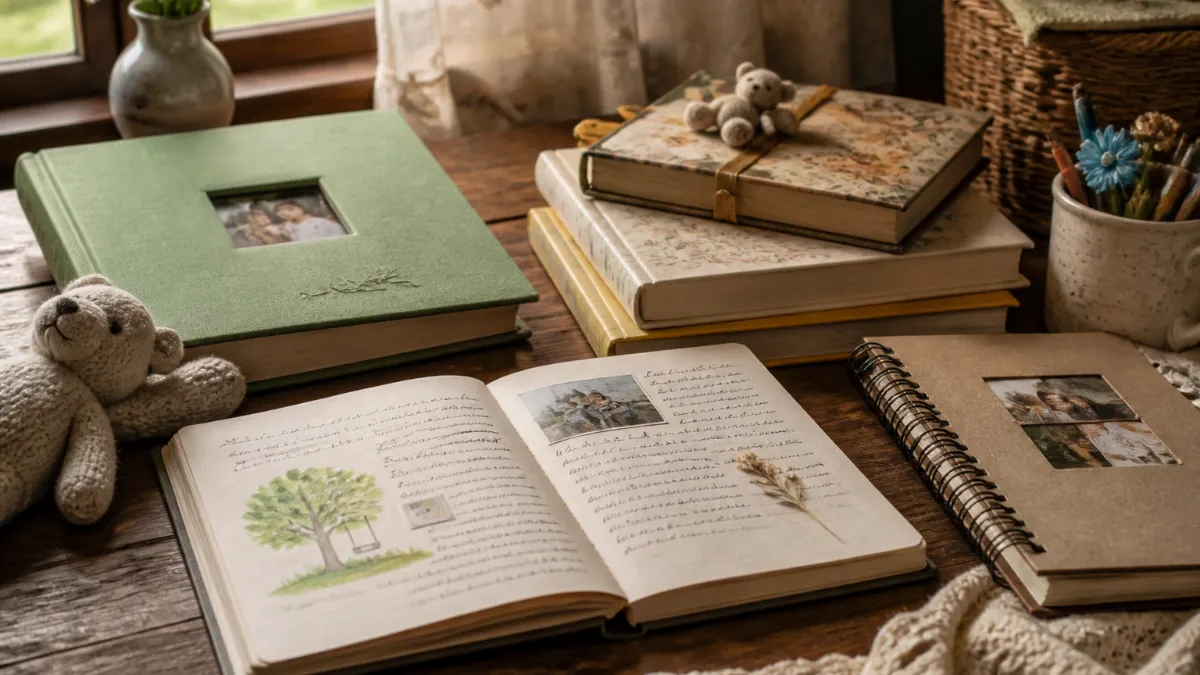
There is a version of a childhood memory book that most parents know well: the hardback journal waiting on the shelf, full of prompts for first words, first steps, and favorite foods at age three. The parent fills it in. The parent keeps it. The parent is, in effect, the author. That is a beautiful thing — a record of how a child looked and moved and surprised the adults around them — but it is worth being clear about what kind of memory it holds. It holds the parent’s memory of the child, written in the parent’s hand.
That distinction matters more than it seems. As children move through the primary-school years, between five and twelve, a different set of memories begins to accumulate: the friends they make, the jokes only their classmates understand, the little rituals of the playground that no parent ever quite sees. These are the childhood memories that rarely make it into any book at all — not because they are unimportant, but because no adult is the right person to write them down.
A childhood memory book can hold a great deal. The question worth asking before you choose one — or give one as a gift — is whose voice is doing the holding.
The Three Formats Most Parents Encounter
When people search for a childhood memory book or a memory keepsake for kids, they tend to find three broad categories. Understanding what each one is designed to do makes it much easier to choose the right one for a particular child or occasion.
Parent-written milestone journals
These are the most common format. They run from pregnancy or birth through the early school years, and they are structured around milestones: first tooth, first day of school, height at each birthday. The parent is the writer, the curator, and often the main character by proxy. Some span just the first year; others are designed to run all the way through adolescence. Whatever the span, the format stays the same: the parent writes, and the child is the subject rather than a contributor. For families who want a careful, longitudinal record written from an adult’s perspective, this format does its job well. What it cannot do is reproduce a friend’s nine-year-old handwriting, or a classmate’s drawing of the two of them on the swings.
School-years scrapbooks
A second format focuses on the school years specifically: class photos, report cards, teacher names, and space for a few mementos. These are parent-curated archives of external evidence — the kind of thing you can pull together from whatever you kept in a drawer. They are useful organizational tools, and looking through one years later can be genuinely moving. But a scrapbook of school years is still a record assembled by an adult from artifacts. The friends themselves never speak.
Friend-authored keepsake books
The third format, the friendship book, is less well known, and it works on a completely different logic. Instead of the parent writing about the child, the child’s friends write in the book directly. Each friend gets a page — or a spread — and fills it in with their own handwriting, their own drawings, their own answers to prompts. The child collects entries over time, at birthday parties, at the end of the school year, or before a move. When the book is full, it is not a record of childhood as an adult observed it; it is a record of the friendships themselves, authored by the people who lived them.
This is the format that most closely resembles the autograph books that generations of children treasured, and the much older album amicorum tradition before them. But where a plain autograph book gave friends nothing more than a blank page to sign, a well-designed friend-authored book gives them structure and invitation: prompts to describe their favorite memory together, space to draw something, a question about what they want to be when they grow up. The result is something with genuine texture and personality on every page.
What Photos Miss — and What Handwriting Keeps
It has never been easier to take photographs of children with their friends. Most families have thousands. Yet ask a thirty-year-old to describe what their closest primary-school friend was really like, and photographs will only take them so far. They can show faces and places. They cannot show the way someone formed their letters, the spelling mistake they always made, or the joke they wrote in the margin because they thought it was funnier than the prompt.
Handwriting is one of the very few things about a child that is genuinely irreproducible. By the time a friend reaches adulthood, their handwriting will have changed completely. The loopy, effortful cursive of a seven-year-old, or the careful block capitals of a ten-year-old who is very proud of their neatness — these are details that exist nowhere else. A childhood memory book built around friends’ handwritten contributions preserves those details in a way that no photograph can replicate and no digital archive can substitute.
The same is true of drawings. A child’s drawing carries a signature style even when the child could not tell you what that style is. The way they draw houses, the size they make people relative to trees, whether they add a sun in the corner or not — these are small, specific, vanishing things. Collected together in a book, they become a portrait of a friendship circle at a particular moment in time that nothing else could have captured.
This is the gap that a friends’ book fills, and it is a gap worth naming clearly: a childhood memory book written by a parent is a record of growing up; a book filled with friends’ contributions is a record of who the child grew up with.
Screen-Free, Handmade, and Built to Revisit
One of the quieter virtues of a friend-authored book is that it is entirely screen-free — not as a deliberate stance, but as a natural consequence of what it is. Friends write and draw by hand. The child collects entries by passing the book around. There are no passwords, no subscriptions, no formats that become obsolete when a platform shuts down.
Many parents are looking for exactly that kind of gift as screen time climbs. A book that friends fill in with their own hands fits that appetite, not because it is nostalgic for its own sake, but because it produces something a digital equivalent cannot: a physical object that can be held, revisited and passed on.
The revisiting matters. A child who receives a friends’ book at age eight and looks through it at eighteen is encountering something with the quality of a time capsule. The entries have not changed. The handwriting is still exactly as it was. The drawing that took up three-quarters of a page because the friend got a bit carried away is still three-quarters of a page. Physical keepsakes carry that kind of permanence in a way that a photo album on a phone — however carefully maintained — rarely does, because the physical object does not depend on anyone updating it or migrating it to a new device.
Childhood Keepsakes That Are Made by the Child’s World, Not the Parent’s
There are two kinds of children’s keepsakes worth telling apart: one a child will receive one day — a parent’s lovingly maintained journal, handed over when they leave home — and one the child is already engaged with while it is being made. A friends’ book belongs to the second category. The child is the one who decides who gets to fill in a page. They are the one who passes it around at a birthday party, then reads it later that evening to see what everyone wrote. They are the keeper of it from the beginning.
This also makes it a more social object than any parent-written journal can be. It exists in the space between children, not in the space between a parent and their own memories. For a child who is changing schools, moving to a new town, or simply reaching the end of a year group and about to scatter to different classes, a book of friends’ handwritten messages and drawings is not just a keepsake — it is a way of saying: these friendships were real, and here is the proof, in the people’s own words.
That quality — proof, in the people’s own words — is something no amount of photographs or parent-written notes can replicate. And it is something a child can carry forward in a way they understand, even at seven or eight years old, because the book is already theirs.
Seven Editions, One Purpose
My Friends Book comes in seven illustrated editions: Animals, Dinosaurs, Fairies, Flowers, Forest, Mermaids and Space. Each one is painted in soft watercolor, from the earthy palette of the Animals edition to the sage and cream woodland of the Forest edition, so the book feels like a considered object rather than a fill-in-the-blank workbook.
Inside, every edition works the same way. Each friend fills a page by hand with memories, favorite things, a drawing and a message, guided by gentle prompts with room to draw, so children of every age can leave their mark. The prompts are light enough to leave room for personality and specific enough to produce something more interesting than a signature and a “have a great summer.”
Seven editions mean there is almost always one that suits the child you are buying for: a child who loves animals, one who is drawn to fairies or flowers, one who would rather have dinosaurs or outer space. That choice makes the gift feel chosen rather than grabbed, which matters for something meant to last.
Where Things Stand
The pull toward physical, hand-made keepsakes is still strong in late 2026, and screen time is a large part of why. Tweens already average more than four and a half hours of screen media a day, according to Common Sense Media, and many families now look for gifts that pull children back toward drawing, writing and time with friends. A book that friends fill in by hand, with no device and no platform to depend on, fits squarely within that shift.
Frequently asked questions
What is the difference between a childhood memory book and a friends' book?
A childhood memory book is usually written by a parent or caregiver and records milestones, photos, and family moments from the child's perspective over time. A friends' book—like My Friends Book—is written and illustrated by the child's own friends, so every page holds someone else's handwriting, drawings, and personality. The two formats preserve entirely different things: one keeps the story of childhood as the parent observed it; the other keeps the voices of the people who shared it.
What age is a children's friendship book suitable for?
Most children's friendship books, including My Friends Book, are designed for children aged roughly 5 to 12—the primary-school years when friendships are vivid and handwriting is already distinctive enough to be a keepsake in itself. Younger children can participate with a little help drawing or dictating a message; older children in the 10–12 range often bring real creativity to their entries.
When is the best time to give a child a friendship book?
A friendship book works well at any point during the school years, but it is especially meaningful at transitions: the end of a school year, a move to a new school, or a birthday when friends are gathered together. Giving one before a move allows the child to collect messages and drawings from everyone they are leaving behind—exactly the kind of keepsake that becomes irreplaceable years later.
Can a friendship book be used as a birthday gift?
Yes—it is one of the most natural birthday gifts for a child aged 5 to 12. A birthday party is already a moment when a child's closest friends are in one place, making it easy to pass the book around and collect entries on the day itself. The book then becomes both a gift and a living record of who was there and what they thought to write.
Related
Sources
About the author

VP Content
Dori Fussmann leads Album Amicorum, an independent studio behind an illustrated Friend Book that children fill in by hand — turning the notes, drawings, and small messages of childhood friendships into a keepsake worth keeping. His background is in building consumer brands, and he started writing here out of a conviction that the memories that matter most belong off-screen. These articles draw on child-development research and the work of experts such as Jonathan Haidt.