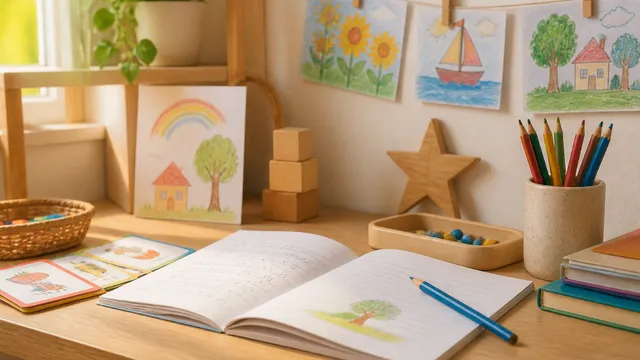
Analog Toys for Kids
Explore what analog toys are, why they matter for development, and how to choose screen-free play that builds skills, connection, and lasting memories.
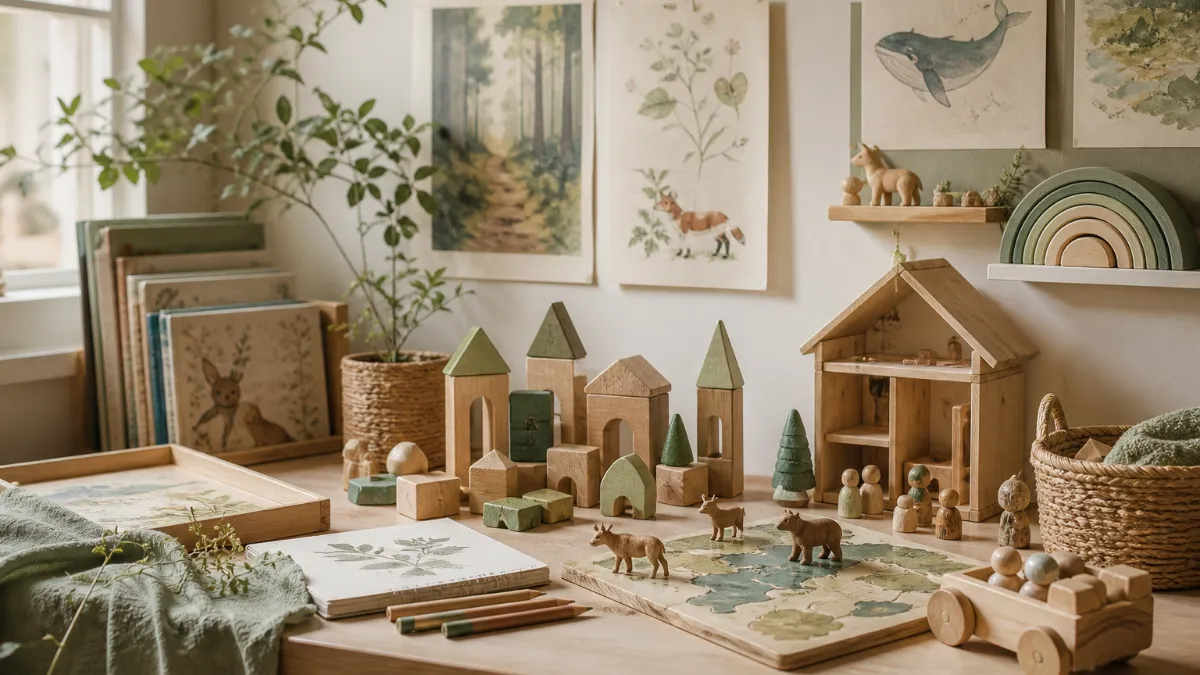
What Are Analog Toys — and Why Do They Still Matter?
Walk into any independent toy shop worth its salt and you will notice something immediately: the toys that catch the eye are quiet. There are no flashing lights demanding attention, no tinny speakers announcing the next level, no charging cables trailing across the shelf. What you find instead are wooden blocks worn smooth at the edges, a puzzle with one satisfying missing piece, a box of pastels that has been refilled twice. These are analog toys — and understanding what they are, and what they do for children, is the starting point for any thoughtful parent navigating today’s overwhelming toy landscape.
An analog toy is any toy that does not require a screen, battery-powered processor, or digital interface to function. The category is deliberately wide. It includes wooden building sets, interlocking tiles, board games, card games, jigsaw puzzles, skipping ropes, clay, watercolors, embroidery hoops, knitting kits, nature journals, and handmade keepsake books. What unites them is not their material or their price point but their relationship to the child: they are open-ended, child-directed, and focus on the process of discovery rather than rote memorization, building critical thinking, creativity, problem-solving, and genuine curiosity. The toy does not play itself. The child does.
This distinction matters more in 2026 than it ever has. The toy industry is in a phase of consolidation; after a strong focus on digital additions and hybrid play concepts, classic analogue play is once again taking centre stage, with vehicles, figures, board games, and haptic construction systems regaining importance. The shift is not merely nostalgic. Retail partners report stable demand for durable products with clear game mechanics, and parents are placing greater emphasis on quality, materiality, and long-term usability. The analog toy resurgence is a values-driven choice, and parents are making it with increasing intention.
The Research Case: What Analog Play Actually Does for Children
Parents have long sensed that a simple wooden train set produces something richer than a battery-operated version ever could. The research now gives that instinct a precise language.
A study surveying 306 parents of preschool children found that parents perceived traditional toys as the most stimulating for a toddler’s sensory, motor, cognitive, and socio-emotional development, and that during analogue play, significantly more parent–child interaction, as well as more language input from parents and toddlers, occurred. That finding is not a minor footnote — it describes a fundamentally different quality of childhood experience. When a child and a parent sit over a puzzle or a craft kit, the toy becomes a shared stage for conversation, negotiation, and discovery. When a screen or a pre-programmed device enters the picture, that dynamic shifts. An observational lab study examining how parent-child pairs responded to tablet apps compared to analog toys found that parents and children were less likely to engage with each other or to respond to each other’s bids for attention during tablet play sessions versus toy play sessions.
When children engage in analog play — building with blocks, drawing, running outside, making up stories with toys, working with clay — their brains are doing remarkable things, and understanding the neuroscience of play helps parents see that this is not just about nostalgia: it is about building the actual architecture of a child’s brain.
Research shows that free, unstructured play — the kind where children make their own rules and solve their own problems — is one of the most powerful drivers of prefrontal cortex development, the region responsible for decision-making, impulse control, and empathy. Studies show that play-based learning has a positive impact on children’s cognitive, language, social, emotional, and physical growth while fostering engagement and motivation. The implications for the family toy shelf are clear: choosing analog is not about depriving children of technology but about protecting and cultivating the kinds of play that technology cannot replicate.
The Spectrum of Analog Toys for Ages 5–12
One of the most liberating things about analog toys is how wide the category truly is. Parents who picture it narrowly — perhaps as wooden educational toys for toddlers — miss the rich, age-spanning world available to children from five to twelve. Here is how that world breaks down across a few key categories.
Building and Construction
Interlocking tiles, magnetic blocks, wooden planks with notches, and open-form construction systems all belong here. Their power lies in scalability: a five-year-old builds a wobbly tower and a twelve-year-old engineers a functioning bridge from the same box of materials. Research indicates that these toys facilitate various aspects of children’s development, with pretend-play toys in particular promoting vocabulary growth, narrative skills, emotional expression, and symbolic thinking. Construction play is rarely silent — it narrates itself, inviting storytelling and collaborative problem-solving alongside the building.
Board Games and Card Games
Board games are one of the most underrated categories in the analog toy world. A well-chosen game teaches rule-following, strategic thinking, patience, and how to lose gracefully — none of which a screen delivers with the same social texture. Games designed for the 5–12 range grow meaningfully in complexity, from cooperative games that teach shared strategy to competitive games that introduce probability and planning. The around-the-table ritual is, itself, the point: analog games create the conditions for conversations that would never otherwise happen.
Art Materials and Craft Kits
Watercolors, colored pencils, embroidery sets, origami paper, knitting needles, lino-cutting tools for older children — the art and craft category is among the most developmentally rich available. The best educational toys enable development across cognitive skills like logic, memory, and problem-solving; creative skills where imaginative play and artistic expression unlock innovation and curiosity; and motor skills involving fine and gross coordination needed for both learning and physical activity. A child who works with their hands is developing all three simultaneously. Craft kits that graduate in difficulty — simple weaving at six, more complex textile work at ten — honor the fact that children are not static; they want to be challenged, and analog materials meet that challenge without a software update.
Nature and Outdoor Play
Magnifying glasses, bug-catching kits, field journals, seed-growing sets, and pressed-flower books all sit comfortably in the analog category. This corner of the toy world is especially important for the 5–12 age group, who have the physical capability and the burgeoning curiosity to engage with the natural world in structured, purposeful ways. A nature journal in which a child sketches and labels what they find on a walk is simultaneously a science tool, an art object, and a record of a childhood spent noticing.
Keepsake Books and Friendship Records
This is the category that tends to surprise parents — the idea that a book can be a toy. But for children ages 6–12, a beautifully illustrated, fill-in friendship book functions exactly as any other analog toy does: it invites creative participation, produces something tangible, and deepens in meaning the more it is used. Unlike a building set that eventually gets disassembled or a craft kit that runs out of supplies, a friendship keepsake book is cumulative. Every page filled adds to its value. Every friend who writes in it makes it more irreplaceable.
Why the Best Analog Toys Grow With the Child
The single most important quality to look for when choosing an analog toy is not whether a child will enjoy it now, but whether the toy will be more valuable to them in two years than it is today. This is the axis on which analog and digital toys diverge most sharply.
A pre-programmed toy has a ceiling. Its interactions are fixed by software, and a child will exhaust them. An open-ended analog toy has no ceiling, because the child’s own growing capability is the variable. One of the most defining toy trends right now is not about novelty or hype — it is about investing in fewer, better-designed products that support how children actually grow, with parents choosing play essentials that feel intentional and look beautiful.
Puzzles illustrate this perfectly. A 100-piece puzzle at age six becomes a 500-piece puzzle at age nine and a 1,000-piece puzzle at age eleven — the skill, the patience, and the satisfaction all scale together. Board games follow the same curve: the child who once needed constant guidance to follow the rules becomes the child who teaches the rules to younger cousins. Art materials deepen as technique accumulates. And friendship keepsake books become more layered with every year of childhood, capturing not just a moment in time but the whole arc of a child’s social world — who their friends were, what they cared about, how they expressed themselves in handwriting that will never look quite like that again.
As a counterpoint to digital innovation, “Creative Mindfulness” has been identified by international toy industry experts as a key trend, focusing on creative approaches toward mindful experiences — precisely what the best analog toys, chosen thoughtfully, are designed to deliver. The toy shelf that grows with the child is not an accident. It is built deliberately, one considered choice at a time.
Building an Intentional Analog Toy Shelf
There is no formula for the perfect toy shelf — every child is different, and so is every family. But there are a few principles that thoughtful parents return to again and again.
Fewer, better. Keeping 15–20 toys accessible and storing the rest, then rotating every 2–3 weeks, allows children to engage more deeply with each item rather than skimming across a crowded room. Abundance, paradoxically, produces boredom.
Prioritize open-ended over single-use. A set of watercolors produces infinite paintings. A kit that produces one specific craft object — however appealing — is done once it is finished. Open-ended materials reward re-engagement because the possibilities genuinely are not exhausted after the first afternoon.
Choose things that invite togetherness. The research on parent–child interaction during analog play is consistent: the toy that brings two people together around a shared task is doing more developmental work than the toy designed to keep one child occupied alone. Board games, collaborative building, and friendship activities all qualify.
Buy for the child they are becoming, not just the child they are. A slightly ambitious puzzle, a craft kit with a skill ceiling above their current level, a friendship book they will grow into — these choices respect the child’s capacity for growth and make the toy shelf a place of aspiration rather than mere comfort.
Include at least one keepsake. The toy that children return to for decades is rarely the most exciting thing under the Christmas tree. It is the thing that holds memory. A beautifully made book, a handcrafted object, a journal filled with handwriting — these are the items that end up in boxes marked “keep” when a childhood bedroom is eventually cleared.
Friendship as an Analog Category of Its Own
There is a moment in middle childhood — somewhere around age seven or eight — when friendship becomes the most important thing in a child’s world. The social currency of this age is enormous: who is your best friend, what do they like, do they think about you the way you think about them? Children at this age are doing the serious developmental work of forming identity through relationship.
Analog toys that honor this work are among the most meaningful choices a parent can make. A friend book — the kind where each friend fills in their own pages with handwritten answers, drawings, favorite things, and personal messages — captures the social world of childhood in a form that no photograph or screenshot can replicate. The handwriting is irreplaceable. The drawings are irreplaceable. The fact that a real person sat with a real pen and thought about what to say is irreplaceable. Pretend-play and social toys promote vocabulary growth, narrative skills, emotional expression, and symbolic thinking — and a friendship book, at its best, does all of these things at once while also producing a record of those bonds that the child will carry into adulthood.
This kind of book has deep historical roots. The album amicorum — Latin for “book of friends” — is a predecessor of the modern autograph book; the tradition dates back to the sixteenth century, and particularly among students, these books were filled with poems, citations, sketches, or paper cuts as a token of friendship.
In a friendship book, two or more people vowed each other their friendship through filling out a page in the other person’s album, often during special occasions or on departure from a place of study, with the entry renewed during reunions — and therefore the friendship book created the opportunity to have a lifelong memory of the book-owner’s childhood friends. The modern illustrated Friend Book inherits that spirit entirely: not a diary kept in private, but a collaborative keepsake assembled by the whole circle of friendship, one handwritten page at a time.
The Toy That Captures Friendship Itself
The right analog toy does something that no algorithm can: it makes a child the author of their own childhood. A puzzle solved, a painting made, a board game won and lost gracefully, a friendship book filled with the handwriting of every person who mattered at a particular age — these are not just activities. They are the substance of a childhood remembered.
If you are building a toy shelf that reflects the values of slow, connected childhood — one that grows with your child rather than aging out of relevance — analog toys are the foundation. And within that foundation, there is a category that deserves particular attention: the keepsakes that hold not just skills or moments but relationships. Just as the right puzzle becomes the one a family returns to on rainy Sundays for years, the right friend book becomes the object a child reaches for whenever a new friend arrives in their life and they want to mark the beginning of something important.
A beautifully illustrated Friend Book — crafted to be filled over years rather than consumed in an afternoon — sits at the intersection of analog play, creativity, and lasting friendship. It is the analog toy that captures friendship itself, and it is the kind of keepsake thoughtful parents, grandparents, and gift-givers will want to explore when they are looking for the gift that genuinely lasts.
Will a Child Used to Screens Actually Play With Analog Toys?
The resistance is real, and you should expect it. A child who has spent significant time with screens has been trained to expect immediate, reactive stimulation: tap here, something happens; swipe there, something new appears. An analog toy does not offer that loop. It offers something different — the child’s own creativity as the engine — and that shift takes a moment to recalibrate.
What the evidence consistently shows, however, is that this recalibration happens faster than most parents anticipate. As digital life speeds up, families are choosing tech-free toys that help them power down and reset, and the Cozy Culture trend reflects a growing fondness for low-tech and no-tech play experiences that help families counterbalance constant digital stimulation and overstimulation. The children following this shift are not suffering. They are discovering something that screens structurally cannot provide: the experience of being the author, not just the audience.
The practical key is availability without pressure. Families are prioritizing longer stretches of play without switching activities every few minutes — screen-free fun in 2026 is not louder, it is deeper. Place open-ended analog toys where children can reach them without asking, step back, and resist the urge to demonstrate or instruct. Open-ended materials that invite a child’s own creativity — rather than prescribing a specific outcome — win children over fastest because there is no way to do them wrong.
Art supplies, building materials, craft kits, and friendship books all share this quality. A blank page in a friend book is an invitation, not a task. When a child’s best friend picks up the pencil and starts filling in their favorite things, the book becomes something no screen can replicate: evidence of a specific person, at a specific moment, that will never exist exactly that way again.
Analog vs. Digital Toys: Where Digital Genuinely Delivers
To be honest about this comparison, the picture of digital and technology-enhanced toys isn’t uniformly negative — and parents who dismiss them entirely miss real value. Studies show that programmable robots, coding toys, and interactive electronic toys can enhance engagement, creativity, computational thinking, and problem-solving skills in children. For children who struggle to sustain attention with open-ended play, a well-designed digital toy can provide scaffolding that keeps them engaged long enough to access those deeper skills.
“Smart” toys with digital additions — wireless-networked sensors or companion software — may better aid in the development of children’s attributes of storytelling, problem-solving, collaboration, empathy, and spatial, computational, symbolic, and emotional thinking. Technology-enhanced toys also offer something that traditional toys sometimes don’t: a low cost of failure. A child experimenting with a coding toy can try, fail, reset, and try again without losing game pieces, breaking components, or disrupting a sibling’s carefully arranged scene. That iterative freedom is genuinely valuable for building resilience and a growth mindset.
The honest takeaway is that “analog good, digital bad” is too blunt a tool. Digital toys can scaffold learning, sustain engagement for diverse learners, and even support certain types of collaboration — particularly in STEM contexts. Technology-enhanced toys offer additional opportunities for young children to engage in meaningful, self-directed exploration of STEM ideas, fostering engineering habits of mind, creative problem-solving, computational thinking, and early scientific inquiry. Parents who thoughtfully include digital tools in a child’s play diet aren’t making a mistake. The question is what those tools are being asked to do.
The “Fewer, Better” Principle: What the Research Actually Shows
This is the part most parents resist, because it runs counter to every gift-giving instinct. But the evidence is striking. A study from the University of Toledo found that “an abundance of toys present reduced quality of toddlers’ play” — having fewer toys led children to focus and engage in more creative, imaginative play, and ultimately resulted in deeper cognitive development. The study placed toddlers in two conditions: four toys, or sixteen. With fewer toys, participants had fewer total incidences of switching, longer durations of sustained play with each toy, and played with them in a greater variety of ways — suggesting that fewer options allow children to engage more deeply and more creatively with what they have.
Research shows that children surrounded by too many toys experience shorter attention spans, sensory overload, and difficulty engaging in deep imaginative play — too many options trigger decision fatigue, leading to restless flitting between toys rather than focused exploration, which undermines brain development during critical early years when children need sustained focus to build problem-solving skills and creativity.
The practical implication: a thoughtfully edited analog shelf of 12–15 items outperforms a room overflowing with toys. This is not deprivation — it is curation. With fewer options, children are more likely to focus and develop mindfulness, allowing for deeper engagement in playtime, and they also become better at repurposing and combining toys — finding new uses and stories in what they already own. The shelf becomes a place of genuine possibility rather than a catalogue no one reads.
A useful system is toy rotation: keep 12–15 items accessible and store the rest out of sight, swapping in a few new-to-them items every few weeks. A crowded toy shelf can make good toys disappear in plain sight — many children play better when they can see fewer choices clearly, and that is exactly where rotation helps.
What a Keepsake Toy Actually Does Differently
Most toys are designed around the experience of play: the building, the racing, the stacking, the imagining. Keepsake-quality analog toys do something more. They produce an output — a finished thing the child owns, can point to, can show a grandparent, can find in a box at twenty-five and immediately remember. That output is the toy’s second life, and it’s the part that actually lasts.
The materials matter here, too. Environmental consciousness, educational value, and a preference for durable, heirloom-quality toys are driving parents toward natural and sustainable materials. Wood, cotton, paper, ceramic, and natural fiber communicate permanence in a way that plastic simply cannot. When a child handles something made from real materials, they tend to treat it as real — carefully, with attention. That instinct is worth cultivating.
In 2026, there is a growing interest in play that inspires creativity and celebrates self-expression, with many parents treating play as a conscious reset — a screen-free space for emotional regulation, creativity, and connection. The result is a surge in demand for toys that feel intentional, calming, and human-centered. A keepsake toy sits at the center of that impulse: it is intentional by design, because its whole point is to produce something that outlasts the afternoon.
Where Things Stand
Analog toys are having a moment as families look for screen-free play in 2026. Parents are putting more weight on quality, materials and toys that last, and the research case for open-ended, play-based learning continues to build. The broader trend toward fewer, better toys shows no sign of slowing.
See Related below for more on this topic.
For further reading, see the Sources listed below.
Frequently asked questions
What exactly counts as an analog toy?
An analog toy is any toy that does not require a screen, battery-powered processor, or digital interface to function. This includes wooden building sets, board games, puzzles, art supplies, craft kits, jump ropes, and handmade keepsake books. The defining quality is that the play experience is driven entirely by the child's own imagination, physical interaction, and social engagement — not by pre-programmed responses or digital feedback.
At what age should I introduce analog toys, and how do I keep kids engaged as they grow?
Analog toys are appropriate from infancy, but for children ages 5–12 — the sweet spot this guide focuses on — the key is choosing toys that grow with the child. Puzzles increase in complexity, art materials allow for more sophisticated expression, board games introduce deeper strategy, and keepsake books like friendship journals become richer as a child's social world expands. Rotating what's accessible and introducing something slightly ambitious every few months sustains curiosity and engagement across the years.
How do analog toys support social development differently from digital play?
Research consistently shows that significantly more parent–child verbal interaction occurs during analog play than during digital play, and that children engage in richer back-and-forth communication when toys are physical and open-ended. Analog toys also invite cooperative and imaginative play with peers — building negotiation, empathy, and shared storytelling — in ways that pre-programmed digital experiences rarely can. A friendship keepsake book, for example, transforms the social act of making friends into a tangible, lasting record of those bonds.
How is a Friend Book different from an ordinary journal or diary?
A Friend Book is not a private record kept by one child, but a collaborative keepsake that travels between friends. Each friend fills in their own pages: handwritten answers, drawings, favorite things, and personal messages. The result is a one-of-a-kind collection of handwritten voices that can never be recreated digitally. Unlike a diary, it is inherently social and grows more meaningful over time as the friendships it captures deepen — making it one of the rare analog toys that becomes more valuable with every passing year.
How many toys should be on an analog toy shelf at one time?
Research suggests that fewer toys lead to deeper, more creative play. Aim to display 12–15 items at most, rotating a third of your collection in and out every few weeks so the shelf always feels fresh without overwhelming your child with choices.
What is the difference between open-ended and closed-ended analog toys?
Open-ended toys — like building blocks, art materials, and blank sketchbooks — have no single 'correct' outcome, so children direct the play themselves. Closed-ended toys have a fixed goal (a puzzle with one solution, for example). A good analog shelf includes mostly open-ended items, with a few closed-ended ones to build focus and problem-solving.
Related
Sources
About the author

VP Content
Dori Fussmann leads Album Amicorum, an independent studio behind an illustrated Friend Book that children fill in by hand — turning the notes, drawings, and small messages of childhood friendships into a keepsake worth keeping. His background is in building consumer brands, and he started writing here out of a conviction that the memories that matter most belong off-screen. These articles draw on child-development research and the work of experts such as Jonathan Haidt.