Friendship Book for Kids
Discover what a friendship book for kids really is, why it matters, and how to choose a beautifully illustrated keepsake your child will treasure for life.
There is a moment most parents recognise, even if they cannot quite name it — the last week of term, a birthday party winding down, a child’s class photo being signed in a rush. It is the moment when a whole world of friendship is about to scatter, and the only thing equal to it would be something that could hold it still. A friendship book for kids exists precisely for this moment. Not a storybook, not a diary, not a printed album: something richer, more alive, and more irreplaceable than any of those things.
This guide explains what a friendship book really is, where it comes from, why it matters more now than it has in decades, and how to choose one that will genuinely last. If you are a parent, grandparent, or gift-giver wondering whether this is the right thing — it is. You just need to know what you are looking for.
What Is a Friendship Book for Kids — Really?
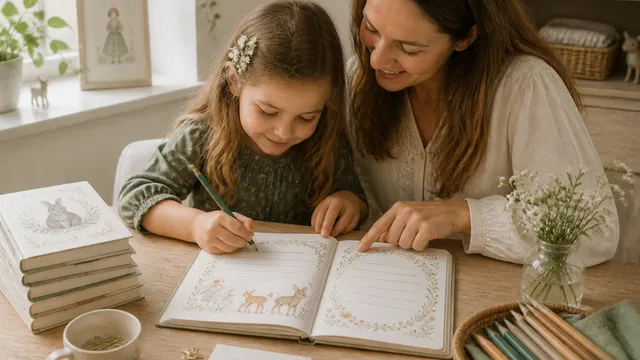
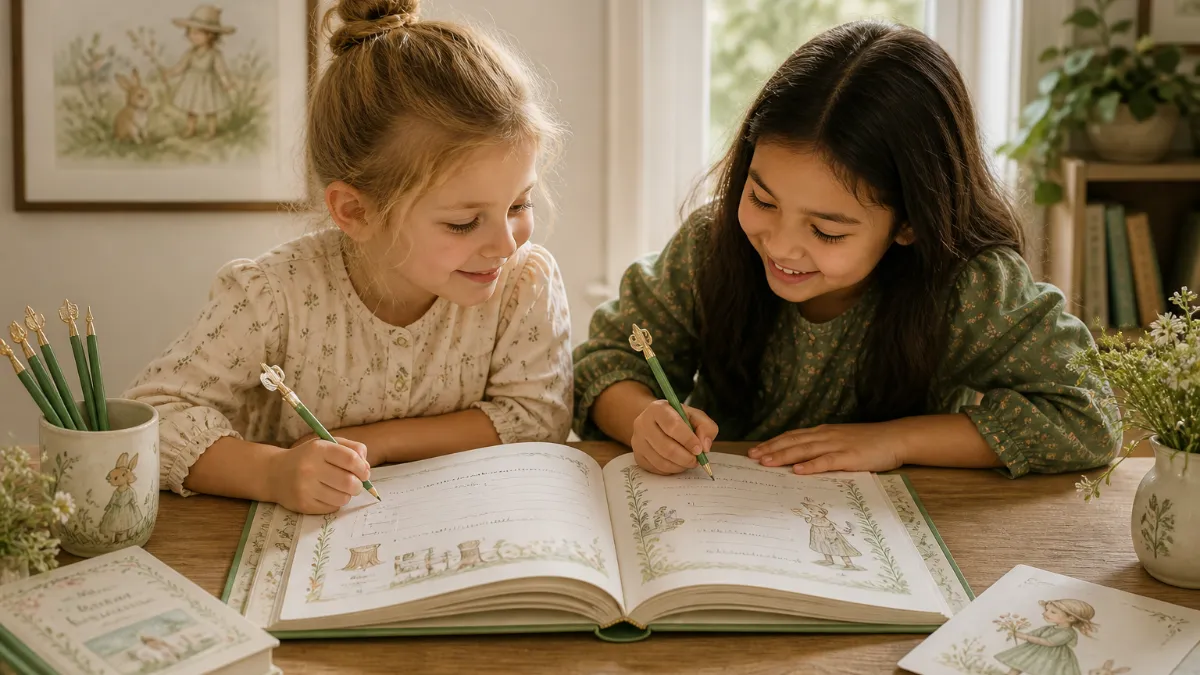
The simplest definition is also the most important one: a friendship book for kids is an interactive keepsake that a child passes around to their friends, who each fill in their own pages. Each friend might share their favourite colour, their most treasured memory, a quick drawing, or a handwritten message. The child collects these responses, and what they are left with is a one-of-a-kind record of real friendships at a real moment in time.
This is categorically different from a storybook (which a child reads) or a personal journal (which a child writes alone). A friendship book is social by design. It depends on other people — and that is precisely where its power comes from. The handwriting is real. The inside jokes are genuine. The wobbly drawings are irreproducible. Long after the school year ends and classmates drift to different schools, different towns, and different lives, those pages are exactly as they were.
It is also worth distinguishing a well-made friendship book from the fill-in-the-blank novelty versions sold in large quantities online. Those books often feature generic prompts presented in bland templates, printed on paper thin enough to bleed through with any pencil pressure. They are disposable by nature — inexpensive enough that no one treats them with care, including the friends filling them in. A genuinely beautiful friendship book, by contrast, signals to every child who holds it that what they are being asked to contribute matters.
A Centuries-Old Tradition, Renewed
The idea of gathering the words, drawings, and signatures of friends into a dedicated book is not a modern invention. The album amicorum (literally “album of friends”) traces its origins to the 16th century, when it emerged as a way to collect autographs and inscriptions.
Particularly among university students, these books were a living tradition well into the 19th century: friends would fill each other’s pages with poems, citations, sketches, or paper cuts, and sign them.
Friendship books were first used by students from Northern Europe in the early sixteenth century to commemorate the cities they visited and the people they encountered during their education. Early on, the books were all prepared by hand — a small illustration would be commissioned from a local artist or workshop and inserted into the book alongside a friend’s signature and a passage of text. The results were objects of genuine beauty, and their owners treated them accordingly.
The primary function of a friendship book was, at its core, to record and confirm relationships across time and distance for posterity. That purpose has not changed. What has changed is the scale of the audience: where the album amicorum once circulated among scholars and nobles, the friendship book for kids today belongs to every child who has ever wanted to hold onto something real before the school year ends and the world moves on.
These books often marked the beginning of a new stage in the bearer’s life — even, for one documented example, an impending emigration from one country to another, during which a young woman circulated her album among family and friends who would stay behind, their entries expressing hope that love and friendship would prevail across great distances. The emotional weight carried by these objects has always been out of proportion to their physical size. A well-made friendship book does not just record — it preserves.
Why a Handwritten Keepsake Cannot Be Replaced by Digital Alternatives
It might seem strange, in a world of instant messaging and shared photo albums, to argue for a handwritten book. But the argument is not really about nostalgia. It is about what a physical, handwritten record can do that a digital one cannot.
A screenshot of a conversation can be deleted. A social profile can be taken down. A photo album app can disappear with a subscription lapse. A handwritten page, on the other hand, cannot be revised after the fact. The handwriting is exactly as it was on the day a friend sat down and filled in their page. The hesitation marks, the doodles in the margins, the signature that trails off at the end — these things are uniquely, irreversibly real.
There is something else at stake, too. Families are increasingly aware of how much of childhood now happens on screens, and the growing shift towards a more balanced, low-screen lifestyle (part of what observers are calling the analog childhood trend) is reshaping what thoughtful parents are choosing to give their children.
A friendship book sits naturally at the centre of this shift: it requires no device, no Wi-Fi, no charging. It asks only for a pencil and a friend.
Unlike digital alternatives or mass-produced fill-in journals, a beautifully illustrated friendship book becomes a one-of-a-kind artifact. No two copies are ever the same, because the people who write in them are irreplaceable — and that fact alone gives the book a significance that no digital equivalent can match.
What to Look For When Choosing a Friendship Book
Not all friendship books are created equal. There are four things worth examining carefully before choosing one.
Illustration Quality and Overall Design
The design of the book sends a message to every child who receives it. A book with thoughtful, original illustration — one that feels like it was made with care rather than assembled from clip art — tells the child that what they are being asked to write matters. It elevates the whole experience, from the moment the book is presented to the moment a friend opens it and realises they want to do their page justice.
Look for books where the design feels cohesive: where the illustrations complement the prompts, where there is visual breathing room on each page, and where the overall aesthetic rewards looking at it closely. This is the book that will sit on a shelf for decades. It should be beautiful enough to deserve that place.
Prompts That Invite Genuine Self-Expression
The quality of the prompts determines the quality of what gets written. Prompts that ask for a favourite colour or a favourite food are a start, but the best friendship books invite something more: a favourite memory with the book’s owner, a drawing of something they love, a message they want to leave behind. In a friendship book, two or more people pledge their friendship through filling out a page in the other person’s album — and this has traditionally taken place during special occasions, like festivities or on the departure from one’s place of study. The best prompts honour that spirit: they ask friends to be present, to think, to mean it.
Avoid books where the prompts feel like data collection — tick-boxes, rankings, or multiple-choice answers. A friendship book should invite a drawing, a sentence written in a child’s own words, a signature that belongs to no one else. The more the prompts leave room for genuine self-expression, the more the finished book will feel alive.
The quality of the prompts determines the quality of what gets written. Prompts that ask for a favourite colour or a favourite food are a start, but the best friendship books invite something more: a favourite memory with the book’s owner, a drawing of something they love, a message they want to leave behind. In a friendship book, two or more people pledge their friendship through filling out a page in the other person’s album — and this has traditionally taken place during special occasions, like festivities or on the departure from one’s place of study. The best prompts honour that spirit: they ask friends to be present, to think, to mean it. Think of it like the difference between signing a generic birthday card and writing a personal letter — the effort shapes how much the moment is remembered. Avoid books where the prompts feel like data collection — tick-boxes, rankings, or multiple-choice answers. A friendship book should invite a drawing, a sentence written in a child’s own words, a signature that belongs to no one else. The more the prompts leave room for genuine self-expression, the more the finished book will feel alive.
Paper Quality
This is often overlooked, but it matters enormously. A child filling in a friendship book will most likely use coloured pencils, felt-tip pens, or ballpoint pens. Paper that is too thin will bleed through, destroying the page behind it and discouraging careful work. Look for paper with enough weight and tooth to take pencil and coloured pencil cleanly — this is the physical foundation of everything the book is meant to preserve.
A Format That Grows with the Child
The ages of five through twelve represent an enormous developmental span. A book designed only for the youngest end of that range will feel babyish to a ten-year-old; one pitched too old will be inaccessible to a six-year-old’s friends. The best friendship books are designed to work across this range — with prompts open-ended enough that a Year 1 child and a Year 6 child can both respond meaningfully, and with enough pages to collect a genuinely rich circle of friends over time.
The Perfect Occasion — and Why Timing Matters
A friendship book is not an everyday gift. It is, at its best, a gift given at a threshold moment — a point in childhood when the circle of friends around a child is vivid, present, and about to change.
The most natural occasions are school transitions: the end of a school year, the move from primary to secondary school, a change of class or a family relocation. These are the moments when children feel most acutely the desire to hold onto something before it passes. But a friendship book is equally powerful as a birthday gift — particularly for a child who has recently moved or started at a new school and is building a new circle of friends. End-of-year class parties, farewell gatherings, and the last day before a long summer are all moments when passing a book around can feel like the most natural thing in the world.
The underlying principle is this: a friendship book is most powerful when the friendships it is designed to capture are actively present. Give it before the summer scatters everyone. Give it at the party, or the last week of term, or the moment when a child’s world is full of the friends who will one day be the faces on those pages. The urgency of the moment becomes part of the book itself.
Why Beautifully Illustrated Books Create Lasting Keepsakes
There is a difference between a book a child keeps and a book a child treasures. The difference is almost entirely in the making: in the care that went into the design, the quality of the materials, the sense that the object itself was meant to matter.
Heritage-quality children’s products hold emotional resonance rooted in early childhood memories, and parents place particular trust in items that feel safe and familiar — comforting and reassuring rather than disposable. A beautifully illustrated friendship book operates on exactly this register. It does not need to compete with a screen for attention. It offers something a screen can never provide: the weight of a real object, the texture of real paper, and the irreplaceable handwriting of a real friend.
This is also why illustration quality is inseparable from the keepsake function. When a book is beautiful to look at, children take more care filling it in. Friends slow down. They think about what to write. They make their drawing a little more carefully. The beauty of the object shapes the quality of what goes into it — and the quality of what goes into it is the whole point.
There are thoughtful options across a range of makers in this space. Some focus on prompted journals for children; others, like Promptly Journals and Artifact Uprising, have built reputations in the broader keepsake category. Life Is Better With Friends and My Friendship Books address the friendship book niche more directly. On Etsy, independent sellers offer handmade and printed versions in the “vriendenboekje” tradition — the Dutch term for the same centuries-old format — with enormous variation in quality. What unites the best options, wherever they come from, is the same thing: care in the design, honesty in the prompts, and paper that holds up to the enthusiasm of a child with a pencil.
From Tradition to Treasure: Bringing It Home
The album amicorum tradition survived for centuries not because anyone legislated it, but because human beings recognised something true in it: that the people who know us at a particular moment in time are irreplaceable, and that having a record of them — in their own words, in their own hand — is worth more than any photograph. When you are ready to begin, here is how to start a friendship book step by step.
A friendship book for kids carries that same recognition forward into childhood, at the exact age when friendships are being formed for the first time, when the world is widening, and when the people a child knows at school genuinely matter in ways they will not always be able to articulate until years later. The child who receives a beautifully illustrated friend book and fills it with real contributions from real friends is not just doing a fun activity. They are building something that will outlast the school year, the primary years, and possibly every other object from this period of their life.
If you are looking for a friendship book that honours the full weight of that idea — one that is beautifully illustrated, thoughtfully prompted, and made to be treasured for decades — Album Amicorum’s My Friends Book is worth exploring. It was designed with precisely this moment in mind: the moment when a child’s circle of friends deserves to be captured, preserved, and handed down. Discovering a book that is equal to that moment makes all the difference.
How Friend Books Compare to Similar Products
The children’s keepsake market is broad, and several strong brands serve adjacent needs. Understanding how a dedicated Friend Book differs from what else is available helps parents and gift-givers find exactly the right thing.
Promptly Journals produces beautifully designed childhood history journals that parents fill in on behalf of their children, capturing milestones and memories from pregnancy through age 18. Their bestselling childhood history journals feature tailored prompts for every phase and year of a child’s development. These are written about a child, primarily by a parent — a fundamentally different object from a Friend Book, which is written by a child’s friends. Both are valuable; neither substitutes for the other.
Artifact Uprising and Rifle Paper Co. represent the premium end of beautifully crafted children’s keepsakes and illustrated books, with an emphasis on design quality and aesthetic refinement. They serve an audience that values craft and permanence — the same audience drawn to a well-made Friend Book — but neither offers the interactive, co-authored format that defines the category.
Duncan & Stone occupies a similar space to Promptly, with prompted journals and milestone books designed for parents to fill in for or with their children. Again: a wonderful product for a different purpose.
Life Is Better With Friends and My Friendship Books offer friendship book formats aimed directly at children, and represent the closest conceptual cousins to an illustrated Friend Book in the English-language market. The degree to which any given product in this space reaches the heirloom standard — in illustration quality, paper, binding, and prompt depth — is where meaningful differences emerge.
Etsy sellers offering vriendenboekje and Freundebuch formats give buyers access to the rich European tradition, often at accessible price points, with enormous variation in quality and durability. Scribble & Dot brings a design-led sensibility to children’s creative products, with a similar audience of parents who prioritize aesthetics and craftsmanship.
The category these brands collectively serve is real and growing. What is rarer is the product that combines the heirloom quality of Artifact Uprising, the interactive format of the Freundebuch tradition, and the illustrated beauty that signals to a child — from the moment they first hold the book — that their friendships deserve this.
What Do Kids Actually Write Inside a Friendship Book?
This is the question that matters most, because it determines whether the book gets used or sits untouched. The answer depends almost entirely on one design decision: are there prompts, or is the page blank?
A blank page is one of the most paralyzing things you can hand a child and say “write something about yourself.” Even adults find this hard. What do I say? How much is enough? Will it sound stupid? A page without guidance produces hesitation, and hesitation produces a book that never gets filled.
Prompted pages remove all of that. When a friend opens a well-designed friendship book, they find questions that are specific, low-stakes, and genuinely fun to answer: What is your favorite food right now? Draw a picture of something you and the owner of this book both love. Write one word that describes your friendship. What’s something silly that only the two of you know about? These questions do not require eloquence — they require honesty, and children are extraordinarily good at that.
The Prompts Do the Work — That’s the Point
The practical genius of a prompted friendship book is that it removes the social burden from both the child asking and the child answering. Nobody has to figure out what to say. Nobody feels put on the spot. The structure is generous in a way that blank pages can never be.
What emerges across those prompted pages (once several friends have each filled one) is something richer than any single entry: a portrait of a child’s world, assembled from the people who actually inhabit it. The combined record of favorite colors, earnest drawings, inside jokes, and private messages becomes something no parent could have planned or assembled from the outside. It grows entirely from the children themselves, which is exactly what gives it lasting meaning.
Where Things Stand
The cultural backdrop for friendship books has grown stronger in 2026. The ‘analog childhood’ trend has families seeking screen-free, tactile experiences for their children, and that appetite extends to the keepsakes and gifts they choose. Handwritten, beautifully made objects are finding a larger audience than they have in years.
See Related below for more on this topic.
For further reading, see the Sources listed below.
Frequently asked questions
What age is a friendship book suitable for?
Most friendship books for kids are designed for children aged 5 to 12, covering the years from early primary school through to the end of elementary age. This range captures the window when friendships are forming most vividly and children are old enough to write, draw, and express themselves meaningfully on a page. Look for books that work across the full range — with open-ended prompts and space for drawings — so the book can grow alongside a child and remain relevant whether they are six or eleven.
How is a friendship book different from a regular journal or diary?
A diary or journal is written by one person, for themselves. A friendship book is passed between friends, each of whom fills in their own pages — adding their handwriting, drawings, favourite things, and personal messages. The result is a living, multi-voiced record of a child's real friendships, not a private log of their own thoughts. That social, collaborative dimension is what makes a friendship book irreplaceable: no two copies are ever the same, because the people who fill them in are unique.
When is the best time to give a child a friendship book?
The most meaningful moments tend to be school transitions — starting a new year, moving to a new school, or finishing primary school. But birthday celebrations and end-of-year class parties are equally good occasions, as they naturally gather the circle of friends who will fill the book. The underlying principle is simple: give it when friendships are at their most vivid and before time moves everyone along.
What should I look for when choosing a friendship book for kids?
Look for four things: illustration quality that makes the book feel genuinely special (not a mass-market photocopied template); prompts that invite real self-expression — favourite things, drawings, memories, and messages — rather than simple tick-boxes; paper quality thick enough for coloured pencils without bleed-through; and a format broad enough in age range to remain relevant as the child grows. A beautifully designed book also signals to the child that the friendships being preserved matter, which shapes how carefully their friends treat the pages.
How is a Friend Book different from an autograph book?
An autograph book collects only signatures — a name, a date, a quick note. A Friend Book goes much deeper: each friend fills in their own dedicated page (or spread) with handwritten answers to prompts, drawings, favorite things, and personal messages to the book's owner. The result is a layered, illustrated portrait of every friendship at a precise moment in time, not just a list of names. That depth is what transforms a Friend Book from a novelty into a genuine keepsake.
How long does it typically take to fill a friendship book?
There is no set timeline, and that is part of what makes a friendship book so different from a school project. Some children pass their book around eagerly over a few weeks at the start of a school year; others add a page at a birthday party, a sleepover, or after a holiday gathering. The book grows alongside the child's friendships, which means it is just as meaningful half-filled as it is complete.
Can a friendship book work for a shy child or an only child?
Absolutely. A friendship book can be especially meaningful for a child who finds open-ended social interaction harder than most. The prompts remove the guesswork — instead of asking a friend to 'say something about yourself,' the page offers a specific, manageable question. For a shy child, passing a book back and forth can feel more natural than conversation, and reading what a friend wrote creates its own quiet bond.
Related
Sources
About the author

VP Content
Dori Fussmann leads Album Amicorum, an independent studio behind an illustrated Friend Book that children fill in by hand — turning the notes, drawings, and small messages of childhood friendships into a keepsake worth keeping. His background is in building consumer brands, and he started writing here out of a conviction that the memories that matter most belong off-screen. These articles draw on child-development research and the work of experts such as Jonathan Haidt.