9 Handwriting Activities for Kids That Create a Keepsake
Published on August 27, 2026
Category: Slow Childhood & Analog Play · Tags: handwriting activities for kids, kids activities at home, childhood keepsakes, fine motor skills, screen-free activities
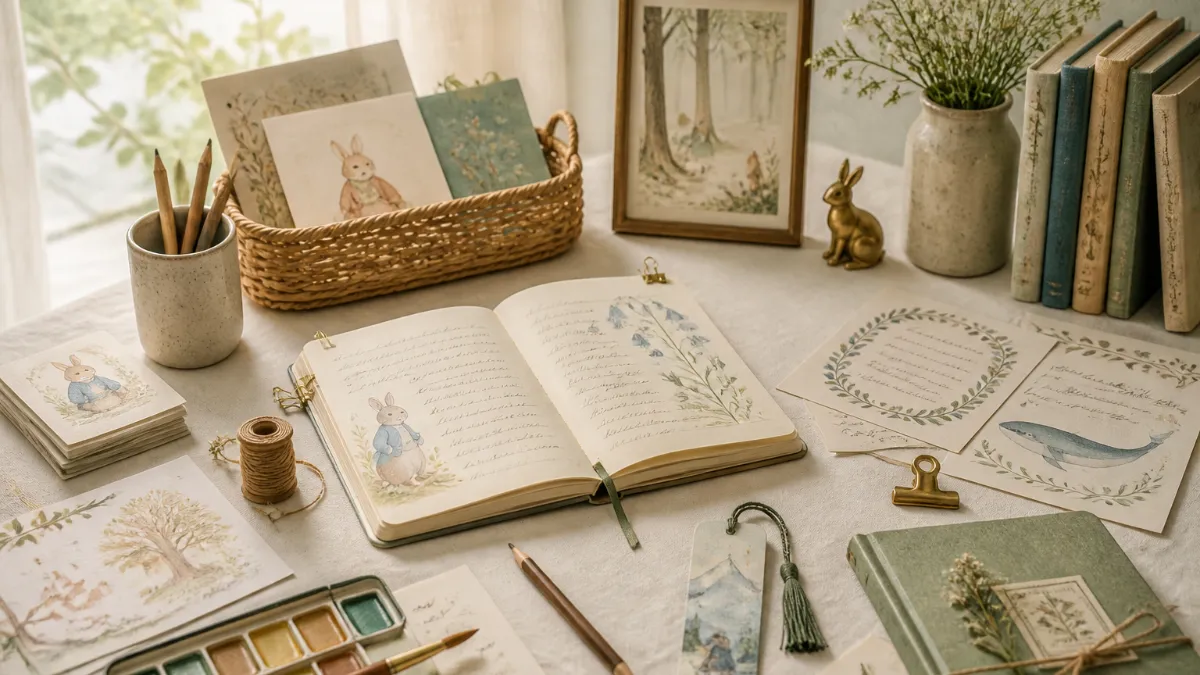
There is a particular kind of pride a child feels when they hold something they made with their own hand — a folded letter, a page of careful writing, a book full of their friends’ handwriting — and recognise it as genuinely theirs. That feeling is not an accident. It is the natural result of handwriting practice that is so purposeful, so grounded in real life and real relationships, that it stops feeling like practice at all. The nine activities below are built around that idea. Every one of them produces a tangible artefact: something the child created, gave, or kept. And every one of them builds the same fine motor control, letter formation, and cognitive engagement as a traditional drill — without a single worksheet in sight.
Why the Best Handwriting Practice Doesn’t Look Like Practice
Typing may be faster, but research shows that handwriting engages the brain in richer ways — capturing details on paper unites “fine motor skills, neuromotor processes, and multiple cognitive processes” in a way that asks children to engage more deeply with what they are writing. The implication for parents is practical: the more a child writes about something real, the more deeply those motor pathways are laid down. Drills have their place, but they will never compete with the intrinsic motivation that comes from writing for a genuine reason.
Writing by hand allows children to slow down and think through their ideas, fostering creativity, and gives kids the freedom to doodle, personalise letters, and develop their unique style. That combination — slowing down, making choices, expressing something personal — is exactly what the activities below are designed to unlock. Sensory variety also matters here. Activities like tracing letters in sand, playing with playdough, or practising with chalk outside make writing practice engaging by keeping small hands challenged and curious rather than fatigued. Rotating between different surfaces and tools is not just fun; it is genuinely good developmental practice.
The 9 Activities
1. A Friend Book
Start here. A Friend Book — a beautifully illustrated book that a child passes among their friends, each one filling a page with their favourite things, a drawing, a message, and their handwriting — is the single most complete handwriting activity on this list. It combines every element that makes practice stick: a real audience, personal expression, sensory engagement with a quality object worth caring for, and a permanent keepsake that grows more precious with every page filled.
The magic of a Friend Book lies in what it asks of a child without ever telling them it is asking anything. A child who would resist sitting down to copy sentences will spend twenty careful minutes choosing exactly the right words to write in a friend’s book, because those words will last. Every entry becomes a preserved moment — handwriting, personality, and memory sealed together on a single illustrated page. Inspired by the centuries-old album amicorum tradition, Album Amicorum’s illustrated Friend Books bring this idea home: a beautifully made object that children actually want to fill, page by page, friend by friend. It sits at the top of this list because no other activity combines purpose, audience, craft, and lasting meaning so completely.
2. Pen-Pal Letters
There is a reason pen-pal programmes have been studied in classrooms for decades. Over the course of pen-pal interventions, researchers have noted an increase in student motivation to write, with analysis of letters revealing that implementing pen pals coincided with an improvement in students’ writing skills. The mechanism is straightforward: when students’ writing activities authentically tie to their lives outside of school, their motivation greatly increases, and sending and receiving letters fits within that authentic and motivating context, because sending mail is a real-world use of student writing that is focused on building relationships.
At home, a pen-pal exchange can be as simple as pairing your child with a cousin in another city, a grandparent, or a family friend. Set a loose rhythm — one letter every two or three weeks — and let the child lead the content. The anticipation of a reply is its own teacher. Students are motivated to reread, revise, and edit their letters because someone is going to see them — a dynamic no worksheet can replicate.
3. Illustrated Thank-You Cards
Thank-you cards occupy a sweet spot between writing practice and genuine social purpose. A child who has been asked to write five words of thanks on a card will often discover, mid-sentence, that they have more to say. Encourage them to illustrate the card first — drawing the gift, the experience, or a small scene that tells the story — and then add the written message alongside. The illustration does two things: it warms up the hand before writing begins, and it gives the child something to explain in words, making the writing feel natural rather than forced.
For children who are particularly reluctant to write, starting with a postcard-sized card reduces the visual intimidation of a blank page. Giving a child blank postcards and letting them create their own designs and messages to send to family and friends is a fun, creative way to practise handwriting while spreading kindness. Keep a small stack of blank cards, envelopes, and stamps in an accessible drawer, and the activity becomes something children reach for rather than something they are told to do.
4. Recipe Copying
Ask a child to copy out a family recipe in their own hand — from a grandparent’s index card, a handwritten note, or dictated slowly by someone they love — and you have created an activity that is at once a handwriting exercise, a memory, and a future heirloom. The repetitive structure of a recipe (ingredients, then method, line by line) suits emerging writers perfectly: the format is predictable, the vocabulary is concrete, and the result has immediate, legible use.
Older children (ages 8–12) can work up to a small handmade recipe book, illustrating each page with a small drawing of the finished dish. The act of careful copying — slowing down, checking spelling, keeping lines even — builds exactly the pencil control and attention to detail that schools try to teach, but wrapped in something that feels like a gift rather than a lesson.
5. A Hand-Drawn Map
Maps are irresistible to children. Ask a child to draw a map of their bedroom, their house, their garden, their walk to school, or an imaginary world — and then label every part of it in their own handwriting. The labelling is the practice. A map of the garden will produce twenty written words naturally: pond, apple tree, gate, big rock, the hiding spot. A map of an imaginary kingdom will produce fifty.
Handwriting and reading share neural pathways, and the physical act of writing helps children develop visual and spatial awareness, fine motor skills, and hand-eye coordination. Map-making engages all of these at once, turning spatial thinking and written language into a single, deeply absorbing project. Frame the finished map and it becomes a piece of art. Store it in a memory box and it becomes a snapshot of childhood geography that will be treasured for decades.
6. Chalk on Pavement
Large-format writing — kneeling on the pavement with a fat piece of chalk, forming letters big enough to read from a window — develops the same motor patterns as small-format writing but engages the whole arm rather than just the fingers. This matters, especially for younger children (ages 4–7), because gross motor movement lays the foundation for the fine motor control that pencil grip requires.
Fun tools like chalkboards and chalk on pavement can build handwriting skills in playful ways. Prompt the writing with purpose: ask your child to chalk a welcome message for a visiting friend, write the week’s menu on the front step, or create a hopscotch grid with numbered squares they have to write themselves. The impermanence of chalk — washed away by rain — also quietly teaches children that the act of writing is its own reward, separate from the permanence of the result.
7. A Birthday Book
A Birthday Book is a notebook dedicated to one person — a sibling, a parent, a grandparent — that grows over the years. Each birthday, the child writes a new entry: a favourite memory from the past year, a wish for the year ahead, their current age and something they have just learned to do. The book is given as a gift and then returned to the child to add the next entry the following year.
The cumulative effect is extraordinary. By the time a child reaches twelve, the Birthday Book for a beloved grandparent will contain seven or eight years of handwriting — the shaky early letters of a six-year-old alongside the confident cursive of a pre-teen. It is a developmental record and a love letter at the same time. And each annual entry is motivated by the most powerful force in young writing: the knowledge that someone you love is going to read every word.
8. A Sensory Letter Tray
For younger children who are building their grip strength and letter formation from the ground up, sensory trays offer a low-stakes, high-engagement introduction to handwriting. Creating sensory writing trays filled with sand or rice encourages letter formation through tactile exploration. Pour a thin layer of fine sand, salt, or rice into a shallow tray; show the child how to trace a letter with their finger; then shake the tray smooth and start again.
Utilising playdough offers several benefits for handwriting practice — its pliable texture makes it easy to manipulate — and this hands-on exercise enables children to refine their fine motor skills while crafting letters, making it a valuable tool for preschoolers and kindergarteners to enhance handwriting in a relaxed home environment. Alternate sand tray sessions with playdough letter-building to vary the sensory input and keep engagement high. Neither activity requires any special equipment, and both can be packed away in two minutes.
9. A Story in Chapters
Ask your child to write a story — not all at once, but one handwritten chapter at a time, in a dedicated notebook, over several weeks. Give each chapter a title page. Encourage simple illustrations at the start of each new section. Set no word count requirement; some chapters will be three sentences, others will be three pages. What matters is the ritual: the notebook comes out, the pen is uncapped, and the story continues.
In a world full of distractions, handwriting requires concentration and patience, teaching kids to focus on forming letters and structuring sentences, building their attention span and discipline. A chapter book is the long game of handwriting practice — one that rewards persistence over months, not days. When the story is finished, bind the pages with a simple cover and the child holds a handmade book. There is very little in childhood that feels more like an achievement.
The Thread Running Through All of These
Look back at the nine activities above and you will notice something they all share: each one produces something. A Friend Book page, a letter in the post, a card in someone’s hands, a recipe on a kitchen shelf, a framed map, a chalked welcome on a path, a birthday entry someone will return to, a tray traced clean and traced again, a story collected chapter by chapter. None of them are drills. All of them are practice.
Paying special attention to developing your child’s handwriting skills is one of the best ways to set them up for both reading and writing success, whether they are just learning how to hold a pencil or have begun writing words and sentences. The key is choosing activities where the child is too absorbed in the what to notice the how — too busy writing a message that matters to remember they are practising anything at all.
Writing for a real audience is consistently the most powerful motivator for reluctant writers. Pen pal writing increased students’ positive self-image and confidence as they developed relationships through writing. That same dynamic — writing directed at a specific, beloved person — runs through every activity on this list, and it is why a Friend Book sits at the very top. Every page a child fills is written to someone: a friend who will read it, laugh at the favourite colour chosen, trace the signature with a finger. The handwriting is invisible as practice. It is just the way the memory was made.
If you are looking for one place to begin — one object that makes handwriting feel like something worth returning to again and again — a beautifully illustrated Friend Book is the answer. Album Amicorum’s Friend Books are designed for exactly this: to give children a reason to pick up a pen that has nothing to do with school and everything to do with the people they love. Every handwritten page becomes a keepsake no screen could hold.
Where Things Stand
Handwriting’s place in children’s education is in active, visible flux as of mid-2026, with developments arriving faster than at any point in the previous decade. As of 2026, 27 states have passed laws reinstating the requirement for cursive instruction — a dramatic shift given that only 14 states required or strongly encouraged it a decade ago. The momentum is not limited to cursive: 2026 has brought continued news about schools in the United States and countries including Sweden, Norway, France, Finland, Italy, and Denmark cutting back on screen time by returning to paper-based learning and handwriting. Closer to home, a January 2026 survey of more than 1,100 early educators by a major education research centre found that seventy percent of respondents reported their students’ fine motor skills had decreased in the past two years — a finding that has added urgency to the policy conversation around handwriting instruction. Meanwhile, recent educational commentary has emphasised that handwriting “remains one of the most proven and timeless methods for students,” pointing to a broader cultural reckoning with what children lose when the pen is replaced by the keyboard too early and too completely.
Further reading: benefits of handwriting for kids · handwriting vs typing for kids · how to encourage handwriting at home for kids · is handwriting important for kids.
Sources: Teaching and Rehabilitation of Handwriting for Children in the … · Activities to Improve Handwriting · How to Improve Handwriting for Kids: 15 Simple Activities.
About the author

Dori Fussmann — VP Content
Dori Fussmann leads Album Amicorum, an independent studio behind an illustrated Friend Book that children fill in by hand — turning the notes, drawings, and small messages of childhood friendships into a keepsake worth keeping. His background is in building consumer brands, and he started writing here out of a conviction that the memories that matter most belong off-screen. These articles draw on child-development research and the work of experts such as Jonathan Haidt.
Related
Sources / Further reading
Frequently asked questions
How much handwriting practice does a child actually need each day?
Most occupational therapists suggest that short, consistent sessions of 10–15 minutes of purposeful handwriting practice are more effective than longer, infrequent drills. The key word is purposeful: when a child is writing something they care about — a letter, a recipe, an entry in a friend book — they naturally practise for longer and with greater care than when completing a worksheet. Quality of engagement matters more than clock time.
What if my child resists all writing activities, even fun ones?
Resistance usually signals one of two things: the task feels like school, or the child doesn't see a reason to write. Start with audience. Ask them to write a two-line note to a grandparent, a list of their favourite foods for a sibling, or a single question in a friend's book. A real recipient changes everything. Also check grip and posture — physical discomfort is a surprisingly common hidden cause of writing avoidance in children.
Are these handwriting activities suitable for left-handed children?
Yes, with minor adaptations. For chalk and sensory tray activities, make sure the writing surface is slightly to the left of centre so a left-handed child's hand doesn't smear. For pen-on-paper activities, try a slightly tilted page (top-right corner angled up) and a quick-drying pen or pencil rather than felt-tip markers that smudge. All nine activities in this list work equally well for left- and right-handed children.
At what age should children start these activities?
The activities in this list span a wide range. Chalk drawing, playdough letter-making, and sensory trays are appropriate from around age 3–4 to build pre-writing fine motor skills. Pen-pal letters, recipe copying, and Friend Books are best suited to children who are already forming letters confidently — typically ages 5 and up. Hand-drawn maps and illustrated thank-you cards sit comfortably in the middle, engaging children from about age 5 through 12.