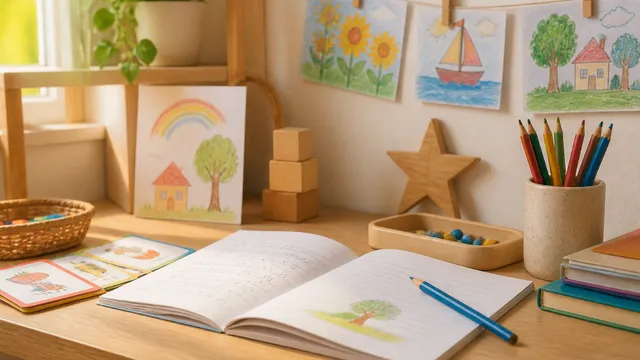
Handwriting vs. Typing for Kids
Neuroscience shows that handwriting and typing shape young children's brains quite differently — and the gap matters most during the foundational years.

If you asked most parents five years ago whether their child needed to learn handwriting, many would have answered with a shrug: keyboards are everywhere, cursive is obsolete, and surely the future belongs to whoever types fastest. That assumption is now being overturned — not by nostalgia, but by neuroscience. A growing body of research is showing that the physical act of forming letters by hand does something to a child’s developing brain that pressing a key simply cannot replicate. And for parents navigating screen time, school readiness, and the question of what actually helps children learn, the evidence is worth understanding carefully.
This is not an argument against typing. Children need digital fluency, and keyboards are not going away. But the two skills are not interchangeable — and for children between the ages of roughly five and ten, the research case for prioritizing handwriting is now unusually strong.
What Happens in the Brain When a Child Writes by Hand
The most striking finding from recent neuroscience is how many brain regions handwriting activates simultaneously. A 2024 study published in Frontiers in Psychology found that, compared to typewriting, handwriting showed more “widespread brain connectivity” in areas associated with learning and memory. That phrase — widespread connectivity — is the key. When a child picks up a pencil, they are not simply recording a thought. They are engaging their visual system (watching the letter take shape), their motor system (coordinating fine hand movements), and their sensory system (feeling the pencil’s resistance against the page) all at once. Handwriting promotes better learning of new words and concepts, as it combines cognitive, sensory, and motor elements in a way that typing does not.
Typing, by contrast, involves a largely uniform physical act — the same press of a key, regardless of which letter is being produced. The handwriting advantage in memory retention is largely due to the fact that writing by hand is a more cognitively demanding process, requiring the brain to engage in deep encoding of information, while typing tends to involve a more passive transcription, often without engaging deeply with the material. The brain has to work harder when writing by hand, and that productive difficulty is precisely what makes the learning stick.
There is also something to be said for pace. Handwriting slows down the writing process, prompting the writer to actively paraphrase and process material rather than merely transcribe it. For a child learning a new concept, that forced slowness is a feature, not a bug. It creates the cognitive friction that consolidates memory.
How Handwriting Shapes Early Literacy — Letter by Letter
The research becomes especially compelling when the focus narrows to early childhood, specifically the window when children are first learning to read and write. Here, handwriting does not just offer a general learning advantage — it shapes the neurological foundations of literacy itself.
Grapho-motor action — the physical movement of forming letters — is a key mechanism for boosting alphabetic and orthographic knowledge in early childhood, and recent research has revealed that substituting handwriting practice with typing may hinder the initial steps of reading development. That finding should give parents and educators pause. It suggests the question is not just “which is faster?” but “which builds the reading brain?”
French children aged three to five years old, for example, were taught to copy letters of the alphabet either by hand or by typing; after three weeks, the handwriting group could recognize more letters than the typing group. A more controlled 2025 study put the question even more precisely: researchers taught fifty children in the last year of kindergarten, aged five to six, nine letters from Georgian and Armenian alphabets and sixteen pseudowords combining those letters, with pronunciations provided to simulate how children typically learn to read, while half the children hand-copied or traced letters and words using pencil and paper, and the other half typed them on a keyboard. The results were unambiguous. Writing by hand showed clear superiority over typing — children who practiced forming the shapes of each letter showed faster gains across decoding and spelling tasks than their typing peers, and when asked to name individual letters, the handwriters were 92 percent accurate, a 16-point advantage over their typing peers, who had 76 percent accuracy.
The benefit of handwriting over typing extended to word identification, word writing, and word decoding — in other words, across the full range of early literacy skills, not just isolated letter recognition. Children who practiced writing by hand had better reading fluency and comprehension than those who practiced typing, particularly when learning letters and sounds. The motor act of forming a letter, it turns out, imprints it neurologically in a way that pressing a key cannot.
Why? Handwriting practice has been identified as a key exercise supporting the acquisition of alphabetic and orthographic knowledge in the prereading stage, because it involves the precise reproduction of letter forms through perceptual-motor activity, and the tactile and motor experiences associated with handwriting play a critical role in embedding alphabetic and orthographic knowledge within the brain’s learning mechanisms. A child who traces the curve of a lowercase b with a pencil is doing something categorically different from a child who taps a key — one is writing, the other is pointing.
The Case for Typing: Real, but Different
None of this means typing is without value. The research consensus is not that typing is harmful — it is that typing serves a different function, and that function is most valuable once literacy foundations are already in place.
Typing may be faster, but the research shows that handwriting engages our brains in richer, more meaningful ways. Speed is typing’s genuine advantage: for older children who already know how to read and write fluently, the ability to get ideas onto a screen quickly allows for longer, more developed written work. Typing also removes physical fatigue as a barrier for children who find sustained handwriting tiring, and for children with certain motor or learning challenges, keyboard access can be a critical accommodation.
Digital technology can motivate students who struggle or have specific learning disabilities. That is a real and meaningful benefit. The point is simply that motivation and accessibility — important as they are — do not replace the neurological work that handwriting does in the foundational years. They address different problems.
The practical approach is to teach children how to write well in either mode, and to choose the mode based on what the lesson is asking children to do, not on what the school happens to have purchased. That is wise counsel — but it presupposes that both skills exist. A child who has never developed fluent handwriting does not actually have a choice between modes. They have only one option, and it may be the shallower one for the learning tasks that matter most early on.
The Handwriting Window: Why Timing Matters
Perhaps the most practically important insight from the research is that the developmental window for handwriting’s impact on literacy is not indefinitely open. The transition from handwriting to typing in early education may have significant implications for children’s long-term motor skills and cognitive development, as handwriting engages fine motor skills and cognitive processes that are crucial for reading and writing proficiency. These are not skills that can be fully retrofitted later — the period when the brain is first building its reading architecture, roughly ages five through ten, is also the period when handwriting’s influence is greatest.
Handwriting and related fine motor skills are linked to better academic performance in preschool — suggesting the benefits begin even before formal schooling. By contrast, the advantages of typing speed and efficiency become most relevant in the middle school years and beyond, when children are producing longer written work and when the scaffolding of early literacy is already in place.
The practical verdict for parents, then, is fairly clear: prioritize handwriting in the five-to-ten age window, when literacy foundations are being laid, and then layer in typing as a complementary skill. Both matter. But the research window for handwriting’s developmental impact is meaningfully narrower, and treating the two as interchangeable during those early years means missing an opportunity that does not come back.
Researchers around the world are digging into the powerful effects of handwriting, revealing how the act of putting pen or pencil to paper significantly shapes how we think, remember, and make sense of new ideas. The word “shapes” is worth sitting with. Handwriting does not just record thought — it participates in building the cognitive structures through which thought is organized. That is a stronger claim than most parents realize, and a more consequential one.
What This Means Beyond the Classroom
There is one dimension of handwriting that neuroscience can document but cannot fully capture: the way a child’s handwriting is, in the most literal sense, theirs alone. The slight backward lean of a seven-year-old’s letters, the way she presses harder at the end of a word, the lopsided loop on her lowercase g — these are not imperfections to be corrected by a font. They are evidence of a child in the act of becoming herself.
Typed text is uniform. It carries no trace of the hand that produced it, no memory of the moment in which it was made. A child’s handwritten message — to a friend, in a birthday card, on a page of a book she will keep for years — is something else entirely. It is a fingerprint in ink, irretrievably tied to the age at which it was made.
This is why, in an era when so much of childhood communication is typed, texted, or auto-corrected into sameness, a handwritten message carries a weight that a digital one simply cannot. A handwritten message in a Friend Book does something a typed one never can: it preserves a child’s exact hand, their pressure on the page, their particular loops and flourishes, at this one irretrievable moment in childhood. Years from now, that page will show not just what was written, but who wrote it — and how old she was when she did.
The research gives parents permission to protect handwriting time without apology. It is not a nostalgic indulgence. It is, quite literally, how children build their reading brains, encode their memories, and leave a mark on the world that is entirely their own.
Where Things Stand
The handwriting-versus-typing debate has moved from research journals into education policy in 2026, with more US states reinstating handwriting and cursive requirements. Researchers keep documenting the effects of handwriting on thinking and memory, even as schools prioritize digital literacy, and the new mandates are starting to address that tension directly.
Frequently asked questions
At what age should children start learning to type?
Most developmental experts and educators suggest introducing formal typing instruction around ages 7–9, once foundational handwriting skills — letter formation, spelling, and basic reading fluency — are already in place. Starting typing too early, before those foundations are set, can shortcut the neurological work that handwriting does in the early literacy window. Think of handwriting first, typing second: not because typing is less valuable, but because the window in which handwriting shapes brain development is narrower and harder to recover later.
Does it matter whether children write in print or cursive?
Both print and cursive engage the fine motor and sensory systems that support learning, but they do so in slightly different ways. Print helps younger children (ages 5–7) learn letter shapes and sound-letter connections. Cursive, which requires fluid, connected strokes, has been linked to improvements in reading fluency, spelling, and even focus in older children. Many educators recommend print first, then introducing cursive around grades 2–3. What matters most is that children are forming letters by hand, regularly and with intention, rather than which specific style they use.
Is there any learning benefit to typing for young children?
For children who already have solid foundational literacy — typically age 8 and up — typing can support learning by allowing ideas to flow faster onto the page, reducing the physical demand of long writing tasks, and building digital fluency they'll need throughout schooling and work. Research also shows that for children with certain motor or learning disabilities, typing can be a valuable accommodation that removes barriers to self-expression. The research consensus is not that typing is bad for children — it's that typing should complement, not replace, handwriting in the years when literacy foundations are being built.
How much handwriting practice do children actually need each day?
Studies suggest that even short, consistent sessions — around 10 to 20 minutes of purposeful handwriting practice per day — are enough to produce meaningful gains in letter recognition, spelling, and reading fluency for children in the 5–10 age range. The key word is purposeful: copying meaningful words, writing short messages, or drawing and labeling pictures is more effective than rote drills. Building handwriting into real, joyful tasks — like writing in a friend book, sending a letter, or keeping a nature journal — tends to produce deeper engagement and more durable learning than worksheet exercises alone.
Related
Sources
About the author

VP Content
Dori Fussmann leads Album Amicorum, an independent studio behind an illustrated Friend Book that children fill in by hand — turning the notes, drawings, and small messages of childhood friendships into a keepsake worth keeping. His background is in building consumer brands, and he started writing here out of a conviction that the memories that matter most belong off-screen. These articles draw on child-development research and the work of experts such as Jonathan Haidt.