How to Build a Handwriting Habit at Home: A Parent's Guide
Published on August 27, 2026
Category: Slow Childhood & Analog Play · Tags: handwriting for kids, how to encourage handwriting at home for kids, fine motor skills, childhood habits, slow childhood, benefits of handwriting for kids
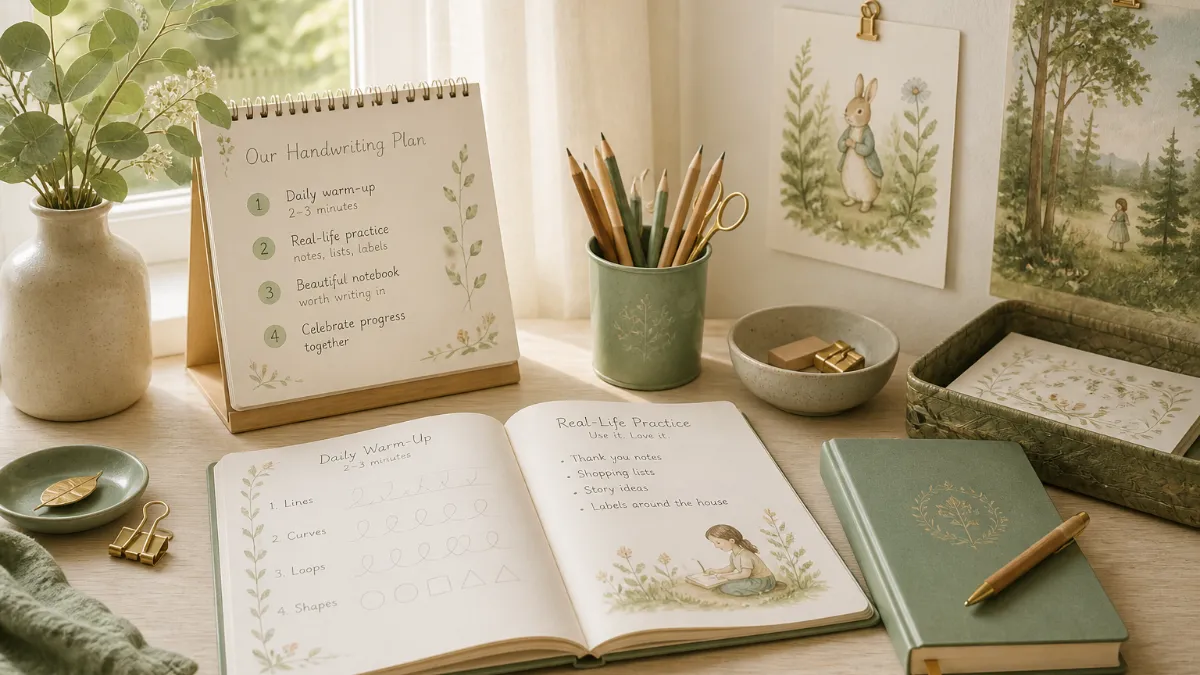
There is a moment most parents recognise — a birthday card that needs signing, a thank-you note that needs writing — when a child picks up a pen and produces something that looks laboured and unfamiliar, as though the act itself is a mild surprise. It is easy, in a household full of screens and keyboards, to assume that handwriting is simply happening somewhere else, at school, handled. But handwriting is a habit, and like all habits, it must be practised regularly at home to truly take root. The good news is that building that habit does not require worksheets, drills, or battles at the kitchen table. What it requires is a plan — one that meets children where they are developmentally, gives them a genuine reason to write, and makes the experience feel like something worth returning to.
Start Small, Start Consistent: Anchoring the Habit to Your Day
The most common mistake parents make with handwriting practice is attempting too much, too infrequently. A thirty-minute session on a Saturday afternoon, however well-intentioned, builds far less habit than five minutes every morning after breakfast. Handwriting educators recommend short, focused lessons at regular intervals, noting that young children benefit most from daily ten-minute sessions rather than longer, sporadic ones. The principle is the same at home: short and daily beats long and occasional every time.
The key is to attach your handwriting window to something that already happens. After breakfast and before screens is a natural anchor point — the morning brain is fresh, the routine is already established, and the contrast between writing and screen time gives the practice a pleasant sense of precedence. Other families find that right after school, before homework, works well: the pencil is already in hand, the child is transitioning between modes anyway. What matters less than the specific slot is the consistency. Within two or three weeks of daily five-minute sessions, most children begin reaching for their writing materials without prompting — because habit, once formed, is self-sustaining.
Avoid framing the session as practice. Frame it as a task. The distinction matters enormously to children aged five through twelve, who are acutely sensitive to whether something is being done for a purpose or merely about a skill.
Write for Real: Choosing Tasks That Give Handwriting Meaning
Worksheets have their place in the classroom — they scaffold letter formation systematically, and that scaffolding has genuine value. But at home, the more powerful tool is purposeful, real-world writing: tasks that exist in the world beyond the page and carry a social weight that a completed worksheet simply cannot replicate.
Grocery lists are underrated as handwriting practice. A child who writes the family’s shopping list is using their motor skills, spelling knowledge, and spatial layout instincts all at once — and the list actually gets used. Birthday cards, thank-you notes for gifts, a short letter to a relative, a message tucked into a sibling’s lunchbox — all of these give writing an audience, and an audience gives motivation. Children who regularly practise handwriting experience significant cognitive benefits, including enhanced reading ability, improved memory retention, and stronger composition skills — and studies suggest that the physical act of forming letters creates neural pathways that support literacy in ways typing cannot replicate. But those neural pathways are built most durably when the writing means something to the child doing it.
Research published in the Journal of Experimental Child Psychology in early 2026 provides evidence for handwriting’s contribution to learning accurate letter and word representations, showing that pre-readers learn letter-sound mappings more accurately by handwriting than by typing. That finding is worth holding onto when a child resists picking up a pen: every handwritten message, every list, every card is doing neurological work that a keyboard simply does not.
Push past the idea that writing must be corrected to count. A six-year-old’s grocery list, full of inventive spelling and crooked letters, is still a handwriting session — and a deeply meaningful one. Celebrate the writing. Save the correction for school.
Build the Body First: Fine-Motor Warm-Ups That Actually Work
Handwriting is not just a language skill or a literacy skill. It is a physical skill, and it can only be as good as the body’s readiness to perform it. Many children enter school with inadequate fine motor skills and poor pencil grasps precisely because they have begun writing before they are developmentally ready — and developmental readiness for writing starts with gross motor movement and play, not worksheets and pencils.
For younger children, the best handwriting preparation happens away from paper entirely. Play dough builds the small hand muscles that control pencil pressure. Squeezing play dough, snapping building blocks, and cutting paper with scissors all enhance the pencil-control strength that handwriting eventually demands. Sand trays — a shallow tray of fine sand in which a child traces letters with a finger — provide satisfying sensory feedback and allow for natural correction without any sense of failure. Chalkboard writing, because it requires a slightly firmer pressure than pencil on paper, builds grip strength and produces letters large enough to engage the whole arm rather than just the fingers. Writing on a whiteboard or chalkboard feels different from paper, adds an element of excitement to practice, and gives children a change of surface that can make a meaningful difference.
As fine motor control develops, the transition to pencil and paper becomes smoother and more confident. Children learn to write naturally and with enthusiasm when they develop fine motor skills gradually — the small hand muscles practised through stacking, clipping, and puzzle work improve hand control and finger dexterity, and later these movements translate directly into holding a pencil and moving it smoothly across paper. The progression matters: don’t skip the body-based warm-ups in favour of getting to letters faster. The body-based work is the letter work, just in an earlier form.
For older children who are already writing but whose hands tire quickly or whose grip is tense, short warm-up exercises — squeezing a stress ball, shaking out the hands, drawing large spirals on paper before beginning — can reduce fatigue and improve the overall quality and enjoyment of the session.
Celebrate What They Say, Not Only How They Say It
One of the fastest ways to extinguish a child’s emerging enthusiasm for handwriting is to respond to their writing primarily with corrections. Letter formation matters — and there is real value in gently guiding a child back to correct strokes before bad habits become fixed — but if a child writes a message to a friend and the first response they receive is about the size of the d or the slant of the s, the message they internalise is that what they said doesn’t matter. That is precisely the wrong lesson.
Young learners who develop fluent handwriting reinforce their composition skills through regular practice, while those without this fluency often struggle to advance their writing abilities — but fluency grows from motivation, and motivation grows from feeling heard. The content of a child’s writing is the most important part. Ask about it. Respond to it. If they wrote a note about their favourite animal, answer the note. If they listed their birthday wishes, read it aloud with delight. The handwriting improves as a side effect of the child wanting to write more, not as the result of corrections applied to writing they wish they hadn’t done.
Handwriting directly influences how children learn to read and comprehend text, and when children write by hand, they are more likely to process and remember information — but that deeper engagement only happens when a child is genuinely invested in what they are expressing. Focusing on expression sustains motivation. Motivation sustains the habit. The habit builds the skill.
There is a practical corollary here for parents who are themselves perfectionists: keep a light touch. Reserve correction of letter formation for a brief, separate conversation — not in the moment of writing, and not in a way that overshadows the content. “Your g looks great today — and I love that you wrote about the dog” goes much further than “this g is backwards.”
Give Handwriting a Home: The Power of a Dedicated Writing Object
Something quietly powerful happens when a child has a writing object that belongs entirely to them — not a school workbook, not a shared family notepad, but something chosen and personal. It might be a notebook with a beautiful cover. It might be a particular pen or a set of coloured pencils kept in a dedicated pouch. Whatever form it takes, a dedicated writing object signals to a child that their handwriting practice has a home, and that home is worth returning to.
Research has shown that handwriting improves letter recognition in children, and the effects of learning through writing last longer than other learning experiences that might engage attention at a similar level. Part of why that is true is engagement — and engagement, for children, is deeply tied to the objects and rituals that surround an activity. A beautiful notebook is not a luxury; it is an investment in the child’s relationship with the act of writing.
This principle extends to the concept of writing for someone. A Friend Book — a beautifully illustrated book in which friends share handwritten messages, drawings, favourite things, and memories — offers something that even the most gorgeous blank journal cannot: a built-in audience. Every page that comes back filled is a message from someone the child loves. Every response they write is a memory being made. That sense of reciprocity and emotional connection transforms handwriting from a discipline into a delight. It is one of the simplest ways to give a child a compelling, renewable reason to pick up a pen — not because they have been asked to practise, but because there is something worth saying and someone waiting to read it.
The broader habit follows naturally. A child who has learned that handwriting is how you reach the people you love — how you preserve the things that matter, how you leave your mark on a page that will last — is a child who will carry a pen willingly for the rest of their life.
Where Things Stand
Handwriting’s place in children’s education has become an increasingly active policy conversation in 2026, with momentum showing no signs of slowing as the new school year begins. As of early 2026, 27 U.S. states have passed laws mandating cursive instruction in elementary grades, with more than half of all states now requiring or strongly encouraging schools to teach students to read and write in cursive — a dramatic shift compared to just 14 states a decade ago.
Florida is among the most recent additions: starting in the 2026–27 school year, state law now requires all third, fourth, and fifth graders to learn cursive writing and demonstrate proficiency by the end of fifth grade, with 38 of 67 districts beginning classes in August 2026. The trend extends well beyond the United States: 2026 has brought continued international news of schools across Sweden, Norway, France, Finland, Italy, and Denmark cutting back on screen time by returning to paper-based learning and handwriting. Underpinning this policy wave is growing research consensus — recent peer-reviewed findings confirm that substituting handwriting practice with typing may hinder the initial steps of reading development — giving parents who prioritise handwriting at home the reassurance that the science and the cultural moment are both pointing in the same direction.
Further reading: benefits of handwriting for kids · handwriting activities for kids at home · handwriting vs typing for kids · is handwriting important for kids.
Sources: Teaching and Rehabilitation of Handwriting for Children in the … · How to Improve Handwriting in Middle School - Part 1 · Help for Parents.
About the author

Dori Fussmann — VP Content
Dori Fussmann leads Album Amicorum, an independent studio behind an illustrated Friend Book that children fill in by hand — turning the notes, drawings, and small messages of childhood friendships into a keepsake worth keeping. His background is in building consumer brands, and he started writing here out of a conviction that the memories that matter most belong off-screen. These articles draw on child-development research and the work of experts such as Jonathan Haidt.
Related
Sources / Further reading
Frequently asked questions
How long should a child practice handwriting each day at home?
For children in the early elementary years, five to ten minutes of focused handwriting each day is more effective than longer, infrequent sessions. Short, consistent windows — anchored to an existing routine like after breakfast or before screen time — build habit without creating resistance. As children grow more fluent and confident, sessions can extend naturally, but daily brevity beats weekly marathons at every stage.
My child resists picking up a pencil. How do I make handwriting feel less like a chore?
The most common reason children resist handwriting is that it feels purposeless — copying letters on a worksheet gives no real reward. Swap worksheets for writing with a genuine audience: a note to a grandparent, a birthday list, a message tucked in a lunchbox, or an entry in a Friend Book to share with a classmate. When the writing has a real recipient, children feel the social satisfaction of their effort, which is far more motivating than a sticker chart.
At what age should children start practicing handwriting at home?
Fine motor readiness, not a fixed age, is the right guide. Many children are ready to experiment with simple mark-making and letter formation from around age four or five, but the groundwork begins earlier through play: threading beads, squeezing play dough, drawing, and building with small blocks all develop the hand strength and dexterity that handwriting eventually requires. Avoid pushing pencil-on-paper practice before a child shows comfortable grip control, as early frustration can create lasting resistance.
Does it matter which style of handwriting — print or cursive — I encourage at home?
Both have value, and they reinforce each other. Print is typically learned first and is important for reading recognition; cursive, with its connected strokes, can actually help some children — particularly those who struggle with letter reversals — process words as unified shapes. The most important thing at home is consistency and comfort: whichever style your child is currently learning at school, support that same formation so they are reinforcing one muscle-memory pattern rather than fighting two different ones.