10 Analog Toys for Kids That Create Something Worth Keeping
Published on August 25, 2026
Category: Children's Keepsakes & Memory · Tags: analog toys for kids, keepsakes for children, screen-free gifts, childhood memories, friendship gifts for kids
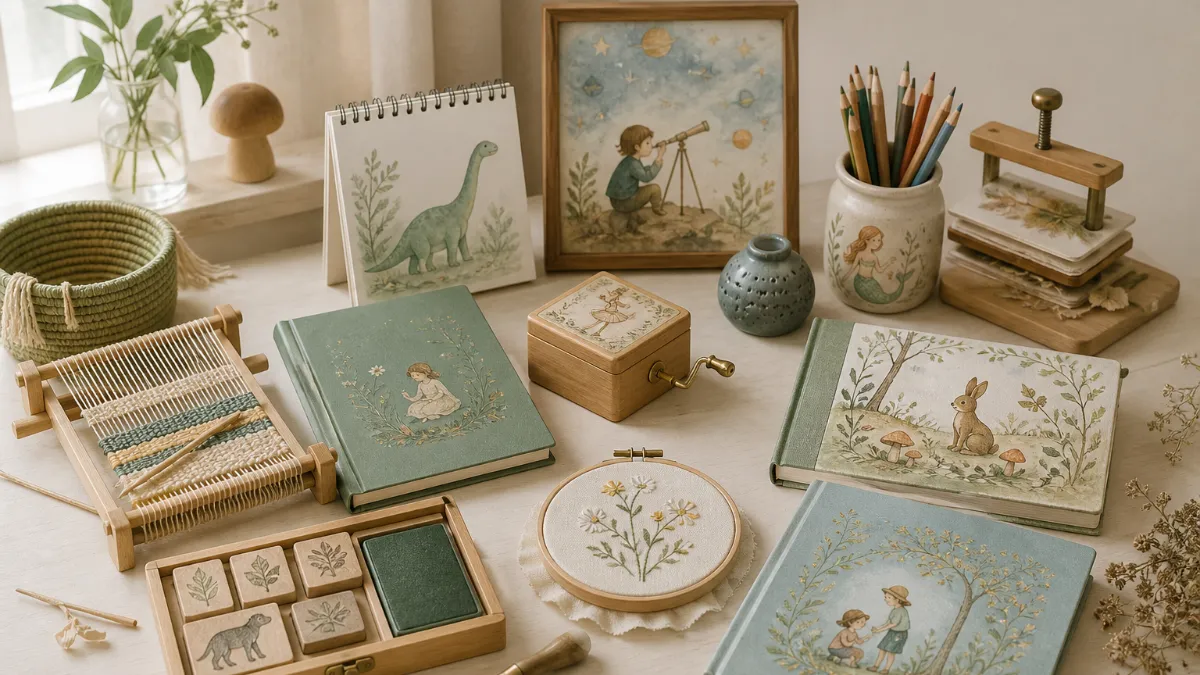
Every parent has stood in a toy aisle — or scrolled through an endless online grid — and felt a creeping suspicion: most of this will be forgotten by February. Not broken, not outgrown, just quietly abandoned. The battery-operated gadget goes silent. The fad collectible loses its novelty. The digital game updates itself into something unrecognizable. What survives? The things that leave a mark. The sketchbook filled over a rainy summer. The weaving that hangs on a bedroom wall for years. The book passed around a classroom, slowly filling with a friend’s handwriting, a cousin’s terrible drawing of a dog, a best friend’s secret favorite color.
This list is for parents and gift-givers who think about the long game — who want to choose a toy that produces something worth keeping, not just something worth unwrapping. Each of the ten picks below was chosen for craft quality, the capacity to create a lasting artifact, and the kind of longevity that makes a child return to it again and again.
What a Keepsake Toy Actually Does Differently
Most toys are designed around the experience of play: the building, the racing, the stacking, the imagining. Keepsake-quality analog toys do something more. They produce an output — a finished thing the child owns, can point to, can show a grandparent, can find in a box at twenty-five and immediately remember. That output is the toy’s second life, and it’s the part that actually lasts.
The materials matter here, too. Environmental consciousness, educational value, and a preference for durable, heirloom-quality toys are driving parents toward natural and sustainable materials. Wood, cotton, paper, ceramic, and natural fiber communicate permanence in a way that plastic simply cannot. When a child handles something made from real materials, they tend to treat it as real — carefully, with attention. That instinct is worth cultivating.
In 2026, there is a growing interest in play that inspires creativity and celebrates self-expression, with many parents treating play as a conscious reset — a screen-free space for emotional regulation, creativity, and connection. The result is a surge in demand for toys that feel intentional, calming, and human-centered. A keepsake toy sits at the center of that impulse: it is intentional by design, because its whole point is to produce something that outlasts the afternoon.
The 10 Best Analog Toys for Kids That Make Keepsakes
1. A Friend Book (Ages 5–12) — The Top Pick
What it creates: A one-of-a-kind record of childhood friendships, filled with handwritten messages, drawings, favorite things, and memories contributed by real people who knew and loved this child.
A Friend Book is different from every other toy on this list in one essential way: it doesn’t create something the child made. It creates something the child’s friendships made. Every entry is a tiny act of love — a friend’s favorite song, a classmate’s drawing of the two of them, a cousin’s inside joke written in loopy seven-year-old script. Once those pages are filled, nothing can recreate them. The friends who wrote in it grow up, move away, change. The book holds them exactly as they were.
The best Friend Books draw on a centuries-old tradition of friendship albums — records that circulated among communities to collect signatures, poems, and drawings from those who mattered. The modern version brings that same spirit into childhood, with beautifully illustrated pages designed to be completed together, slowly, over months and years. Unlike a scrapbook the parent assembles or a digital photo album that lives in the cloud, a Friend Book is genuinely the child’s — gathered by them, filled by their people, kept by them for life.
No other toy on this list can be called irreplaceable in quite this way. A sketchbook can be refilled. An instrument can be relearned. A Friend Book, once complete, is the only one of its kind in the world.
2. A Quality Watercolor Set with a Dedicated Sketchbook (Ages 6–12)
What it creates: A filled sketchbook — a visual diary of a child’s growing eye, taste, and skill, page by page. The key word here is dedicated. A sketchbook that lives alongside a specific set of watercolors becomes a project, not just a toy. Label the spine with a year. Watch the first page — tentative, a bit muddy — evolve toward something the child is quietly proud of by page forty. Unlike a single painting tacked to the fridge, a completed sketchbook is a record of growth, not just a snapshot. Choose watercolor paper-bound books rather than loose sheets, and pan sets in real pigment colors rather than the thin, chalky discs sold in grocery-store kits. Quality materials signal that this is worth doing carefully, and children respond to that signal.
3. A Letterpress or Linocut Stamp Kit (Ages 7–12)
What it creates: Hand-printed cards, wrapping paper, fabric, and art — a growing printed portfolio the child can share and give away. Printmaking has an almost magical quality for children: you carve or arrange something, press it once, and it multiplies. A good stamp kit with foam or soft lino blocks, non-toxic inks, and a brayer introduces a genuine craft process — design, transfer, print, clean, repeat. The keepsake dimension appears in the things the child makes for others: a set of hand-printed birthday cards for a grandmother, custom wrapping paper for a sibling’s gift, a printed bookmark passed to a friend. These objects leave the house and become keepsakes for someone else, which doubles their meaning.
4. A Weaving Loom with Finishing Instructions (Ages 6–12)
What it creates: A finished woven textile — a wall hanging, a small rug, a pouch — made from real fiber, stitch by stitch. A frame loom is one of the most satisfying analog toys because it has an unambiguous finish line. There’s a moment when you cut the warp threads, tie the fringe, and hold up something you made from nothing but yarn and attention. That moment is the keepsake. Wall hangings made by eight-year-olds have a way of staying on walls long after childhood ends. Look for looms that come with finishing instructions — many beginner kits skip this step, leaving children with a half-attached weaving and no idea how to complete it. The finishing is the point.
5. A Traditional Board Game with a Long Legacy (Ages 5–12)
What it creates: Shared family memory — rituals of play that become part of a household’s story. This category requires some reframing: the keepsake isn’t the game itself (though a well-made wooden game can last decades), it’s the accumulation of plays. The same game, played dozens of times across years, becomes a kind of shorthand — a reference point in family stories, a ritual that marks rainy afternoons and power outages and holiday visits. Choose games made from wood or sturdy materials, with rules simple enough that a five-year-old and a twelve-year-old can genuinely play together. The game that gets played most is the keepsake.
6. A Nature Journal Kit (Ages 6–12)
What it creates: A naturalist’s record — pressed flowers, leaf rubbings, sketched birds, field observations — a seasonal diary of the outside world. A nature journal kit that includes a blank, durable journal, waterproof field pencils, a magnifying glass, and a simple press for flowers or leaves becomes a summer project that archives itself. The child who fills one over a single season has made something genuinely unrepeatable: those specific flowers from that specific garden, those birds spotted on that specific walk, pressed and labeled in a nine-year-old’s handwriting. Years later, it reads like a time capsule of a particular childhood summer, a particular set of senses paying attention to the world.
7. A Handcraft Sewing Kit (Ages 7–12)
What it creates: A finished sewn creature or object — a felt animal, an embroidered pouch, a hand-stitched doll — made entirely by the child’s hands. There is something uniquely satisfying about a sewn object, because the evidence of the maker’s hands is permanently woven into it. Crooked seams, slightly uneven ears, a button eye that’s just a little off-center — these are not flaws, they are signatures. A child who sews their first creature from a quality kit has made something they will keep. Look for kits that include pre-cut felt pieces, real embroidery floss, a blunt needle appropriate for the age, and a design simple enough to finish in a single afternoon so the child experiences that rush of completion before moving on.
8. A Marble Run with Extension Packs (Ages 5–10)
What it creates: An engineering portfolio of sorts — photographs and memories of increasingly complex builds, plus the cognitive habit of iterative design. A marble run is not an obvious keepsake toy, but it belongs on this list for one reason: the best ones are modular and extensible, which means the child returns to them repeatedly, building more complex structures each time. The keepsake is the photographic record — take a picture of every finished run before dismantling it — and the growing confidence of a child who has learned to fail, adjust, and redesign. Document the builds over years. That accumulating record becomes a portrait of a developing engineer, one marble-run photograph at a time.
9. A Cooperative Card Game (Ages 6–12)
What it creates: A shared narrative — the collective memory of games won and lost together, and the social skills built in the process. Where competitive games produce winners and losers, cooperative card games produce shared stories. The whole group either succeeds or fails together, which means every player is invested in every other player’s decisions. For children ages 6–12, this models a kind of social reasoning — reading a teammate’s anxiety, offering a resource you could keep for yourself, celebrating collective success — that competitive play rarely requires. The keepsake is the relationship, reinforced every time the cards come out. Choose decks designed for mixed ages so the game can scale as the children grow without leaving younger siblings behind.
10. A Musical Instrument Starter Set (Ages 5–12)
What it creates: A skill — the most durable keepsake of all — and potentially a lifelong relationship with music. A ukulele, a small-bodied guitar, a pentatonic xylophone, a recorder: any instrument a child can pick up and immediately make something with, before mastery, is worth the investment. The keepsake dimension is layered: there’s the instrument itself, often kept for decades; there’s the memory of learning (the first song that finally clicked, the first time someone stopped and listened); and there’s the skill, which compounds over years and never fully leaves. Instruments made from real wood and natural materials age beautifully and sound better — which matters more than any packaging claim — and that improving sound gives the child a reason to keep returning.
Why Material Quality Is a Signal, Not a Luxury
Across all ten picks, one pattern holds: the toys that become keepsakes are almost always made from natural or sustainable materials — wood, cotton, real paper, ceramic, natural fiber. The global wooden toy market was valued at roughly USD 33.9 billion in 2026 and is projected to reach USD 57.1 billion by 2035, with growth credited to environmental consciousness, educational value, and a preference for durable, heirloom-quality toys. That market growth reflects something real that parents already sense: a toy made from honest materials sends a message to a child that this object is worth their attention, worth their care, worth finishing.
Cheap materials produce disposable behavior. When a toy feels temporary — when it bends, fades, or breaks under normal use — children treat it as temporary. Conversely, a loom made from solid wood, a sketchbook with proper watercolor pages, a Friend Book with illustrated boards and quality paper: these feel like they were made to last, because they were. The child internalizes that signal and acts accordingly, returning to the object, protecting it, completing it.
This is also why gift-givers should resist the temptation to buy bigger sets at lower quality. A single beautiful sketchbook paired with a small, genuine watercolor set will be used more carefully, and kept longer, than a giant art-supply kit in a branded plastic case. The size of the gift is not the point. The durability of the output is.
The Friendship Category Is Its Own Thing
Most keepsake toys create something the child made — a painting, a weaving, a sewn creature. These are wonderful, and they belong on any thoughtful shelf. But there is a separate category that is rarer and, in many ways, more precious: toys that create something the child’s friendships made. These are the keepsakes that can never be recreated, because they depend on specific people, in a specific moment, choosing to contribute.
A Friend Book belongs entirely to this category. Parents in 2026 are increasingly focused on creating an “analog, grounded childhood” for their children — and a Friend Book is one of the most concrete expressions of that impulse available. It is slow, by design. It accumulates over months and years. It asks friends to stop and write, to draw, to think for a moment about what they actually want to say. In an era when most childhood communication is instant and ephemeral — a voice message, a disappearing photo, a reaction emoji — a handwritten entry in a Friend Book is almost countercultural.
That is precisely what makes it worth giving. Unlike any other toy on this list, a Friend Book doesn’t just leave a trace of the child — it leaves a trace of everyone who loved them during the years that mattered most. It is, in the most literal sense, a book made of friendships. And when childhood is over, there is no app, no subscription, no reorder that puts that back. The only way to have it is to start it now, while the friends are still there and the handwriting is still small.
Where Things Stand
The broader trend toward analog, keepsake-quality play for children is gaining measurable momentum heading into the second half of 2026. The global wooden toy market was valued at roughly USD 33.9 billion this year and is projected to expand at approximately 6% annually through 2035, with analysts crediting environmental consciousness, educational value, and rising interest in alternative learning philosophies — Montessori, Waldorf, and Reggio Emilia — as key drivers alongside straightforward demand for screen-free alternatives to electronic entertainment.
Industry observers at Toy Fair 2026 described a growing appetite for play that inspires creativity and self-expression, framing it as a “conscious reset” in which screen-free play serves as a dedicated space for emotional regulation and human connection rather than simply a rejection of technology — resulting in a surge in demand for toys that feel intentional, calming, and human-centered. Pinterest’s 2026 Parenting Report reinforced this cultural direction, noting that parents are actively focused on creating an “analog, grounded childhood” centered on craft activities and meaningful hands-on experiences. No major disruptions or reversals of this trend have surfaced in recent weeks; market data and cultural signals continue to point in the same direction, suggesting that demand for intentional, keepsake-quality analog toys is a durable shift rather than a passing moment.
See Related below for more on this topic.
For further reading, see the Sources listed below.
About the author

Dori Fussmann — VP Content
Dori Fussmann leads Album Amicorum, an independent studio behind an illustrated Friend Book that children fill in by hand — turning the notes, drawings, and small messages of childhood friendships into a keepsake worth keeping. His background is in building consumer brands, and he started writing here out of a conviction that the memories that matter most belong off-screen. These articles draw on child-development research and the work of experts such as Jonathan Haidt.
Related
Sources / Further reading
Frequently asked questions
What makes an analog toy a true keepsake rather than just a toy?
A keepsake-quality analog toy produces a tangible artifact the child can hold, revisit, and show others years later — a filled sketchbook, a finished weaving, a sewn creature, or a book full of a friend's handwriting. The key distinction is output: the toy doesn't just entertain in the moment, it leaves a physical trace of the child's creativity, growth, or relationships that outlasts the play session itself.
At what age do children most appreciate keepsake-style analog toys?
Generally ages 5–12, though the sweet spot shifts by toy type. Younger children (5–7) tend to love tactile craft kits — sewing, stamping, simple weaving — where the process is the reward. Older children (8–12) increasingly appreciate the sentimental dimension: a sketchbook they've filled over a summer, an instrument they've practiced, or a Friend Book they can pass around at school and read back years later.
How do I encourage a child to actually use a keepsake toy rather than set it aside?
Start with a ritual: introduce the toy at a meaningful moment (a birthday, the first day of summer, a new school year) so it carries context from the start. Keep it accessible — on a shelf at eye level, not buried in a toy box. For Friend Books and journals, let the child be the keeper with genuine ownership over who fills it and when. Children protect and return to things they feel are genuinely theirs.
Is a Friend Book appropriate as a classroom or party gift?
Absolutely — a Friend Book is one of the few gifts that genuinely improves with the social setting of a classroom or birthday party. Unlike a toy that one child takes home and uses alone, a Friend Book invites the whole group to contribute. It can be passed around at a party, filled by classmates over a school year, or sent home with a child at the end of a playdate. The more people contribute, the more irreplaceable it becomes.