Analog vs. Digital Toys: Which Builds Deeper Connection?
Published on August 25, 2026
Category: Slow Childhood & Analog Play · Tags: analog toys for kids, analog vs digital toys, childhood friendship, screen-free play, kids connection
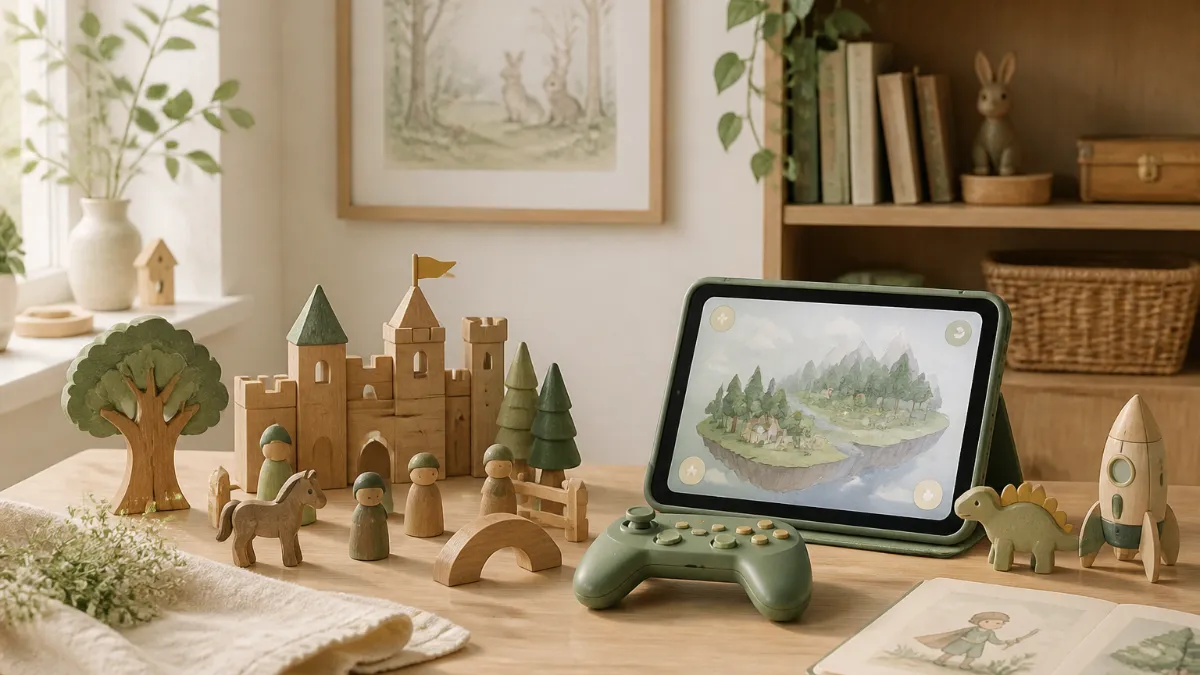
When parents talk about the toy aisle — physical or virtual — the conversation almost always collapses into a familiar binary: screens are bad, wooden blocks are good. But that framing misses the more interesting and practically useful question, which is not about quality or safety or screen time in the abstract. It’s about connection. Specifically: which type of toy actually builds the kind of deep, lasting friendship between children that parents hope their kids will carry into adulthood? The answer, when you look at the research, is more nuanced than the culture war suggests — but it does have a clear winner when friendship is the goal.
What the Research Actually Says About Analog Play and Social Interaction
The most direct evidence comes from a peer-reviewed study published in a developmental psychology journal, which compared children playing the same game in analog versus digital formats. Results showed that children in the analog condition communicated verbally with each other more often, responded more often to interaction attempts of their partners, and showed less frequent negative forms of interaction. This wasn’t a marginal difference. The study used experimental conditions — an experimental setup where 24 dyads of children between ages 4 and 10 were each randomly assigned to play either a digital or analog version of the same game together — which means the content of play was held constant. Only the medium changed. And the medium changed everything about how the children related to each other.
That finding aligns with what parents themselves observe and report. A descriptive study collecting data from 306 parents of children with an average age of 3.6 years found that parents perceived traditional toys as the most stimulating for a toddler’s sensory, motor, cognitive, and socio-emotional development, and that during analogue play, significantly more interaction and language input from both parents and children occurred. Language — conversation, negotiation, narration, shared storytelling — is not incidental to childhood friendship. It is the primary currency of it. When a toy suppresses verbal exchange, it suppresses the very mechanism through which children build closeness.
Children who use electronic toys are exposed to fewer adult words, fewer conversational turns, fewer parental responses, and fewer productions of content-specific words than during play with traditional toys or books. The implications extend beyond vocabulary. Every missed conversational turn is a missed opportunity to understand a friend’s preferences, to negotiate whose idea to follow, to laugh together at a shared mishap. These micro-moments are the building blocks of real childhood relationships.
The Case for Digital Toys: Where They Genuinely Deliver
To be honest about this comparison, the picture of digital and technology-enhanced toys isn’t uniformly negative — and parents who dismiss them entirely miss real value. Studies show that programmable robots, coding toys, and interactive electronic toys can enhance engagement, creativity, computational thinking, and problem-solving skills in children. For children who struggle to sustain attention with open-ended play, a well-designed digital toy can provide scaffolding that keeps them engaged long enough to access those deeper skills.
“Smart” toys with digital additions — wireless-networked sensors or companion software — may better aid in the development of children’s attributes of storytelling, problem-solving, collaboration, empathy, and spatial, computational, symbolic, and emotional thinking. Technology-enhanced toys also offer something that traditional toys sometimes don’t: a low cost of failure. A child experimenting with a coding toy can try, fail, reset, and try again without losing game pieces, breaking components, or disrupting a sibling’s carefully arranged scene. That iterative freedom is genuinely valuable for building resilience and a growth mindset.
The honest takeaway is that “analog good, digital bad” is too blunt a tool. Digital toys can scaffold learning, sustain engagement for diverse learners, and even support certain types of collaboration — particularly in STEM contexts. Technology-enhanced toys offer additional opportunities for young children to engage in meaningful, self-directed exploration of STEM ideas, fostering engineering habits of mind, creative problem-solving, computational thinking, and early scientific inquiry. Parents who thoughtfully include digital tools in a child’s play diet aren’t making a mistake. The question is what those tools are being asked to do.
The Decisive Differentiator: What Does Each Type of Play Leave Behind?
Here is where connection-minded parents should focus their attention, because this is where the two types of play diverge most sharply. The key question isn’t what a toy does during the session. It’s what the play produces afterward.
Consider what happens after an hour of digital gaming with a friend. The session ends, the console turns off, and the shared experience — the levels cleared, the monsters defeated, the scores achieved — exists nowhere in the physical world. It cannot be touched, revisited, or shown to a grandparent years later. The relationship was present and engaged during the session, but the artifact of that friendship has evaporated.
Now consider what happens after an hour of analog play oriented toward a shared creative outcome. Children who have built something together, illustrated something together, or written something for each other walk away holding a physical object that is evidence of their relationship. That object can be returned to. It can trigger memory. It can be discovered in a drawer a decade later and immediately recall the warmth of the friendship it represents.
Analog toys support cooperation and leadership skills in group play and encourage imagination and creative thinking in individual play. But beyond those developmental outputs, they tend to produce something real — a shared creation that outlasts the session. This is not a trivial distinction for parents who care about friendship. Children who have made something together have a different and richer basis for their relationship than children who have merely played together.
Toys that facilitate imaginative play and problem solving are most likely to enable caregiver engagement, whereas toys that are electronically based are less likely to do so. The same logic applies to peer engagement. Open-ended, imaginative play creates space for genuine collaboration rather than parallel consumption.
Face-to-Face Conditions: Why Analog Wins for Friendship Specifically
Beyond what play produces, there is the question of the conditions it creates. Deep peer friendship requires specific inputs: sustained face-to-face contact, turn-taking, shared physical space, and mutual vulnerability — the willingness to suggest something silly, to be corrected, to laugh at yourself. Analog play reliably generates all of these. Digital play, especially when mediated through a screen interface, tends to reduce them.
Children in analog play situations are more responsive than children in the digital play situation. Responsiveness — the quality of genuinely reacting to what your friend says, does, or needs — is perhaps the single most important relational skill children develop through play. A child who learns to read the cues of a playdate partner, to notice when their friend is frustrated or delighted, is building the emotional attunement that underlies every meaningful relationship they will ever have.
Analog toys made from natural materials are effective tools for supporting children’s problem-solving, creativity, and social interaction skills, play a critical role in helping children explore their surroundings, and promote the development of cooperation and leadership skills in group play. In practice, this means that a playdate organized around analog toys — building, drawing, crafting, board games, imaginative role play — is doing relational work that a playdate organized around a shared screen simply cannot replicate at the same depth.
This is not a counsel of perfection. Most children’s households will include both types of play, and most children will be healthier and happier for the variety. Alternating screen time with tangible play helps prevent overstimulation and promotes healthier patterns, and many parents in 2026 opt for hybrid or purely analog toys to foster focused, hands-on learning and give children a break from digital overload. A balanced household can include both, but consciously protecting certain contexts — playdates, family evenings, birthday rituals — as analog-first is a meaningful act of guardianship over the relational quality of childhood.
Building a Home That Privileges Connection
The practical implication for parents is less about banning devices and more about being intentional about which contexts get which type of play. Digital play has its place in a child’s week — for solo exploration, STEM experimentation, or rainy-day engagement. But for the specific goal of building and deepening peer friendships, analog conditions are simply superior. They require children to be physically present with one another, to communicate, to take turns, to create together, and to leave that creation in the world.
Removing screens from playtime can create a different space for children to push their imaginations to the limit, strengthen motor skills, and develop deeper connections with friends and family. This is the intuition that drives the growing “slow childhood” movement, and the research backs it. When children play without screens, they talk more, respond more, collaborate more genuinely, and produce shared experiences that are felt and remembered.
The logical extension of this principle leads somewhere interesting: if the goal is to deepen childhood friendship through analog play, the most powerful analog toy isn’t just one that keeps children away from screens. It’s one whose entire purpose is the friendship itself — one that treats the relationship between two children as the thing worth capturing and preserving.
That’s the idea at the heart of the Friend Book. Rather than a toy that children play alongside each other, a Friend Book is a toy that children make for each other — a handwritten, hand-illustrated record of a specific friendship at a specific moment in childhood. A friend writes their favorite color, their silliest memory, their secret wish. They draw a picture. They sign their name. And then that artifact, that evidence of real connection, lives in the world permanently — on a shelf, in a drawer, in the hands of a child who will one day be an adult turning pages and remembering exactly who they were and who mattered to them.
Album Amicorum’s Friend Books are designed precisely around this idea: that the friendship itself is worth commemorating, that handwritten memories are irreplaceable in a way no screenshot or saved game file can be, and that the most lasting gift you can give a child is not a toy they will outgrow but a record of the relationships that shaped them. In a household that values both connection and intentionality, a Friend Book isn’t just an analog toy. It’s the analog toy whose purpose is the bond between children — the one output that no digital experience can ever produce.
Where Things Stand
The analog play movement has continued to gain cultural momentum through mid-2026, moving well beyond niche parenting circles into mainstream consumer behavior. As digital life speeds up, families are increasingly choosing tech-free toys that help them power down and reset, with the “Cozy Culture” trend reflecting a growing fondness for low-tech and no-tech play experiences that counterbalance constant digital stimulation. This shift is showing up in market data as well: a May 2026 industry analysis valued the global wooden toy market at approximately USD 33.9 billion, with roughly 6% annual growth projected through 2035, driven by sustainability, educational value, durability, and growing interest in Montessori-style learning. At the same time, the viral #analogbag trend — originating with a creator sharing a bag of offline activities as a phone replacement habit — spread from social media into international news coverage and the daily routines of families everywhere in 2026, reflecting the same underlying appetite for screen-free, tangible experience. A 2026 systematic review published in a peer-reviewed education journal also reinforced the complementary value of both play types, finding that integrating both physical and digital games into educational settings can boost engagement and motivation, and that games enhance problem-solving and promote collaborative learning — while separately confirming that the relational richness of face-to-face, analog interaction remains distinct and difficult to replicate digitally.
See Related below for more on this topic.
For further reading, see the Sources listed below.
About the author

Dori Fussmann — VP Content
Dori Fussmann leads Album Amicorum, an independent studio behind an illustrated Friend Book that children fill in by hand — turning the notes, drawings, and small messages of childhood friendships into a keepsake worth keeping. His background is in building consumer brands, and he started writing here out of a conviction that the memories that matter most belong off-screen. These articles draw on child-development research and the work of experts such as Jonathan Haidt.
Related
Sources / Further reading
Frequently asked questions
Do digital toys have any benefits for children's social development?
Yes — digital and technology-enhanced toys can genuinely support problem-solving, computational thinking, and even some forms of collaboration. The concern for connection-minded parents isn't that digital toys are harmful in every way, but that the social interaction they generate during play tends to be shallower and more transient. Research shows children in analog play conditions communicate verbally more often and respond more positively to each other's attempts at interaction than children playing the same game in a digital format.
How much screen-free play time should kids get each day?
While exact time recommendations vary by age and source, most child development guidance emphasizes prioritizing unstructured, child-led play — especially for children under 12. The quality and social richness of play matters as much as the quantity. For parents focused on friendship and connection, deliberately protecting certain play times — particularly playdates, family evenings, and shared rituals — as screen-free creates the conditions where the deepest peer relationships form.
What makes a toy good for building childhood friendships specifically?
The best friendship-building toys share a few traits: they require two or more children to participate, they leave room for conversation and negotiation, they produce a shared outcome or experience, and ideally they create something physical or tangible that can be revisited. Toys that demand turn-taking, shared storytelling, or collaboration consistently outperform solo-use or screen-mediated toys for the depth of peer connection they generate.
Are Friend Books an appropriate activity for children who aren't strong writers yet?
Absolutely. Friend Books like Album Amicorum's are designed to capture more than words — children can draw, doodle, choose favorite colors, or simply leave a handprint alongside a short message. The tactile, personal nature of contributing to a friend's book is meaningful regardless of writing ability, making them wonderful for a wide range of ages across the 5–12 bracket.