How to Build an Analog Toy Shelf for Kids: A Room Guide
Published on August 25, 2026
Category: Slow Childhood & Analog Play · Tags: analog toys for kids, screen-free play, toy organization, slow childhood, childhood friendship and connection
Start With the Audit: Know What You Actually Have
The first step to building a meaningful analog toy shelf isn’t buying anything. It’s seeing clearly what is already in the room — and being honest about what those things actually do.
Pull every toy out into the middle of the floor. Then sort them into four categories: analog open-ended (no battery, no screen, no fixed outcome — blocks, art supplies, clay, blank notebooks); analog closed-ended (no battery or screen, but one correct solution — puzzles, board games with set rules, lacing cards); battery- or screen-dependent (electronic toys, apps, tablets, anything that requires power to do its main job); and hybrid (building sets that pair with an app, or crafts that scan into a device). This simple audit immediately makes visible what is invisible when toys are scattered across shelves, bins, and bedroom floors.
Once the sorting is done, the decision-making becomes intuitive. Anything battery- or screen-dependent that duplicates something an analog toy already does well — a digital drawing tablet when actual sketchbooks sit unused, for instance — is a candidate to donate or store. Hybrids are worth examining one by one: some genuinely extend open-ended play, but many require the app to function at all, making them effectively screen toys in disguise. The rule of thumb is simple: if removing the battery leaves you with nothing interesting, the toy is closed by design rather than opened by imagination.
What remains after the audit is your raw material. Most parents are surprised by how many genuinely good open-ended analog items were already there, buried under the noise.
Choose by Developmental Zone, Not by Age Label
Toy packaging uses age labels as liability disclaimers as much as developmental guides. A more useful lens is the developmental zone your child is currently in — what kinds of thinking, social engagement, and physical skills they are actively building — because that tells you which toys will actually pull them forward.
For ages 5–8, the priority is tactile construction, early art materials, and cooperative games. Children in this zone are building spatial reasoning, fine motor control, and the first genuine interest in other people’s perspectives. A set of wooden building blocks, beeswax crayons and drawing paper, modelling clay, a simple cooperative board game, and a collection of picture books with real narrative depth serve this zone beautifully. The toys that work best here have multiple possible outcomes: the same blocks can become a bridge today and a market stall tomorrow.
For ages 9–12, layer in strategy games that require planning and negotiation, craft kits that produce a shareable output (a sewn pouch, a hand-bound booklet, a lino-print card), and what might be called social keepsake projects — things that involve other people in their creation. Children in this zone are building identity through their friendships and their interests. The toys and materials that serve them best are ones that don’t just entertain in the moment but produce something that can be held, shared, or returned to. Research on children’s play supports this: parents consistently perceive traditional, analog toys as the most stimulating for cognitive and socio-emotional development, and analog play generates significantly more parent–child and peer interaction as well as richer language use. A shelf that respects developmental zones makes that richness possible at every age.
The “Fewer, Better” Principle: What the Research Actually Shows
This is the part most parents resist, because it runs counter to every gift-giving instinct. But the evidence is striking. A study from the University of Toledo found that “an abundance of toys present reduced quality of toddlers’ play” — having fewer toys led children to focus and engage in more creative, imaginative play, and ultimately resulted in deeper cognitive development. The study placed toddlers in two conditions: four toys, or sixteen. With fewer toys, participants had fewer total incidences of switching, longer durations of sustained play with each toy, and played with them in a greater variety of ways — suggesting that fewer options allow children to engage more deeply and more creatively with what they have.
Research shows that children surrounded by too many toys experience shorter attention spans, sensory overload, and difficulty engaging in deep imaginative play — too many options trigger decision fatigue, leading to restless flitting between toys rather than focused exploration, which undermines brain development during critical early years when children need sustained focus to build problem-solving skills and creativity.
The practical implication: a thoughtfully edited analog shelf of 12–15 items outperforms a room overflowing with toys. This is not deprivation — it is curation. With fewer options, children are more likely to focus and develop mindfulness, allowing for deeper engagement in playtime, and they also become better at repurposing and combining toys — finding new uses and stories in what they already own. The shelf becomes a place of genuine possibility rather than a catalogue no one reads.
A useful system is toy rotation: keep 12–15 items accessible and store the rest out of sight, swapping in a few new-to-them items every few weeks. A crowded toy shelf can make good toys disappear in plain sight — many children play better when they can see fewer choices clearly, and that is exactly where rotation helps.
Arrange the Shelf for Agency, Not Aesthetics
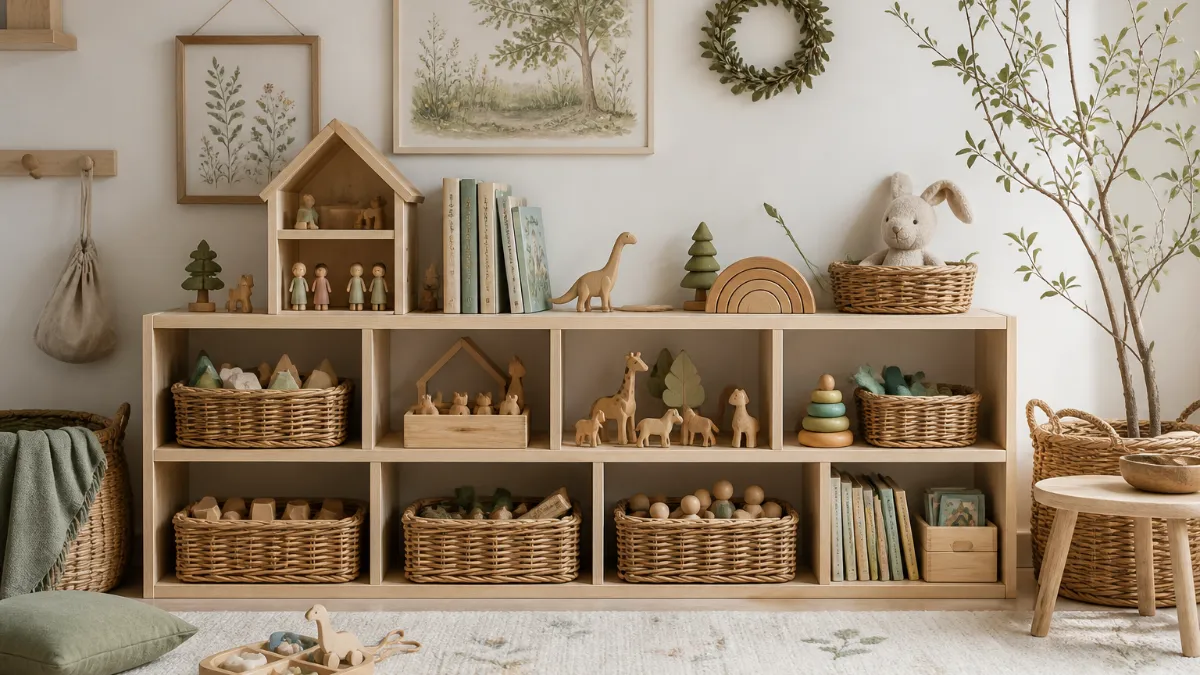
A beautifully styled shelf that a child cannot reach or navigate independently defeats the entire purpose. The goal is an arrangement that supports self-directed play — where your child walks over, selects something, and settles in without needing you to retrieve, explain, or set up.
The practical principles are straightforward. Place the shelf at child height so every item is visible and reachable without climbing or asking. Group items by category rather than by size or colour, so a child looking for something to build with goes directly to the construction corner, and a child in an artistic mood finds all the drawing materials together. Use open bins or trays rather than lidded boxes — if a child has to wrestle a lid off or dig through a closed container, the friction is often enough to make them abandon the idea and reach for something passive instead.
A low shelf or cart at kid height, stocked with a rotating handful of options, is the practical foundation — too many choices overwhelm, and four to six items per category is plenty, kept tidy so children can see and reach what they need. Labels (pictures for younger children, words for older ones) help reinforce independence and make tidying-up a task children can own. When a child can self-select freely, they invest more — research consistently shows that intrinsic motivation and self-choice lead to longer, more focused play sessions than adult-directed play.
Keep the shelf genuinely tidy. Not museum-tidy, but clear enough that every item has a visible home. Clutter on the shelf communicates the same cognitive overwhelm as clutter in a room.
Leave Intentional Blank Space — and Fill It With Something That Grows
The most important thing on a thoughtfully built analog toy shelf might be what isn’t there yet. Leave one deliberate gap — a slot of empty space, or a single item that functions as an open invitation rather than a completed thing. A blank sketchbook. An empty craft tin. A ball of yarn and a pair of blunt scissors. These signals communicate something that pre-packaged toys cannot: you are the content here.
The Toy Association’s 2026 “Cozy Culture” trend reflects a growing consumer fondness for low-tech and no-tech play experiences that help families counterbalance digital overstimulation — across age groups, families are embracing toys that prioritize comfort and engage the senses, and rather than rejecting technology outright, this movement represents a conscious reset, with play serving as a screen-free space for emotional regulation, creativity, and connection, driving a surge in demand for toys that feel intentional, calming, and human-centered. Blank space on a shelf is the physical expression of that reset.
Removing screens from playtime creates a different space for children to push their imaginations to the limit, strengthen motor skills, and develop deeper connections with friends and family — but only if the shelf itself invites that kind of open, self-directed engagement. A shelf full of toys that do everything for the child is just a screen without a backlight.
The One Toy That Bridges the Whole Shelf
Once the shelf is built — the art supplies arranged, the construction toys accessible, the cooperative games within reach — there is one category that tends to quietly unite everything else: the social keepsake project. Something that brings art, writing, friendship, and memory together in a single object. For children ages 5–12, few things do this as naturally as a Friend Book.
A Friend Book is not a journal a child fills alone. It circulates. Friends sit together with it at birthday parties, on playdates, during long car trips. Each friend fills their own page — favourite colour, a drawing, a secret message, a memory — and leaves a little piece of themselves behind. Over months and years, the book becomes a document of a child’s friendships that no photograph or digital record can replicate, because it is literally in their friends’ own handwriting, their own drawings, their own words.
Album Amicorum’s In My Friends Book is designed for exactly this space on the shelf: beautifully illustrated, open-ended, and built to be passed around. It is the one item on the shelf that gets richer with every use rather than wearing out, and the one item that makes the shelf itself into something living. A child who has a Friend Book has something to bring out whenever a friend visits — which means every playdate becomes a small act of memory-making. When the shelf is finally built with intention, the Friend Book belongs in that blank space you left. It will fill itself.
Where Things Stand
The analog toy and screen-free play space is seeing sustained, broad-based momentum heading into late 2026 rather than any single dramatic news event. In February 2026, the Toy Association unveiled its official 2026 Toy & Play Trends, and one of the headline themes — “Cozy Culture” — describes exactly what Montessori-minded parents have valued all along: low-tech, sensory, natural-material toys that help children slow down, focus, and connect.
As digital life speeds up, the Cozy Culture trend reflects a growing fondness for low-tech and no-tech play experiences that help families counterbalance constant digital overstimulation, with consumers embracing toys that prioritize comfort and engage the senses through tactile materials, gentle interactivity, and natural design aesthetics. Separately, practical guidance on toy organization and decluttering has gained visibility in mainstream outlets this spring and summer, with recent reporting emphasising less-is-more frameworks and child-height, rotation-based shelf setups as the most accessible entry point for parents looking to shift away from cluttered, screen-heavy playrooms. The topic of analog toy curation remains stable and growing, with no sign of reversal.
See Related below for more on this topic.
For further reading, see the Sources listed below.
About the author

Dori Fussmann — VP Content
Dori Fussmann leads Album Amicorum, an independent studio behind an illustrated Friend Book that children fill in by hand — turning the notes, drawings, and small messages of childhood friendships into a keepsake worth keeping. His background is in building consumer brands, and he started writing here out of a conviction that the memories that matter most belong off-screen. These articles draw on child-development research and the work of experts such as Jonathan Haidt.
Related
Sources / Further reading
Frequently asked questions
How many toys should be on an analog toy shelf at one time?
Research suggests that fewer toys lead to deeper, more creative play. Aim to display 12–15 items at most, rotating a third of your collection in and out every few weeks so the shelf always feels fresh without overwhelming your child with choices.
What is the difference between open-ended and closed-ended analog toys?
Open-ended toys — like building blocks, art materials, and blank sketchbooks — have no single 'correct' outcome, so children direct the play themselves. Closed-ended toys have a fixed goal (a puzzle with one solution, for example). A good analog shelf includes mostly open-ended items, with a few closed-ended ones to build focus and problem-solving.
At what age should I start building an analog toy shelf for my child?
You can start as early as age two with simple tactile materials, but the curated analog shelf approach described here is especially effective for ages 5–12, when children develop stronger independent play, social interests, and the capacity to invest in longer projects like cooperative games, craft kits, and social keepsake books.
How do I stop the shelf from getting cluttered again after I've organized it?
Introduce a one-in, one-out rule: before any new toy joins the shelf, one existing item is donated, stored for rotation, or passed along to a friend. Seasonal audits — perhaps at the start of each school term — keep the collection intentional and help children appreciate what they have rather than accumulating out of habit.