Analog Toys for Kids: Parent Questions, Honestly Answered
Published on August 25, 2026
Category: Slow Childhood & Analog Play · Tags: analog toys for kids, screen-free play, childhood development, kids toys, friendship keepsakes
What Exactly Counts as an Analog Toy?
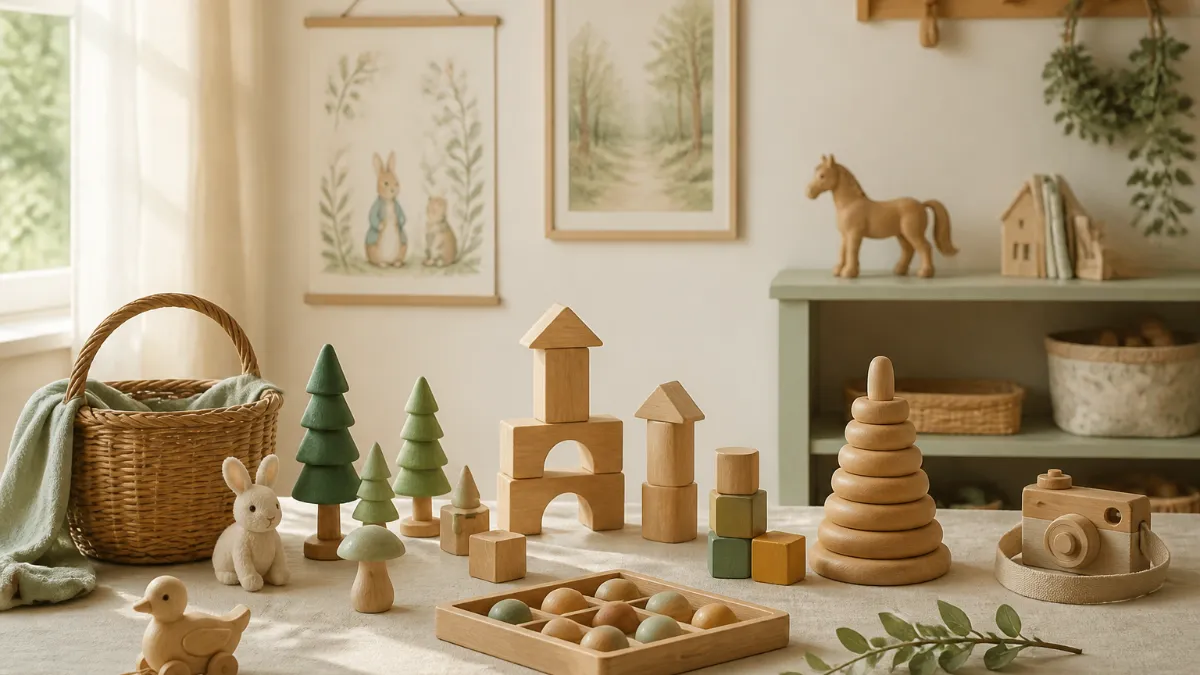
Parents ask this question more than any other, and it deserves a precise answer before anything else. An analog toy is any toy that does not require a screen, app, or internet connection to function. Wooden blocks, board games, art supplies, puzzles, dress-up items, musical instruments, craft kits, and friendship keepsake books all qualify. Tablets, electronic learning devices, and app-dependent games do not — even when the content those devices deliver is genuinely educational.
The definition matters because it sets the boundaries of a useful conversation. Notice what it does not say: analog toys cannot be clever, cannot be challenging, cannot be technologically sophisticated in their design. A beautifully engineered marble run involves physics, spatial reasoning, and cause-and-effect thinking. A hand-illustrated friend book involves literacy, emotional vocabulary, and social reasoning. Neither needs a battery to deliver those benefits. The absence of a screen is the criterion — everything else is open.
Some parents worry that this definition is too restrictive, that they are giving up richness in exchange for principle. The evidence suggests the opposite is true. Research shows that parents perceive traditional toys as the most stimulating for a child’s sensory, motor, cognitive, and socio-emotional development, and that during analog play significantly more parent–child interaction, as well as more language input from both parents and children, occurs. The richness was there all along. Screens obscured it.
At What Age Do Analog Toys Matter Most?
The honest answer is: all of childhood. But if you have limited bandwidth and want to know where analog play delivers its most concentrated developmental return, the window between five and twelve years old stands out clearly.
This is the period researchers call middle childhood, and its defining feature is the deepening of peer relationships. Friendships become especially important in middle childhood as more time is spent with peers, and close friendships — mutual relationships that develop gradually — influence both positive and negative social behaviors throughout this period.
High-quality friendships can foster positive self-esteem, social and emotional adjustment, and cognitive growth. Those outcomes are not delivered by a toy itself, but by the conditions play creates: two children working on the same thing, negotiating, laughing, and producing something together.
Children’s peer relationships are related to their functioning in multiple ways, and can contribute to their social and emotional development positively and negatively. These relationships are linked to well-being, psychological adjustment, engagement with school, and broader feelings toward peers. Analog toys that require two or more players — a cooperative board game, a shared art project, or a friend book that friends fill in together — create precisely the kind of sustained, reciprocal interaction that builds these outcomes. Digital games can bring children into proximity, but they rarely produce the eye contact, the shared laughter over a terrible drawing, or the handwritten message that a child re-reads years later.
The 5–12 window is also the period when social identity begins to form in earnest. Children are figuring out who they are relative to their peers, what their friendships mean, and which moments feel worth remembering. Analog toys that mark and preserve those moments — rather than letting them dissolve into a scroll of content — give children something to hold onto.
My Child Is Used to Screens — Will They Actually Play With Analog Toys?
The resistance is real, and you should expect it. A child who has spent significant time with screens has been trained to expect immediate, reactive stimulation: tap here, something happens; swipe there, something new appears. An analog toy does not offer that loop. It offers something different — the child’s own creativity as the engine — and that shift takes a moment to recalibrate.
What the evidence consistently shows, however, is that this recalibration happens faster than most parents anticipate. As digital life speeds up, families are choosing tech-free toys that help them power down and reset, and the Cozy Culture trend reflects a growing fondness for low-tech and no-tech play experiences that help families counterbalance constant digital stimulation and overstimulation. The children following this shift are not suffering. They are discovering something that screens structurally cannot provide: the experience of being the author, not just the audience.
The practical key is availability without pressure. Families are prioritizing longer stretches of play without switching activities every few minutes — screen-free fun in 2026 is not louder, it is deeper. Place open-ended analog toys where children can reach them without asking, step back, and resist the urge to demonstrate or instruct. Open-ended materials that invite a child’s own creativity — rather than prescribing a specific outcome — win children over fastest because there is no way to do them wrong.
Art supplies, building materials, craft kits, and friendship books all share this quality. A blank page in a friend book is an invitation, not a task. When a child’s best friend picks up the pencil and starts filling in their favorite things, the book becomes something no screen can replicate: evidence of a specific person, at a specific moment, that will never exist exactly that way again.
Are Analog Toys Backed by Science, or Is This a Parenting Trend?
This is the question that separates informed parents from anxious ones, and the answer is worth sitting with. The developmental research supporting analog, traditional, and screen-free play is not new, not thin, and not driven by nostalgia. It has been accumulating for decades across multiple disciplines.
Studies show that parents perceive traditional toys as the most stimulating toys for a toddler’s sensory, motor, cognitive, and socio-emotional development. Brain imaging research adds another layer: studies suggest that young children practice their mind-reading skills — tuning into thoughts, feelings, and desires — when they play with dolls, and researchers suspect that kids learn to reason about possible worlds when they engage in pretend play. Even a simple, low-tech object turns out to be doing significant cognitive work.
The social dimension is equally well-supported. Children’s relationships with peers provide an important context for development, offering opportunities for support and allyship, as well as social learning, and are associated with their broader adjustment. Analog play — especially play that involves more than one child — creates the conditions for that relational learning in ways that digital play rarely matches. When two children collaborate on a physical, shared object, they must read each other’s cues, negotiate, and respond in real time.
What has changed is not the science but the cultural conversation surrounding it. Rather than rejecting technology outright, this movement represents a conscious reset, with play serving as a screen-free space for emotional regulation, creativity, and connection. Parents today are not anti-technology ideologues. They are making calibrated choices about where technology adds value and where it quietly subtracts it. The research gives them solid ground to stand on when they make those choices.
What’s the Best Analog Toy to Start With for a Child Who Loves Friends?
The answer follows directly from the question: any toy that requires two or more people and produces something shared and tangible. A cooperative board game where players win or lose together. An art kit designed for two, where each child contributes to a single canvas. A puzzle large enough that one child cannot finish it alone. Or a friend book — a keepsake where each friend fills in their own page, in their own handwriting, with their own drawings and messages.
Removing screens from playtime can create a different space for children to push their imaginations to the limit, strengthen motor skills, and develop deeper connections with friends and family. The toys that create deeper connections tend to share one quality: they produce something the child can return to. A finished board game leaves a memory. A filled art kit leaves a painting. A friend book, though, leaves something rarer — a record of a specific friendship at a specific age, in the actual handwriting of a child who was there.
The best analog starting point for a socially-oriented child is the one that makes their friends feel seen. The toy that does that most reliably is not the most technically impressive or the most expensive. It is the one that puts a pen in their friend’s hand and asks: tell me your favorite things. That is a conversation. And conversations, unlike most toys, get better with time.
Where Things Stand
The momentum behind screen-free, analog play shows no signs of slowing as the 2026–2027 school year begins. In February 2026, The Toy Association unveiled its official 2026 Toy & Play Trends at Toy Fair, and one of the headline themes — “Cozy Culture” — describes exactly what Montessori-minded parents have valued all along: low-tech, sensory, natural-material toys that help children slow down, focus, and connect.
A second theme, Inspiring Inventors, reflects growing demand for building and customization toys that support creativity and problem-solving, with the group noting that 78% of parents want more toys that help their kids develop skills like these. At the same time, a major trend in 2026 is the rise of screen-free toys, with parents actively looking for alternatives to digital entertainment as toy trends reflect this shift. Most recently, just one day before this article was published, a toy industry editorial team joined a national television broadcast to highlight the best screen-free educational toys for kids ahead of the new school year — a sign that the conversation around analog play has moved firmly from niche parenting philosophy into mainstream back-to-school guidance. The scientific foundation underpinning these trends remains stable, with no major new findings that contradict the established picture of analog play’s developmental benefits.
See Related below for more on this topic.
For further reading, see the Sources listed below.
About the author

Dori Fussmann — VP Content
Dori Fussmann leads Album Amicorum, an independent studio behind an illustrated Friend Book that children fill in by hand — turning the notes, drawings, and small messages of childhood friendships into a keepsake worth keeping. His background is in building consumer brands, and he started writing here out of a conviction that the memories that matter most belong off-screen. These articles draw on child-development research and the work of experts such as Jonathan Haidt.
Related
Sources / Further reading
Frequently asked questions
Can a toy be 'analog' if it has moving parts or makes sounds without a battery?
Yes. The defining feature of an analog toy is that it requires no screen, app, internet connection, or digital processor to function. A music box, a spinning top, or a marble run all involve mechanical movement or sound and are firmly analog. The distinction is not about complexity or sensory richness — it is about whether the play experience lives inside a device or in the child's own hands and imagination.
How long does it realistically take for a screen-habituated child to prefer analog play?
Most parents and child development educators report that the adjustment window is one to two weeks of consistent, low-pressure availability — meaning the analog toys are always accessible and screens are not immediately offered as an alternative. The key is removing the comparison rather than demanding enthusiasm. Open-ended toys that have no 'wrong' outcome tend to win children over fastest because they invite rather than instruct.
Are analog toys better for introverted children who prefer one-on-one play?
Analog toys are especially well-suited to introverted children because they support deep, focused play rather than the rapid stimulation that digital games often provide. One-on-one formats — a shared puzzle, a craft kit for two, or a friend book filled in together — match an introverted child's natural preference for intimate connection over group performance. These formats also generate more sustained conversation than side-by-side screen use.
What should I look for when choosing an analog toy that genuinely lasts?
Look for three qualities: open-endedness (the toy can be used in multiple ways as the child grows), durability of materials (wood, thick cardstock, fabric, or sturdy board rather than thin plastic), and meaning-making potential (does playing with it produce something the child actually wants to keep or return to?). A toy that creates a record of time — a filled sketchbook, a completed puzzle photographed and reassembled, or a friend book full of handwritten messages — outlasts any battery-powered alternative.