Alternatives to a Smartphone That Kids Enjoy
Step-by-step guide for parents choosing a smartphone-free childhood: audit the void, replace real connection, and build routines kids genuinely love.

The First Question Isn’t “What Do I Give Them?” — It’s “What Did the Phone Actually Do?”
Most parents who decide to delay or limit their child’s smartphone arrive at the same uncomfortable moment: the phone is gone, and the silence that follows feels enormous. Children slump. They complain. They insist there is nothing to do. It’s tempting to read this as proof that the experiment has failed — but it’s actually proof that it was necessary. The answer usually lies in slow childhood and analog play, not another device.
Researcher Jonathan Haidt describes today’s dominant model of childhood as “phone-based” and argues that the shift away from play has been damaging. The transition from a play-based to a phone-based childhood, in his words, “has been a catastrophic failure.” Walking that back is not a punishment. It’s a recalibration. But recalibration requires a plan, and a good plan starts not with a shopping list of alternatives, but with an honest audit.
Before you can replace a smartphone, you have to understand what function it was serving. Was your child using it primarily to communicate with friends? To fill unstructured time? To watch videos? To play games? To feel part of something? Each of these is a different need, and each requires a different response. A child seeking connection needs something different from a child seeking entertainment. Conflating them leads to replacement strategies that feel hollow — the child knows what’s missing, even if they can’t articulate it. Do the audit honestly, and you’ll find you don’t need a hundred new activities. You need the right three or four.
Step 1: Audit the Void — Know Exactly What You’re Replacing
Sit down with a piece of paper and map out how your child actually used their device. Break it into categories: communication, entertainment, creative output, information, and social visibility (seeing what peers are doing). Be specific. Did they spend most of their time in group chats? Watching short-form video? Playing multiplayer games with friends? Each category has a better analog equivalent — but you need to know which ones matter most in your family.
According to Common Sense Media, 8- to 12-year-olds average more than four and a half hours of screen media a day. That’s not idle time — it’s time that was filling something. When it disappears overnight, you’re not left with five free hours of creative possibility. You’re left with five hours of unmet need. The audit is how you identify which of those needs is loudest for your particular child, so you can address it directly rather than offering a scattergun of activities that don’t quite hit the mark.
For many children, especially those in the 8–12 age range, the loudest need is social: the feeling of being connected, of knowing what’s happening with their friends in real time. That’s the one to tackle first.
Step 2: Replace Connection, Not Just Entertainment
Of all the functions a smartphone serves, the social dimension is the hardest to replicate — and the most important to get right. One of the central concerns researchers identify is that all children are on phones, making it seem like the only way to avoid social isolation is to be on a phone. This is the fear that lives inside your child’s resistance: not that they’ll be bored, but that they’ll be left out.
The answer is not to dismiss this fear, but to actively engineer its solution. Arrange playdates deliberately and consistently — not as an occasional treat but as a regular rhythm. Encourage your child to write letters or send postcards to friends they don’t see every day. Reach out to other parents directly to coordinate time together. These feel like small gestures, but to a child, a letter in the post is not a lesser version of a text message — it’s a more vivid one. It has weight, texture, and permanence that no notification ever achieves.
One of the most effective analog tools for this age is a beautifully made Friend Book: a structured, illustrated book in which each friend contributes their own page — handwriting, drawings, favorite things, a message, a memory. Unlike a social media profile that refreshes and disappears, a Friend Book accumulates. Each page is a fixed moment in a real friendship. Children who grow up with them tend to return to them again and again, not just in childhood but for decades afterward, and the accumulation of those pages becomes something no digital platform can replicate: a tangible record of who loved you and who you loved at every stage of growing up.
Step 3: Build a Weekly Rhythm of Anchor Activities
Removing a smartphone without replacing the rhythm it created leaves children adrift. Phones are, among other things, time-structuring devices — they give children something to do in every gap. When those gaps open up, the transition feels formless. The solution is to create new anchors.
Researcher Jonathan Haidt recommends parents come together to create one weekly tradition: “free play Fridays.” His proposal is simple: “Let’s just all agree that Friday is a day when you do not schedule any educational activities.” The value of this kind of protected, unstructured time is well-documented. Unstructured free play sparks creativity, hones problem-solving skills, and nurtures social development — it’s a chance for kids to follow their curiosity, dive into imaginative play, and sharpen their critical thinking.
Beyond a free-play afternoon, think in terms of weekly rituals that your child can look forward to and depend on. A craft night with materials laid out on the table. A Saturday morning outdoor ritual — a walk, a bike ride, a weekly visit to the same local spot in different seasons. A game night with real cards or a board game your family genuinely enjoys. These anchor activities don’t need to be elaborate; they need to be consistent. Children thrive on predictability, and when screen-free time has a predictable shape, the formlessness fades.
The goal is for your child to arrive at Thursday night not dreading the weekend but anticipating it. That shift — from the phone as the thing you look forward to, to the things you do as the things you look forward to — is the whole project in miniature.
Step 4: Equip the Environment for Analog Living
Children reach for their phones partly because phones are always there, already on, already offering something. If you want to convert boredom into creativity rather than screen demand, the environment has to make the alternative easier than the default.
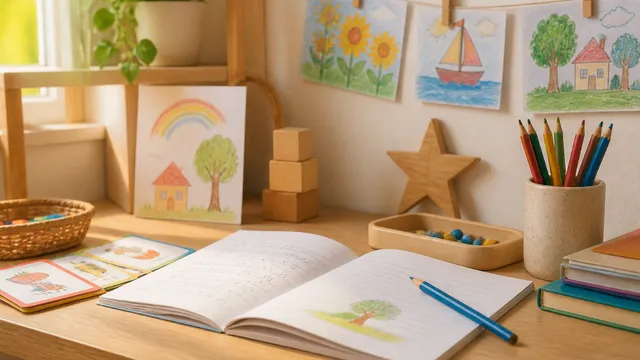
Stock your home intentionally. This doesn’t mean buying everything at once — it means identifying two or three open-ended materials that your specific child gravitates toward and making sure those are always accessible, not locked in a cupboard or buried under other things. A set of watercolors and good paper left on the kitchen table gets used. The same set in a box on a high shelf gets forgotten. Art supplies, building blocks, modeling clay, illustrated journals, and beautifully made keepsake books all have one thing in common: they reward sustained attention in a way that digital content does not. You get better at them. They leave something behind.
Prompted journals and illustrated keepsake books earn a particular mention here, because they solve a problem that pure free play sometimes doesn’t: they give children who like structure a creative scaffold. A journal with thoughtful prompts — or a Friend Book with a dedicated page for each friend — gives a child something to do that is both creative and social. It connects the act of making to the act of remembering, and the result is an artifact that carries meaning forward in time. Other prompted journals on the market focus on the self — memories between parent and child, gratitude practices, bucket lists. These are genuinely valuable. But they don’t address the social dimension: the child’s world of friends, the small rituals and inside jokes and handwritten promises that define peer friendship at its most vivid.
Step 5: Coordinate with Other Families — This Is the Most Important Step
Haidt advocates for parents to take on these decisions about how their kids spend their time as a community. “It’s how families can restore a healthy childhood,” he says. This is not a polite suggestion — it’s the crux of everything. One family can do everything right and still have a child who feels isolated, because the social reality at school is determined by what the majority does. Collective action is what changes the majority.
The Smartphone Free Childhood movement’s approach centers on the “Parent Pact”: talking to other parents in your child’s year group. If ten friends don’t have smartphones, the peer pressure vanishes. You don’t need to convert the whole school. You need enough of your child’s actual friend group to be aligned that the social stakes change. Three families is often enough to make a meaningful difference; five or six is transformative.
Grassroots groups tied to the smartphone-free cause are popping up worldwide. In the US alone, advocates collaborate with organizations including the Screen Time Action Network and Schools Beyond Screens. Finding one of these groups — or simply sending a text to four parents you already know — is genuinely the highest-leverage action in this entire process. Everything else helps. This is the one that actually shifts the social norm.
Putting It Together: The Friend Book as the Missing Piece
When you implement all five of these steps — auditing honestly, replacing connection deliberately, building weekly rhythms, equipping the environment, and aligning with other families — something shifts. Screen-free time stops feeling like absence and starts feeling like fullness. Children discover, sometimes slowly and sometimes with a rush, that real life is richer than a feed. But that discovery is not automatic, and it is not merely the result of removing a screen. It requires the right materials, the right structures, and the right social context.
This is where a beautifully made Friend Book becomes not just a nice addition but a genuinely useful tool. It sits at the intersection of everything: it is creative, social, structured, beautiful, and enduring. When a child gives a Friend Book to a friend — or receives one — they are participating in something that began in medieval Europe, when scholars and travelers kept albums of inscriptions and portraits from the people they valued most. The modern form is different in its illustrations and its prompts, but the impulse is the same: to ask a real person, in the real world, to leave something permanent of themselves. That is not a lesser version of social media. It is the original version of it — and the one that actually lasts.
Other keepsake products on the market — from Promptly Journals’ prompted memory books to the premium printed photo books offered by Artifact Uprising — address adjacent needs beautifully. But a Friend Book occupies a specific and unreplaceable niche: it is the child’s own social record, written by the friends themselves, in their own handwriting, with their own drawings. No adult curates it. No algorithm surfaces it. It belongs entirely to the child, and every page in it was made by someone who chose to be there.
As you build your toolkit of smartphone-free alternatives, this is the piece that addresses the social void most directly and most beautifully. Give a child the time, the rhythm, the environment, and the community — and then give them the book. The rest takes care of itself.
Where Things Stand
Parents in the US and abroad are increasingly joining efforts to delay smartphones, and the Smartphone Free Childhood movement has grown into an international campaign. As it grows, the practical question of what children do instead has become central, driving interest in analog social tools, craft materials and even a return of the home phone.
For further reading, see the Sources listed below.
Frequently asked questions
What is the hardest part of a smartphone-free childhood to replace?
The social dimension is the most difficult. Children use smartphones primarily for connection — messaging friends, sharing moments, staying in the loop. Replacing this requires active effort: coordinating regular playdates, encouraging letter-writing, and giving children tangible tools like a Friend Book to record and celebrate their friendships in the real world. The key is replacing the function, not just removing the device.
How do I handle peer pressure when my child is the only one without a smartphone?
The most effective solution is collective action. Reaching out to even three or four other families in your child's class or friend group — and aligning on a shared approach — changes the social equation dramatically. When a critical mass of peers doesn't have smartphones, 'everyone else has one' stops being true. Local Smartphone Free Childhood groups can help you find like-minded families quickly.
How do I fill the boredom that comes when screens are removed?
Start by stocking your home with open-ended analog materials: art supplies, board games, building sets, journals, and illustrated books. Boredom itself is valuable — research consistently shows it drives creativity and problem-solving — but children need the raw materials to convert boredom into something satisfying. A weekly rhythm of anchor activities (a craft night, an outdoor ritual, a free-play afternoon) also helps so that screen-free time feels full rather than empty.
At what age should a child get a smartphone, according to current research?
Researcher Jonathan Haidt and organizations like Smartphone Free Childhood recommend delaying smartphone access until at least age 14 (high school), and social media until 16. These recommendations are based on research linking early smartphone and social media adoption with significantly higher rates of anxiety, depression, and disrupted development. Many families find that coordinating this delay with other parents in their community makes it far more manageable for their child socially.
Related
Sources
About the author

VP Content
Dori Fussmann leads Album Amicorum, an independent studio behind an illustrated Friend Book that children fill in by hand — turning the notes, drawings, and small messages of childhood friendships into a keepsake worth keeping. His background is in building consumer brands, and he started writing here out of a conviction that the memories that matter most belong off-screen. These articles draw on child-development research and the work of experts such as Jonathan Haidt.