Friendship Activities for Kids
Discover the best friendship activities for kids ages 5–12: why they matter, how to make them meaningful, and how to preserve the memories they create.
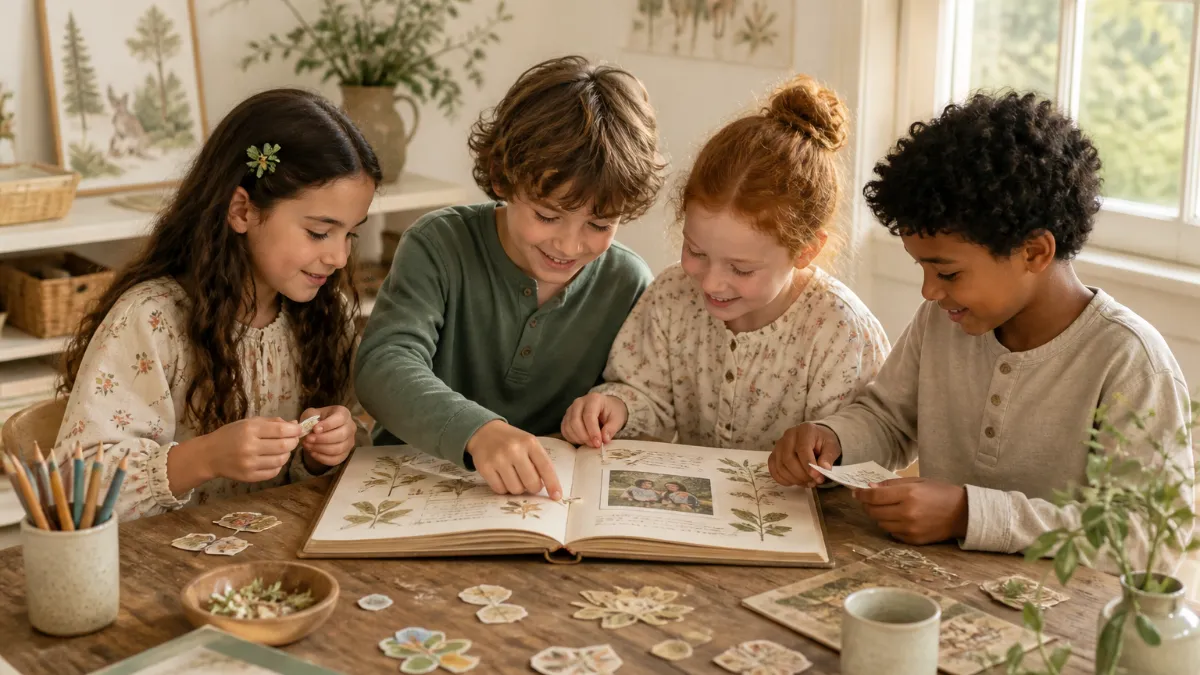
There is a version of a childhood afternoon that most parents can picture clearly: two children bent over a table, pencils moving, shoulders almost touching, occasionally dissolving into laughter over something only they understand. No screens. No schedule. Just the quiet, industrious pleasure of making something together. That image captures something essential about what friendship activities can be at their best — not entertainment to fill time, but experiences that build something real, between real people, at a particular and unrepeatable moment in a child’s life.
This guide is for parents who sense the difference between keeping children occupied and genuinely nurturing their friendships. It covers why friendship activities matter developmentally, how to distinguish the most impactful types, and how to make the memories children build together last far longer than the afternoon.
Why Friendship Activities Are More Than Just Fun
The case for intentional friendship activities begins with the research, and the research is unambiguous. A Journal of School Psychology study found that children with strong friendships have a higher sense of belonging and life satisfaction, research from the University of Illinois shows children with healthy friendships have better emotional intelligence and do better in school, and the American Academy of Pediatrics notes that strong friendships help improve mental health and lower the risk of anxiety and depression. These are not marginal findings. A University of Virginia study found that kids with close friends tend to have better physical and mental health later in life.
What the research makes clear is that friendship is not simply a pleasant by-product of childhood — it is a developmental engine. Socializing through play and friendship activities helps children build socially and emotionally, and as they explore friendship activities, they learn to master the nuances of empathy, compromise, and conflict resolution. These are not skills that arrive automatically with age. They are practiced, refined, and deepened through repeated, meaningful contact with other children — and the activities that structure that contact shape the quality of what gets built.
Young children are more likely to develop friendships if they understand the thoughts and feelings of other people, and as kids get older, mind-reading skills such as empathy, moral reasoning, and perspective-taking are linked with likability and positive peer relationships. Friendship activities that ask children to share, listen, create together, and express genuine feelings are, in effect, exercises in exactly these capacities. A well-chosen activity is not decoration around a playdate — it is the practice ground for the social-emotional skills that will serve a child for life.
The Distinction That Changes Everything: School vs. Home
Most online searches for “friendship activities for kids” return classroom-ready resources: circle time prompts, SEL worksheets, group games designed for twenty children at once. These are genuinely valuable in their context. The classroom is a place where students learn how to understand themselves, build relationships, and navigate emotions, and since students spend a significant portion of their time at school, social-emotional development in the classroom is crucial.
But classroom friendship activities serve a fundamentally different purpose than what thoughtful parents are reaching for when they want to deepen a specific friendship between their child and a particular best friend. School-based SEL is designed for broad skill-building across a diverse group. Home-based friendship activities are something else entirely: they are intimate, personal, and targeted at the bond between two or a handful of children who have already chosen each other. They can go deeper, stay longer with a single topic, and — crucially — they can produce something that belongs only to those children.
Good friendships share several common ingredients, including nurturance, disclosing vulnerabilities, conveying trust and loyalty, and helping friends cope and thrive — and research finds that young children’s social skills are strongly influenced by positive parental involvement. This is the heart of the distinction: parents are not neutral bystanders in their children’s friendship lives. Structuring the right activity, at the right moment, with the right friend, is itself a meaningful act of parenting.
The Activities That Create the Deepest Connection
Not all friendship activities are equal. There is a meaningful difference between activities that entertain children simultaneously (watching a film, playing a video game) and activities that require them to engage with each other — to communicate, collaborate, and produce something together. The most impactful friendship activities for children ages 5–12 combine doing something together with making something tangible: a physical record of the moment that outlasts the afternoon.
Creative and Craft-Based Activities
Making things together is one of the oldest forms of human bonding, and it works as powerfully for children as it does for adults. Project-centered gatherings replace passive scrolling, as shared making lowers social pressure and builds deeper connection. When two children are working with their hands — drawing, painting, weaving friendship bracelets, collaging — the activity itself takes the social pressure off. They don’t have to perform friendship; they simply do it, side by side, while making something real.
Making friendship bracelets is an activity that never goes out of style — as children weave their threads and beads together, they can discuss the characteristics of a good friend, someone who is kind, patient, understanding, and supportive. What makes craft activities particularly powerful is not just the conversation they enable during the making — it’s the object that remains afterward. A bracelet, a painting, a collaborative drawing: these become artifacts of the friendship, proof that this time together existed and mattered.
Storytelling, Writing, and Sharing Favorites
For children who are old enough to write — roughly ages 6 and up — activities that involve recording thoughts, preferences, and memories in their own hand are especially rich. Asking a friend to write down their favorite color, their favorite food, what they want to be when they grow up, or a memory they share is an act of both self-disclosure and listening. It creates a snapshot of who this person is, right now, at this exact age — information that becomes more precious with every passing year.
Studies show that children who participate in conversations about emotions and mental states tend to be more socially competent. Activities that invite children to name and share their inner world — through writing prompts, drawing, or simple question-and-answer formats — do exactly this. They make the invisible visible. They give children a vocabulary for talking about themselves with each other, which is the foundation of genuine intimacy.
Games, Cooking, and Active Play
Shared experiences that require cooperation — cooking a simple recipe together, playing a cooperative board game, building something physical, gardening, or going on a nature walk with a shared purpose — build the trust and memory-making that deeper friendships rest on. While organized activities offer valuable experiences, they may not provide much time for genuine socialization, and much of childhood friendship develops during playdates, neighborhood gatherings, and spontaneous hangouts. The best parent-facilitated activities create the conditions for that spontaneous quality — a loose structure that gives children something to do together while leaving ample room for the unscripted moments that become the memories.
Letters and Pen Pals
For children whose friendships span distance — a cousin in another city, a school friend who moved away — letter writing is a particularly meaningful friendship activity. Handwritten letter writing has seen renewed interest as an intentional, slower alternative to instant digital messaging, with the format’s inherent delay functioning as a deliberate feature rather than a limitation. For children, that deliberateness is also a lesson: caring enough about someone to sit down, write something by hand, decorate the envelope, and send it through the mail is a physical expression of affection that no text message can replicate.
Why Analog, Hands-On Activities Create Different Connection
There is a qualitative difference between the connection children build through hands-on, analog activities and the kind that forms around shared screen time. Screen-based activities are often parallel rather than collaborative — each child is consuming, responding to, or competing within a system designed by someone else, with no room to leave their own mark. Analog activities are generative. Children are the authors. What they produce did not exist before they made it together.
The evidence points in a clear direction: children know, intuitively, what serves them. When given permission to do less and do it with a friend, they tend to choose the activities — making things, exploring together, telling stories — that create the richest memories.
The things children make together in an analog afternoon also have a different relationship to time. A drawing completed on a rainy Saturday, a recipe written out in wobbly handwriting, a letter decorated with stickers: these objects hold the afternoon inside them. Twenty years later, they don’t just remind a person that the friendship existed — they show exactly what it looked like, sounded like, cared about. That is something no algorithm preserves.
Making Friendship Memories That Last
The gap most families encounter is not a shortage of good friendship activities — it is a shortage of ways to gather and keep what those activities produce. An afternoon of beautiful moments disappears when the friend goes home. A drawing gets folded into a pocket, and eventually lost. A shared joke fades. This is the natural attrition of childhood, and for most of human history it was simply accepted as the price of growing up.
But there has always been another way. The album amicorum — literally “book of friends” — originated in 16th-century Europe, when university students carried blank books and asked friends, teachers, and mentors to write or draw on their pages as they traveled. The tradition eventually gave rise to the friendship books and autograph albums that were popular through much of the 19th and early 20th centuries: a child’s book passed among friends, each one contributing a page of their handwriting, their favorite things, a small drawing or poem. These books survived. They are the reason we know what a child in 1887 loved, who they counted as their dearest friends, and what they thought the future held.
The instinct behind that tradition — to gather, in one place, the handwritten traces of the friendships that define a childhood — is as sound today as it was centuries ago. When children have a dedicated space to collect what their friends create for them, those individual moments of connection accumulate into something far greater: a complete portrait of a friendship, and of the child who held it.
The Friend Book as the Natural Capstone
Every friendship activity described in this guide is more valuable when its product has somewhere to go. A drawing given freely is a gift; a drawing added to a friend’s book is a permanent record. A question answered in conversation is quickly forgotten; a question answered in a child’s own handwriting, with their own illustration beside it, becomes a keepsake that survives decades.
This is why a beautifully made friend book is not simply another craft activity — it is the structure that gives every other friendship activity permanence. It is the place where a child gathers the handwriting of everyone who mattered to them at age seven, or nine, or eleven: their favorites, their jokes, their drawings, their messages. It cannot be recreated. The version that exists — with those specific friends, at those specific ages, in those exact words — exists only once.
Album Amicorum’s illustrated friend book is designed precisely for this purpose. It draws on that centuries-old tradition of the album amicorum to give children a beautiful, purposeful space for collecting the handwritten contributions of their friends — not as a school project, not as a digital archive, but as a genuine keepsake of childhood exactly as it was. If you have been investing in meaningful friendship activities for your child, a friend book is the place where all of those investments are gathered and held.
The Two-Test Rule: Why Most “Friendship Crafts” Don’t Make the Cut
Browse any list of friendship activities for kids and you will find plenty of suggestions that check one box but not the other. A friendship bracelet made from cheap plastic beads deepens connection in the moment — children are close, laughing, helping each other tie knots — but the bracelet breaks by next week and ends up in a bin. A prompted worksheet about “my best friend” might produce something written, but if it is printed on flimsy paper and filled out in five minutes with no real investment, it rarely survives a backpack.
The activities on this list are different. Each one asks children to contribute something genuinely of themselves — their handwriting, their opinions, their imagination, their voice — and to do it in a medium that holds up. The distinction matters because a child who finds a friendship bracelet still on her wrist two years later, or pulls out a folded illustrated page from a box under her bed, does not just remember the craft. She remembers the afternoon, the friend, the particular way that day felt. The artifact carries the memory. That is the entire point.
The Capture: The Most Skipped and Most Important Step
Here is the honest truth about most playdates and friendship afternoons: they end with a hurried goodbye and a vague sense that it was lovely. Three weeks later, nobody can remember the specific details — what made everyone laugh, what surprising thing one child said about the other, what they made together. The afternoon leaves no mark because nothing captured it.
The capture phase changes that. It is short — five to ten minutes — and it happens before anyone puts on their shoes to leave.
How to Run the Capture Phase
Bring the children back to the table. Give each child a fresh piece of paper, or a page in a shared book, and a single prompt: Write or draw one thing you want to remember about your friend today.
That’s it. The prompt is deliberately singular — one thing, not a list — because the constraint produces specificity. A child who must choose only one thing will choose something real: not “she is nice” but “she said she wished she could fly and she meant it.” That’s the raw material of a genuine friendship record.
For younger children, the capture can be purely visual: a small drawing of a moment from the afternoon, signed and dated. For older children, a sentence or two is enough — the handwriting itself becomes part of what is preserved.
If the afternoon has produced decorated pages, lists, or illustrated notes in the main activity phase, those can double as the captured artifact. The important thing is that before the afternoon ends, each child has created something that names the other and names the day.
Why This Phase Is Transformative
When children see themselves as participants in preserving something meaningful, it shifts the emotional weight of the afternoon. Unlike toys or digital experiences that are quickly outgrown, a handwritten record becomes a keepsake that transports a child back to this exact moment long after they are grown. The handwriting is the proof: this happened, we were here, this is what it felt like.
Parents often worry that children won’t engage with the capture phase, especially if it feels formal. The solution is to model it without making it a performance. A parent who quietly writes their own one-sentence observation — “Today I noticed how hard you both laughed about the map” — demonstrates that capturing is a natural act, not a homework assignment.
When Your Child Is Shy
This is one of the most common concerns parents bring up, and the answer is usually the opposite of what they expect: for shy or anxious children, a structured activity often makes social time easier, not harder.
Think about what unstructured social time actually asks of a shy child. It requires them to generate conversation topics, initiate play, negotiate roles, and read social cues — all simultaneously, with no script. That is an enormous cognitive and emotional load. A structured activity removes most of it. There is already something to do, something to talk about, and a clear reason to be sitting near another person. The task carries the social weight that the child doesn’t yet know how to carry alone.
The crucial distinction is between low-stakes creative tasks and performance-based ones. Drawing side by side, writing answers to prompts, decorating a page together — these activities have no winners and no audience. A child cannot “fail” at filling in their favourite colour or drawing their dream pet. Games with scores, talent showcases, or activities with a “best” outcome are a different matter entirely: they introduce exactly the evaluative pressure that makes shy children shrink. Not every activity fits every child on every day — some kids thrive in group settings and hate role-play, while others will talk freely in a small group but freeze in a whole-class setting. Choosing creative, open-ended tasks over competitive ones is the single most reliable way to keep anxiety low and engagement high.
If your child is shy, structure is your ally. Just make sure the structure serves connection rather than performance.
Structured Activities vs. Free Play: Why Children Need Both
It would be convenient if the research landed cleanly on one side of this debate. It doesn’t, and that is actually the most useful finding. Structured goal-directed tasks show clear advantages for non-friends or new acquaintances , while established friends reach their deepest connection through free, unstructured time. The implication is not that one is better than the other — it is that they serve different moments in the arc of a friendship.
The most friendship-deepening environments combine both: a light structure that initiates connection, followed by extended free-play time that deepens it organically. Think of a structured activity as the warm-up, not the main event. Fifteen minutes of making something together — a drawing, a game, a shared craft — can ease two children into the same emotional frequency. What follows, when the activity ends and the children are left to their own devices, is where the real friendship-building begins.
Guided play in early childhood education is defined as a playful learning approach in which children retain control over their activities, while adults intentionally scaffold the environment, pose open-ended questions, or subtly guide interactions toward specific learning goals. The practical version of this for parents is simpler than it sounds: set up a starting point, then leave the room.
Where Things Stand
Hands-on, screen-free activities are one of the clearest family trends of 2026. With a new school year under way, there is renewed focus on helping children build friendships, and much of that happens in playdates and unstructured time at home, exactly where a shared creative project can leave a lasting memory.
For further reading, see the Sources listed below.
Frequently asked questions
What age is best to start friendship activities with children?
Children as young as 5 can participate in simple friendship activities like cooperative art projects or sharing their favorite things. The 5–12 age range is particularly rich for intentional friendship activities because children are forming their first chosen friendships, developing empathy, and becoming capable of producing lasting keepsakes — letters, drawings, and written memories — that they can revisit for years.
How are home-based friendship activities different from classroom SEL activities?
Classroom and school-based SEL activities are designed to build broad social skills across a whole group — things like turn-taking, conflict resolution, and community building. Home-based friendship activities, by contrast, are parent-facilitated and focused on deepening a specific bond between two or a few children. They tend to be more personal, more creative, and more likely to produce a tangible keepsake — a piece of art, a written memory, or a shared story — that belongs only to those friends.
Why do hands-on, analog friendship activities matter more than screen-based ones?
Screen-based activities are often passive and leave nothing behind. Hands-on, analog activities — drawing, writing, crafting, cooking together — require attention, communication, and effort, which deepens connection. Critically, they often produce something physical: a drawing, a letter, a bracelet, or a book. That tangible artifact becomes a record of the friendship at a specific moment in childhood, something no screenshot or video can fully replicate.
What is a friend book, and how does it work as a friendship activity?
A friend book (sometimes called a vriendenboekje, or friendship book) is a beautifully illustrated book that a child passes among their friends, asking each one to fill in a page with their handwriting, favorite things, drawings, and messages. Each completed page is a one-of-a-kind portrait of that friendship at that moment in time. Unlike a single afternoon's activity, a friend book accumulates over months or years, becoming a permanent, irreplaceable keepsake of childhood friendships.
How long should a friendship activity session last for primary-school-aged children?
For ages 5–7, 20 to 30 minutes is typically the sweet spot — long enough to produce something tangible, short enough to end before energy flags. For ages 8–12, sessions of 40 to 60 minutes allow for more depth, especially if the activity has a creative output such as a drawing, a written page, or a shared book. The single most important thing is to end while enthusiasm is still high, so the memory attached to the activity stays positive.
What if my child and their friend disagree or fall out during the activity?
Minor friction during shared creative activities is normal and actually useful — it gives children low-stakes practice in negotiation and repair. The most helpful parent response is to briefly acknowledge the disagreement and redirect to the physical material. Named sections or clearly divided materials make redirecting much easier, because there is always an obvious 'yours' and 'theirs' to return to.
Related
About the author

VP Content
Dori Fussmann leads Album Amicorum, an independent studio behind an illustrated Friend Book that children fill in by hand — turning the notes, drawings, and small messages of childhood friendships into a keepsake worth keeping. His background is in building consumer brands, and he started writing here out of a conviction that the memories that matter most belong off-screen. These articles draw on child-development research and the work of experts such as Jonathan Haidt.