How to Start a Kids' Friendship Book
A parent's practical guide to starting a friendship book with kids — from setting up the very first page to building a keepsake that lasts for decades.
Why Starting a Friendship Book Is Worth Doing Right
Some keepsakes you simply buy and put on a shelf. A friendship book is not one of them. It has to be started (introduced, explained, handed around, coaxed into life) and the way you begin it shapes everything that follows. A book passed to a friend with a casual “just write something” will return with a first name and a smiley face. A book introduced with a little intention and warmth will come back with a favorite color, a memory, a drawing that looks exactly like the child who made it. The difference between those two outcomes isn’t the book. It’s the setup.
This guide walks through exactly that setup (from choosing the right moment to preserving what you’ve gathered) so that the friendship book you start becomes the kind of thing your child is still reaching for at thirty.
Some keepsakes you simply buy and put on a shelf. A friendship book is not one of them. It has to be started (introduced, explained, handed around, coaxed into life) and the way you begin it shapes everything that follows. Think of it like planting a garden: the seeds you have matter far less than how carefully you prepare the soil before they go in. A book passed to a friend with a casual “just write something” will return with a first name and a smiley face. A book introduced with a little intention and warmth will come back with a favorite color, a memory, a drawing that looks exactly like the child who made it. The difference between those two outcomes isn’t the book. It’s the setup. This guide walks through exactly that setup (from choosing the right moment to preserving what you’ve gathered) so that the friendship book you start becomes the kind of thing your child is still reaching for at thirty.
Step 1: Choose the Right Moment to Begin
Friendship books don’t need a special occasion, but they thrive with one. The best time to introduce a friendship book to your child is at a natural inflection point in their social life: the start of a new school year, the final weeks of a grade they’re about to leave, or the weeks before a move. These are the moments when friendships feel vivid and a little bit fragile — when everyone can sense, even if they can’t articulate it, that things are about to change.
The End of a School Year Is Particularly Powerful
There’s something about the last weeks of a grade that creates both urgency and sentimentality in children. They know their classroom is about to dissolve. Friendships that felt permanent suddenly feel precious. A friendship book introduced at this moment gives that feeling somewhere to go. Friends who might otherwise drift apart over a summer have the chance to leave something of themselves behind (a handwriting sample, a favorite food, a drawing) before they do.
A move is similarly charged. If your family is relocating, or if a beloved classmate is leaving, a friendship book started in the weeks before departure becomes something closer to a time capsule than a keepsake. It captures a specific configuration of children that will never exist again in quite the same way.
The beginning of a school year also works well, particularly for children starting in a new class or a new school altogether. Here the book serves a slightly different function: it becomes a project, a reason to approach new classmates, a structured way to begin building connection.
Step 2: Set It Up With Your Child First
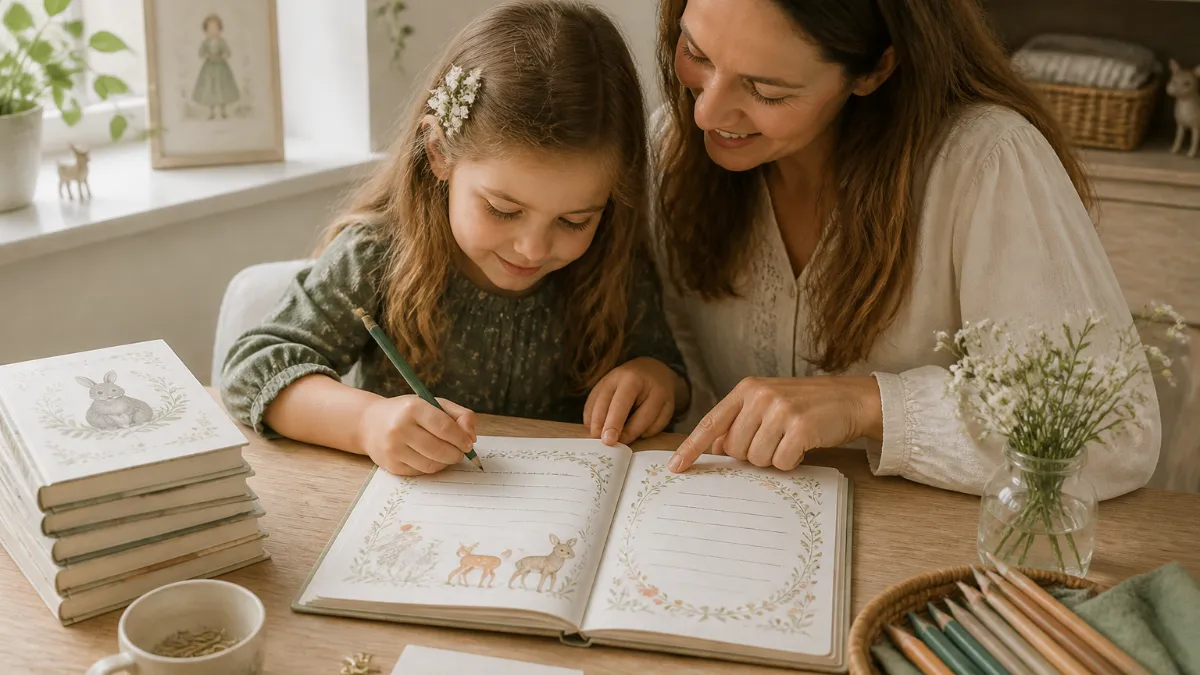
Before the book goes anywhere near another child, sit down with your child and fill in their own introductory page together. This step is easy to skip (it feels like housekeeping) but it matters enormously. A child who has filled in their own page understands what the book is asking. They can explain it to a friend confidently. They feel a sense of ownership over it rather than handing over an object they don’t quite understand.
What the Introductory Page Should Include
Most friendship books include a page at the front where the book’s owner records their own name, age, favorite things, and a self-portrait. Walk through it with your child as you would any creative project: ask questions, let them take their time, resist the urge to correct or improve their handwriting. Their handwriting right now (wobbly, large, utterly their own) is exactly the point. It is the handwriting of a seven-year-old, and in fifteen years it will be one of the most remarkable things about the page.
Once the introductory page is complete, take a moment to look through the rest of the book together. Show your child what the pages for their friends look like. Explain that each friend will fill in one, and that no two will be the same. When a child can visualize what the finished book might look like, they become genuinely excited to start collecting.
Step 3: Introduce It to Friends Intentionally
Resist the urge to send the book to school in a backpack with a vague instruction to pass it around. The results will be unpredictable, and the book may return half-filled, scribbled over, or (worst of all) lost.
A Playdate, Party, or Farewell Is the Ideal Setting
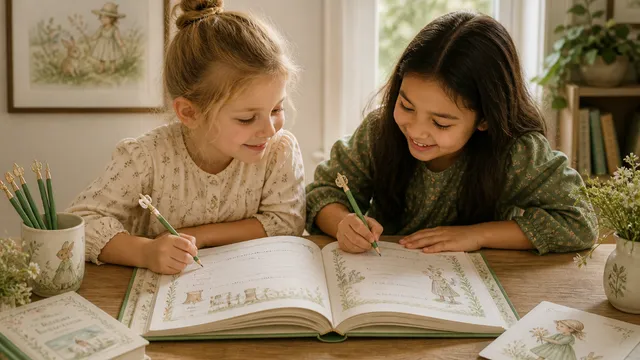
The best environment for introducing a friendship book is one where children have time, space, and a low level of ambient distraction — a playdate at home, a birthday party, or a class farewell gathering. In these settings, sitting down to fill in a page feels like participation in the event rather than homework. There’s no bell about to ring. Friends can take ten minutes to think about their favorite things, draw a picture, and write a message without rushing.
Birthday parties are particularly well-suited to this: the guest of honor has a natural reason to hand the book to each friend, and completing a page can become part of the party itself, the way signing a card might be at an adult gathering — but slower, more personal, and far more likely to be remembered. Similarly, a class farewell or end-of-year celebration gives everyone a meaningful activity and gives the departing child something tangible to carry away from that gathering.
If a formal occasion isn’t available, a simple afternoon playdate works beautifully. Invite one or two close friends, set out the materials, and let the filling-in happen naturally as part of the afternoon. The unhurried pace of a playdate often produces the most thoughtful pages.
Step 4: Give Friends the Right Prompts and Tools
One of the quiet reasons friendship books fail to reach their potential is that children — particularly shy or uncertain ones — freeze in front of a blank space. They don’t know what to write. They don’t know if what they want to draw is good enough. They hand the book back too quickly and the page ends up half-empty.
Remove the Friction With Materials and Permission
Two things reliably solve this problem. The first is having a small set of good colored pencils nearby. This is not about encouraging elaborate artwork — most children don’t need encouragement to draw once the pencils are in front of them. It’s about signaling that drawing is welcome. A child who sees pencils next to the book knows they can illustrate their page, not just fill it in with words. That permission alone changes what they produce.
The second is the prompts themselves. A well-designed friendship book asks specific, low-stakes questions: What is your favorite food? What do you want to be when you grow up? Draw a picture of something that makes you happy. These prompts remove the anxiety of a blank page by replacing it with something to respond to. There are no wrong answers. A child who writes “pizza” next to “favorite food” has given the book’s owner something real — something that will conjure a specific person at a specific age for decades to come.
Remind children, gently, that their handwriting and their drawings are exactly what make their page irreplaceable. No one else in the world writes their letters quite the way they do. That’s the whole point.
Step 5: Store and Revisit It as a Keepsake
Once the pages begin to fill, a friendship book crosses a threshold from activity to artifact. It becomes something that should be protected.
How to Store It Well
Keep the book somewhere your child can access it — a special shelf, a memory box, a drawer set aside for things that matter — but somewhere it won’t be treated as a casual possession. A book stored spine-out among school binders will get dog-eared and forgotten. A book stored with a little deliberateness will be revisited with a little deliberateness.
Bring it out at meaningful moments: a birthday, the last day of school, a reunion with a friend from another chapter of life. The revisiting is where the keepsake quality fully emerges. What looked ordinary when it was written — the crooked letters, the drawing of a dog, the declaration that a best friend’s favorite color is “rainbow” — becomes something quietly extraordinary with the passage of time. A parent who reads those pages ten years later often finds themselves unexpectedly moved. The child who reads them at twenty finds something even harder to name.
The Handwriting That Looks Small Now Will Feel Enormous Later
This is the fact that most parents only understand in retrospect, and it’s worth saying plainly before the book is even started: a child’s handwriting is one of the most irreplaceable artifacts of their childhood. Photographs capture the face. Video captures the voice. But handwriting — especially handwriting inside a friendship book, answering a specific question on a specific day — captures something more interior than either. It captures how a child moved through the world at a particular age. That is worth protecting carefully.
Where Everything You Need Is Already Gathered
The steps above aren’t complicated, but they do require a book designed with all of them in mind. The prompts need to be calibrated for the right age range. The pages need to be beautiful enough to encourage care and participation. There should be a natural place for a self-portrait, for a favorite color, for a message that can’t be condensed to a checkbox.
Album Amicorum’s My Friends Book was designed to make each of these steps feel effortless rather than improvised. The book opens with the owner’s introductory page — so Step 2 is built right in. The friend pages carry thoughtful illustrated prompts — so Step 4 is already handled. The quality of the book itself signals to every child who holds it that what they’re about to add matters. You don’t need to supplement it with a separate instruction sheet, or explain the concept from scratch. The book does that work for you, in the most graceful way possible.
Starting a friendship book with intention is what transforms it from a nice idea into an actual keepsake. And the best keepsakes don’t require you to figure everything out yourself — they come with the structure already in place, waiting for your child’s particular, irreplaceable handwriting to make them real.
Write the Opening Page Yourself
Before a single friend contributes, the parent — or the child, with help — should write the opening page. This page does two things: it explains what the album amicorum is, and it invites friends into the tradition with warmth and intention.
A good opening page might include:
- The child’s name and the date the book began
- A simple explanation of what an album amicorum is and why this one is being started
- An invitation to contributors: what they might write, draw, or share
- A short note about what friendship means to the child
This does not need to be elaborate. Two or three sentences written by hand, in the child’s own words (or dictated by a younger child to a parent), are enough. What matters is that the book has an origin — a moment it came from — and that contributors feel welcomed rather than handed a blank obligation.
Simple Prompts That Help Friends Fill Their Pages
Children sometimes need just a little direction before they can begin. When a blank page feels overwhelming, a gentle prompt can unlock everything. The key is giving enough structure to get started while leaving the creative space wide open — so the result still feels genuinely theirs, not like an assignment they completed.
The pages in My Friends Book use thoughtful prompts and provide generous room for both writing and drawing. These prompts are designed to feel inviting rather than prescriptive, nudging children toward their own ideas rather than steering them toward a predetermined answer. Parents and caregivers can also encourage children to think through questions like these before they begin:
| Memory idea | What children can add |
|---|---|
| A favorite shared moment | A short story about something the two of them enjoyed together |
| What makes this friendship special | A message in their own words about why this person matters |
| Favorite things right now | A few things they love at this exact stage of childhood |
| A creative memory | A drawing connected to an experience, a joke, or a feeling |
The goal is not to produce a finished product that looks a particular way. It is to give the child enough direction to find their own voice on the page — and then get out of the way and let them use it.
Where Things Stand
More families are slowing childhood down in 2026: limiting screens, building quieter routines and reclaiming offline experiences like free play and real connection. Friendship books fit that shift naturally, and interest in them has stayed steady alongside the wider analog parenting movement.
See Related below for more on this topic.
For further reading, see the Sources listed below.
Frequently asked questions
When is the best age to start a friendship book for a child?
Most children are ready to start a friendship book between ages 5 and 7, when they can recognize their friends' names and appreciate receiving written messages — even simple ones. That said, a friendship book can be started at any age through childhood. The most meaningful pages often come from wherever the child is right now, whether that's a kindergarten classroom or a fifth-grade farewell.
What if my child's friends are too young to write on their own?
That's completely fine — and part of the charm. Younger friends can draw a picture, add a handprint, or dictate a message to a parent who writes it for them. The page becomes a record of exactly where that friend was developmentally, which makes it even more precious to look back on.
How many friends should fill the book before we consider it complete?
There's no magic number. Some families keep a single book across several years, adding pages from different grades and seasons of friendship. Others start a new book for a specific chapter — a school year, a move, a summer. The book is complete when it feels complete to your child, not when a certain quota is reached.
Can a friendship book double as a birthday or going-away gift?
Absolutely — and it's one of the most thoughtful ways to give one. Presenting a friendship book at a birthday party gives the child an immediate reason to start passing it around, and friends who are present can fill a page that same day. For a child who is moving away, a book that friends fill at a farewell gathering becomes an instant, irreplaceable record of that chapter of life.
Can family members — like grandparents or cousins — add pages too?
Absolutely. A Friend Book is not limited to school friends. Grandparents, cousins, neighbours, teammates, and teachers can all contribute a page. Each person brings a different perspective, and a grandparent's handwriting or a cousin's drawing can become one of the most treasured pages in the finished book.
Related
Sources
About the author

VP Content
Dori Fussmann leads Album Amicorum, an independent studio behind an illustrated Friend Book that children fill in by hand — turning the notes, drawings, and small messages of childhood friendships into a keepsake worth keeping. His background is in building consumer brands, and he started writing here out of a conviction that the memories that matter most belong off-screen. These articles draw on child-development research and the work of experts such as Jonathan Haidt.